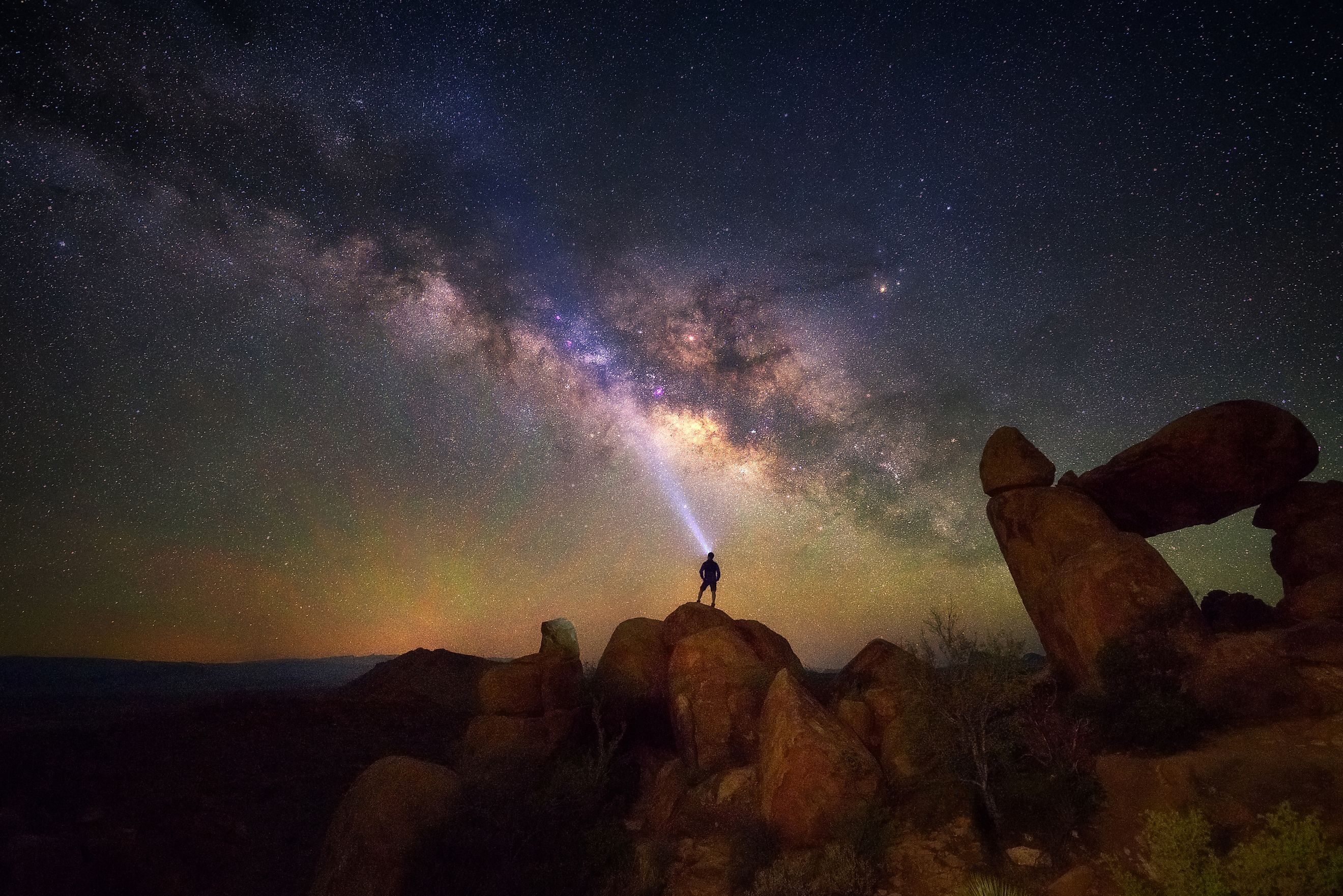
Why The Milky Way May Never Collide With Andromeda
Andromeda is closing in on the Milky Way at about 250,000 miles per hour (400,000 km/h), and for decades, astronomers predicted that the two galaxies would collide and merge within four to five billion years. A landmark June 2025 study in Nature Astronomy challenged that forecast. Across 100,000 computer simulations, researchers found roughly even odds of a merger over the next 10 billion years, and only about a 2% chance of a head-on collision on the original timeline.
Much of that uncertainty comes down to two smaller neighbors. Factoring in the Triangulum Galaxy raised the odds of a merger, while the Large Magellanic Cloud lowered them. Stranger still, astronomers believe the galaxies may already be touching, with their gas halos overlapping even though their stellar discs remain about 2.5 million light-years apart. Even still, it turns out a full collision is not the biggest threat Earth faces.
A Collision Once Thought Inevitable

For many years, astronomers widely accepted that the Milky Way and Andromeda would collide. Both are massive spiral galaxies within the Local Group, a collection of galaxies bound together by gravity. Andromeda, also known as Messier 31, is the nearest large spiral galaxy to our own and contains hundreds of billions of stars.
In 2012, observations from NASA's Hubble Space Telescope helped astronomers measure Andromeda's sideways motion across space. The measurements supported the prediction that the galaxy was moving toward the Milky Way on a trajectory that would bring the two together. Models suggested their first close encounter would occur in approximately four billion years, with a complete merger following roughly two billion years later.
The Pull of Other Galaxies

A major challenge to the traditional prediction emerged in a study published in Nature Astronomy in June 2025. Researchers combined observations from the Hubble Space Telescope and the European Space Agency's Gaia mission with updated estimates of the masses and movements of galaxies in the Local Group. They examined 22 variables and ran 100,000 computer simulations exploring possible outcomes over the next 10 billion years. The results indicated that the Milky Way and Andromeda have approximately equal chances of merging or remaining separate during that period.
Two smaller galaxies proved particularly important in the simulations. The Triangulum Galaxy, also known as Messier 33, and the Large Magellanic Cloud both exert gravitational influences that can alter the trajectories of their larger neighbours. Including Triangulum increased the predicted likelihood of a merger, while including the Large Magellanic Cloud reduced it. Uncertainties in the galaxies' masses, positions, and velocities also contributed to the range of possible outcomes.
The study also found that a head-on collision within the next four to five billion years had only about a 2% probability. The findings do not establish that the galaxies will remain separate forever. A close encounter could occur without a complete merger, and a merger remains possible beyond the simulations' 10-billion-year timeframe. What was once considered nearly inevitable is now one of several plausible outcomes.
Galaxies May Already Be Touching
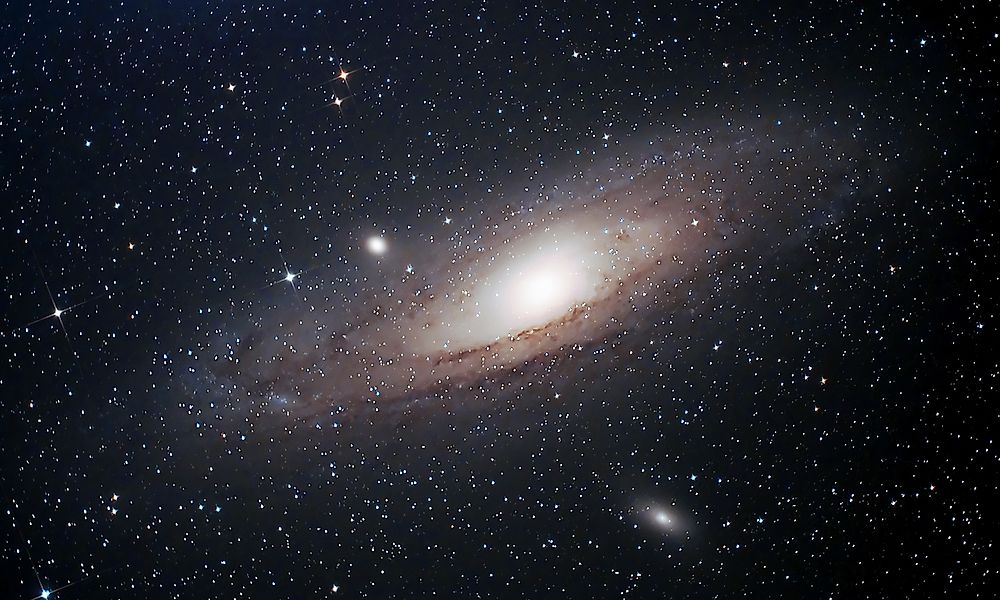
Although the Milky Way and Andromeda's main stellar discs remain separated by some 2.5 million light-years, their gaseous halos may already be overlapping. Galaxies are surrounded by extensive envelopes of diffuse gas that extend far beyond their visible stars. They are difficult to observe directly because the gas is so faint, but astronomers can investigate their properties by studying how they absorb light from more distant objects.
In 2020, researchers used the Hubble Space Telescope to map the gaseous halo surrounding Andromeda. By examining light from 43 quasars, extremely bright objects powered by supermassive black holes in distant galaxies, they determined that Andromeda's halo extends approximately 1.3 million light-years from the galaxy and as far as 2 million light-years in certain directions.
The Milky Way also has a gaseous halo, although determining its full extent is difficult because observers on Earth are located inside it. Astronomers believe Andromeda's halo may already be interacting with our galaxy's own extended envelope of gas. However, the precise boundaries of these halos remain uncertain, and their possible overlap does not mean the galaxies' main stellar structures have collided.
So, What Would a Collision Look Like?

If the Milky Way and Andromeda collide, the process would unfold over hundreds of millions or billions of years. As the galaxies approached, their gravitational fields would begin altering their structures. Spiral arms could stretch into long streams of stars, while repeated close encounters would redistribute material throughout both galaxies. Interacting gas clouds could become compressed, creating conditions that encourage new star formation.
Despite the scale of such an encounter, direct collisions between individual stars would be extraordinarily unlikely. Stars are separated by such vast distances that most would pass through the other galaxy without striking another star. Their positions would change, however, as gravitational interactions redirected them into new orbits. The galaxies' original spiral structures could become unrecognizable. If the two galaxies completed a merger, their combined stars, gas, and dark matter could eventually form a larger galaxy with a more elliptical structure.
For observers on Earth, if the planet remained habitable and observers existed at the time, the night sky could change dramatically. Andromeda would appear increasingly prominent as it approached, potentially occupying a much larger portion of the sky. Gravitational interactions would gradually alter the Milky Way's structure, changing the distribution of stars visible from our Solar System.
Will Earth Survive a Collision?

Even if the galaxies merge, a direct collision between the Sun and another star would be extremely unlikely. The Solar System could remain gravitationally intact during the encounter, although its orbit around the center of the resulting galaxy might change considerably. Simulations have suggested that the Sun could be moved into a different region of the merged system.
Earth's long-term future is more directly threatened by the Sun's evolution. As the Sun ages, it gradually becomes brighter, increasing the amount of energy reaching Earth. Over roughly the next billion years, rising solar luminosity is expected to make the planet increasingly hostile to life as we know it. In approximately five billion years, the Sun is expected to enter its red giant phase, expanding dramatically as it approaches the final stages of its evolution. By that stage, Earth will almost certainly have become uninhabitable, regardless of whether the Milky Way and Andromeda are approaching a collision. The expanding Sun may eventually engulf Earth, although the planet's precise fate remains uncertain.
Rethinking the Collision Prediction

Predictions about the distant future of galaxies depend on the observations and assumptions used to construct them. Astronomers can measure the motion of nearby galaxies with increasingly sophisticated instruments, but forecasting their interactions billions of years into the future remains challenging. Small uncertainties in their masses and velocities can lead to substantially different trajectories over long timescales.
The 2025 study does not invalidate the observations behind earlier research. Instead, it builds on decades of measurements while considering additional gravitational influences and uncertainties. The newer simulations demonstrate that other outcomes become possible when the broader Local Group and its property uncertainties are considered.
Future observations from space telescopes and other astronomical instruments could help refine estimates of the galaxies' masses and movements. More precise measurements of Andromeda's sideways motion will be particularly valuable, as even small differences in its trajectory could influence whether the galaxies collide. Improved knowledge of the Large Magellanic Cloud and Triangulum Galaxy will also help researchers reassess the likely outcome.
An Unwritten Cosmic Future
The Milky Way and Andromeda may eventually merge into a single enormous galaxy, or they may pass one another and remain separate for billions of years. The June 2025 research demonstrates that their collision is far less certain than astronomers once believed. Although the galaxies are moving toward one another, their eventual encounter depends on complex gravitational interactions involving other members of the Local Group. Whether their visible structures ever collide remains an open scientific question, one that future observations may help resolve.