Why Parker Solar Probe Survives Touching The Sun
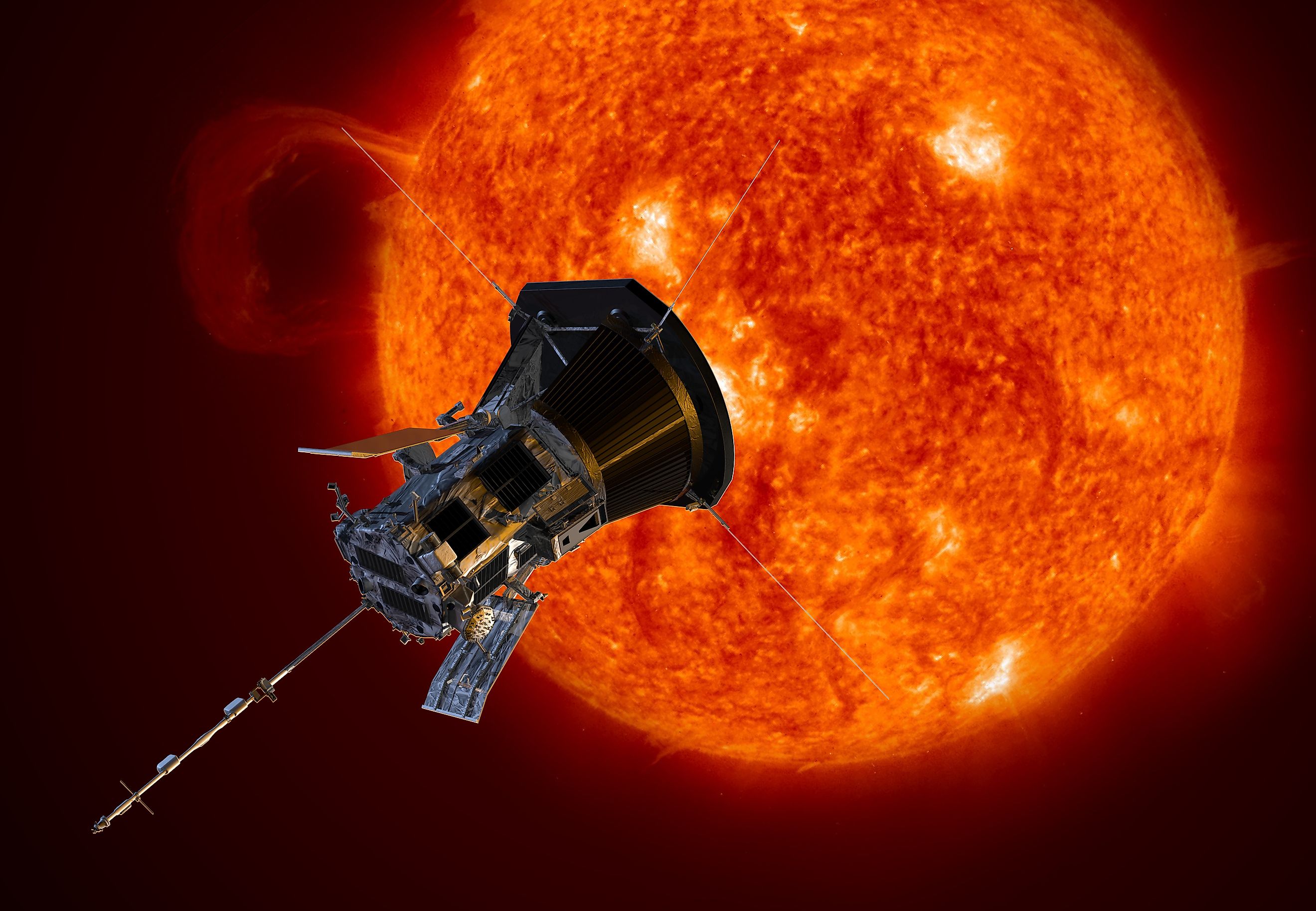
Is it possible for a spacecraft to pass through the Sun's corona without being destroyed by the extreme conditions? NASA's Parker Solar Probe was built to do exactly that. Launched in 2018, the spacecraft has traveled closer to the Sun than any other human-made object and became the first spacecraft to fly through its upper atmosphere. Its observations are providing scientists with an unprecedented look at the solar wind and the processes occurring near our star.
History of the Parker Solar Probe

The idea of sending a spacecraft close to the Sun dates to the beginning of the Space Age. In October 1958, the same month the National Aeronautics and Space Administration (NASA) began operations, the National Research Council's Space Studies Board recommended a mission to orbit Mercury to measure particles and magnetic fields near the Sun.
That same year, University of Chicago physicist Eugene Parker published a groundbreaking theory about the solar wind. Parker proposed that the Sun's extremely hot corona continuously expands outward, producing a stream of charged particles that moves through the solar system. His theory was controversial at first, though spacecraft observations soon provided evidence of the solar wind.

Scientists and engineers studied several possible solar-probe designs over the following decades. Earlier concepts relied on a gravity assist from Jupiter. In 2007, mission designer Yanping Guo developed an alternative trajectory that used repeated passes by Venus. This approach allowed the spacecraft to gradually reduce its orbital energy and make many close passes by the Sun. The redesigned mission became known as Solar Probe Plus.
In 2017, NASA renamed Solar Probe Plus as Parker Solar Probe in honor of Eugene Parker. It was the first NASA mission named for a living person. Parker was 91 when he watched the spacecraft launch from Florida on August 12, 2018. NASA's Office of Inspector General reported that the mission's 2014 agency baseline commitment was about $1.55 billion, and by December 2018, its estimated cost over the planned mission was about $1.42 billion. NASA's 2015 contract for launch services using a United Launch Alliance Delta IV Heavy was valued at $389.1 million.
How the Probe Survives Touching the Sun

Parker Solar Probe had a launch mass of about 1,510 pounds. Its most important protective feature is its Thermal Protection System, an approximately eight-foot-wide heat shield positioned between the spacecraft and the Sun. The shield is about 4.5 inches thick and consists of carbon-composite foam between carbon-carbon face sheets. Its Sun-facing surface has a specially formulated white ceramic coating that reflects as much solar energy as possible. During the closest passes, the front of the shield can reach nearly 2,500 degrees Fahrenheit while the spacecraft behind it remains at roughly 85 degrees Fahrenheit.
The spacecraft also has a cooling system for its solar arrays. About a gallon of pressurized, deionized water circulates through the arrays and radiators. As Parker approaches the Sun, most of its solar panels retract into the heat shield's shadow. Only a small portion remains exposed to generate power, and the circulating water helps keep those exposed sections from overheating.

Parker must also point its heat shield toward the Sun without constant instructions from Earth. Seven sensors sit around the edge of the shield's shadow. If the spacecraft detects sunlight, the computer can automatically correct Parker's orientation and return sensitive equipment to the protected area behind the shield. Parker also encounters radiation, energetic particles, and high-speed dust grains, so its instruments and electronics were designed with radiation-resistant components and materials that have been tested for harsh near-Sun conditions. Some instruments, such as the Solar Probe Cup, extend beyond the heat shield to directly sample particles in the solar wind.
The Probe's Journey

Parker Solar Probe follows a highly elliptical orbit around the Sun. Its first Venus gravity assist took place on October 3, 2018, about seven weeks after launch. The spacecraft then made its first close solar approach on November 5, coming within about 15 million miles of the Sun's surface. It completed its first full orbit around the Sun in January 2019.
Parker completed seven planned gravity assists at Venus. Instead of using the planet to gain orbital energy, Parker transferred some of its energy through each encounter, shrinking its solar orbit and bringing its closest point to the Sun progressively inward. On April 28, 2021, Parker crossed the Alfvén critical surface and entered the Sun's upper atmosphere for the first confirmed time. The spacecraft was about 8.1 million miles above the solar surface when its instruments detected the magnetic and particle conditions showing it had crossed the boundary. NASA announced the milestone in December 2021 after scientists analyzed the data.

On September 4, 2026, Parker completed its 29th close solar approach, again coming within about 3.8 million miles of the solar surface at approximately 430,000 miles per hour. Both records, which make Parker the fastest human-made object and the spacecraft to travel closest to the Sun, were first set during its December 24, 2024, encounter. Parker completed the 24th and final close approach of its original seven-year plan in June 2025, and following NASA's 2026 Heliophysics Senior Review, the mission was extended into 2029. Parker continues collecting observations as solar activity moves through the later stages of the current solar cycle.
What Scientists Are Learning from the Probe

Parker Solar Probe carries four scientific instrument suites. FIELDS measures electric and magnetic fields. SWEAP examines the particles that make up the solar wind. ISʘIS studies energetic particles, while WISPR photographs large-scale structures in the corona and solar wind. One of Parker's main goals is to help scientists understand two long-standing solar mysteries. Researchers want to know why the Sun's corona is dramatically hotter than its visible surface. They also want to determine how the solar wind is heated and accelerated as it moves away from the Sun.
These questions also have practical importance on Earth and in space. Solar activity can produce space weather that affects satellites and radio communications. Strong events can also disturb electrical grids or expose astronauts to increased radiation. Better observations of the solar wind and eruptions near their sources can help scientists improve models for understanding and forecasting these events. Parker's WISPR images can also be compared with direct measurements from its other instruments as the spacecraft passes through the same regions. Together, these observations are giving scientists a view of the Sun that no previous spacecraft could provide.