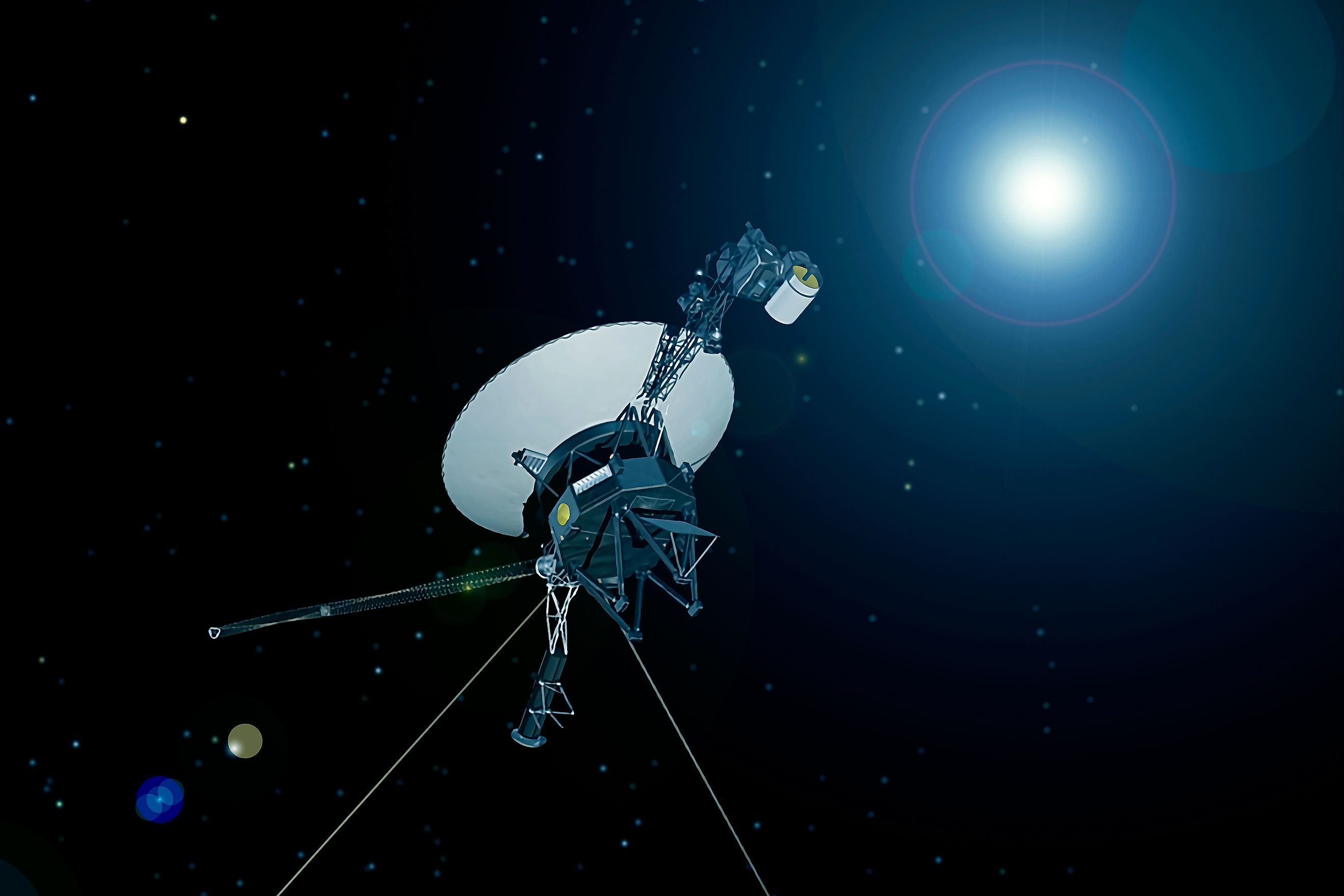
What Happens When The Voyager Probes Finally Go Silent
When the Voyager probes finally go silent, they will not stop moving. Their radios will fall quiet once their plutonium power runs too low, ending the only direct measurements anyone has taken of interstellar space. Both spacecraft will keep coasting through the Milky Way, and in about 40,000 years, each will pass another star. Each spacecraft also carries a Golden Record of Earth's sounds and images that could survive for millions of years, long after the probes stop communicating with Earth.
Launched in 1977, the twin probes are already so far from Earth that radio messages take about 20 hours to reach Voyager 2 and nearly 24 hours to reach Voyager 1. On November 18, 2026, Voyager 1 will reach one light-day from Earth, 16.1 billion miles away. A simple command and the spacecraft's reply will take at least two days to travel to and from Earth. Engineers have kept both probes alive on dwindling nuclear power, but eventually no repair or power-saving measure will be enough.
Keeping The Lights On

Both Voyagers rely on generators that turn heat from decaying plutonium into electricity. Each loses about four watts of electrical output a year. After nearly five decades, that shrinking supply must still support a long list of scientific instruments and equipment needed to keep the probes operating, creating a growing conundrum for engineers back home.
Switching off one system can interfere with another. Some systems require heated fuel lines that could freeze if engineers shut off too much heat. Engineers must decide what can be shut down without putting the remaining systems at risk.
To conserve power, NASA shut down Voyager 1's low-energy charged-particle instrument in April, leaving the craft with two functioning scientific instruments. One measures magnetic fields, and the other detects plasma waves, the electrical disturbances in the charged gas surrounding the probe. Voyager 2 has both of those instruments, as well as a third that measures the high-energy particles of cosmic rays blitzing through space.
NASA switched off three devices on Voyager 2 at the same time in July 2026. Three others already aboard took over, drawing less electricity and keeping the probe warm enough to work. NASA estimated the savings would keep all three of Voyager 2's remaining science instruments running for at least another year. Engineers made the same swap on Voyager 1 in early September.
Recognizing The Final Silence

Voyager 1 has experienced serious communication problems before. Starting in November 2023, the probe sent back unreadable data because a damaged memory chip in one of its onboard computers had stopped working. Engineers split the code stored on the failed chip and moved it into several parts of the computer's memory that still worked. On April 20, 2024, Voyager 1 sent back readable engineering data for the first time in five months, and the team could finally see how the spacecraft was doing.
A different problem caused the next silence. Voyager 1 missed two scheduled check-ins in October 2026. Its signal returned after 48 hours, before engineers sent a command to investigate. The team found that one set of thrusters had gone offline and a backup set had taken over. NASA was still investigating what caused the outage.
A lost signal can have several causes, and engineers cannot immediately tell which one they are dealing with. One silence came from a broken chip scrambling the probe's data, and the other came during a thruster failure. If Voyager goes quiet again, the team will need to work out whether the probe has enough power to transmit, if its antenna has drifted away from Earth, or if the problem is something engineers can fix from Earth. With every message taking about a day to arrive, a fix sent on Monday morning might not show results until Wednesday, so telling a temporary silence from a permanent one could take days or weeks.
What Earth Will Lose

No other spacecraft has traveled farther than Voyager 1 and Voyager 2 and kept transmitting data back to Earth. Both have officially passed through the heliosphere, the vast bubble of charged particles and magnetic fields created by the Sun. After Voyager 1 made it through in 2012, Voyager 2 did so in a different direction six years later. They remain the only probes to have measured interstellar space firsthand.
Their instruments record what the probes encounter along the way, including magnetic fields, charged particles, and disturbances traveling through the surrounding gas. Once those critical instruments shut down for good, scientists will lose their only direct observations along those routes.
There will be no final photograph. NASA shut down Voyager 1's cameras on February 14, 1990, after the series of pictures that included the Pale Blue Dot image of Earth. Voyager 2's cameras had gone dark the year before. The instruments still operating measure magnetic fields, plasma waves, and cosmic rays, none of which requires a camera.
The Journey Continues Without Power

The Sun's gravity will still pull on them as they move through the Milky Way, but both probes are already traveling fast enough to escape the solar system.
Voyager 1 is moving away from the Sun at about 38,000 mph, enough to cover a little over 900,000 miles a day. At that speed, NASA estimates the probe will take about 300 years to reach the inner edge of the Oort Cloud. Getting past the far side could take about 30,000 years.
Those estimates depend on where the cloud begins and ends. Astronomers infer the existence of this distant collection of icy objects from the paths of comets that swing into the inner solar system. Both Voyagers entered interstellar space when they crossed the outer edge of the bubble created by the solar wind, but the Oort Cloud lies much farther out.
In about 40,000 years, both spacecraft will make distant passes by other stars. Voyager 1 is expected to pass about 1.7 light-years from a star called Gliese 445. Around the same time, Voyager 2 should pass about as far from another star, Ross 248. At their closest, the probes will each still be about 10 trillion miles from the star they pass.
The Message That Travels With Them

Both Voyagers will have long since stopped transmitting by the time they pass those stars. Each left Earth with a 12-inch record made of gold-plated copper. Alongside pictures and music, the discs hold spoken greetings in 55 languages. For any potentially intelligent neighbor that encounters the Golden Record, NASA included a needle and cartridge and etched playback instructions onto its aluminum cover.
The grooves can hold the recordings long after the probes shut down for good. If the discs survive the trip, two machines launched in 1977 could pass other stars tens of thousands of years from now with the sound of waves breaking on Earth still pressed into their records.