The American Town Where Wi-Fi Is Banned For Radio Astronomy
Wi-fi is often considered a basic utility, like running water, but not in Green Bank, West Virginia. Wi-fi was banned there for decades until 2025, and now, it's limited to a single frequency. The town is located in the United States National Radio Quiet Zone, home to an important astronomy site called the Green Bank Observatory. The scientific work being done in the town and the zone surrounding it means that wi-fi can only be used very carefully, if at all. Here are some more details about the "Quiet Zone" and how it impacts Green Bank and its residents.
What Is The National Radio Quiet Zone

Green Bank is inside the National Radio Quiet Zone, spanning around 13,000 square miles, but it also sits within a much smaller, more restricted area called the West Virginia Radio Astronomy Zone. This ten-mile circumference around the Green Bank observatory was established in the 1950s to protect radio telescopes. The Zone, which is located in the Blue Ridge Mountains, actually includes bits of three states, West Virginia, Virginia, and a small portion of western Maryland.
Restrictions in the Zone are not uniform. The closer the radio telescopes are, the more potential there is for a device to interfere with them. Due to Green Bank's immediate proximity to the Green Bank Observatory and the Green Bank Telescope, it has historically had the most severe restrictions even within the Zone, including the once-total ban on wi-fi.
Green Bank Observatory

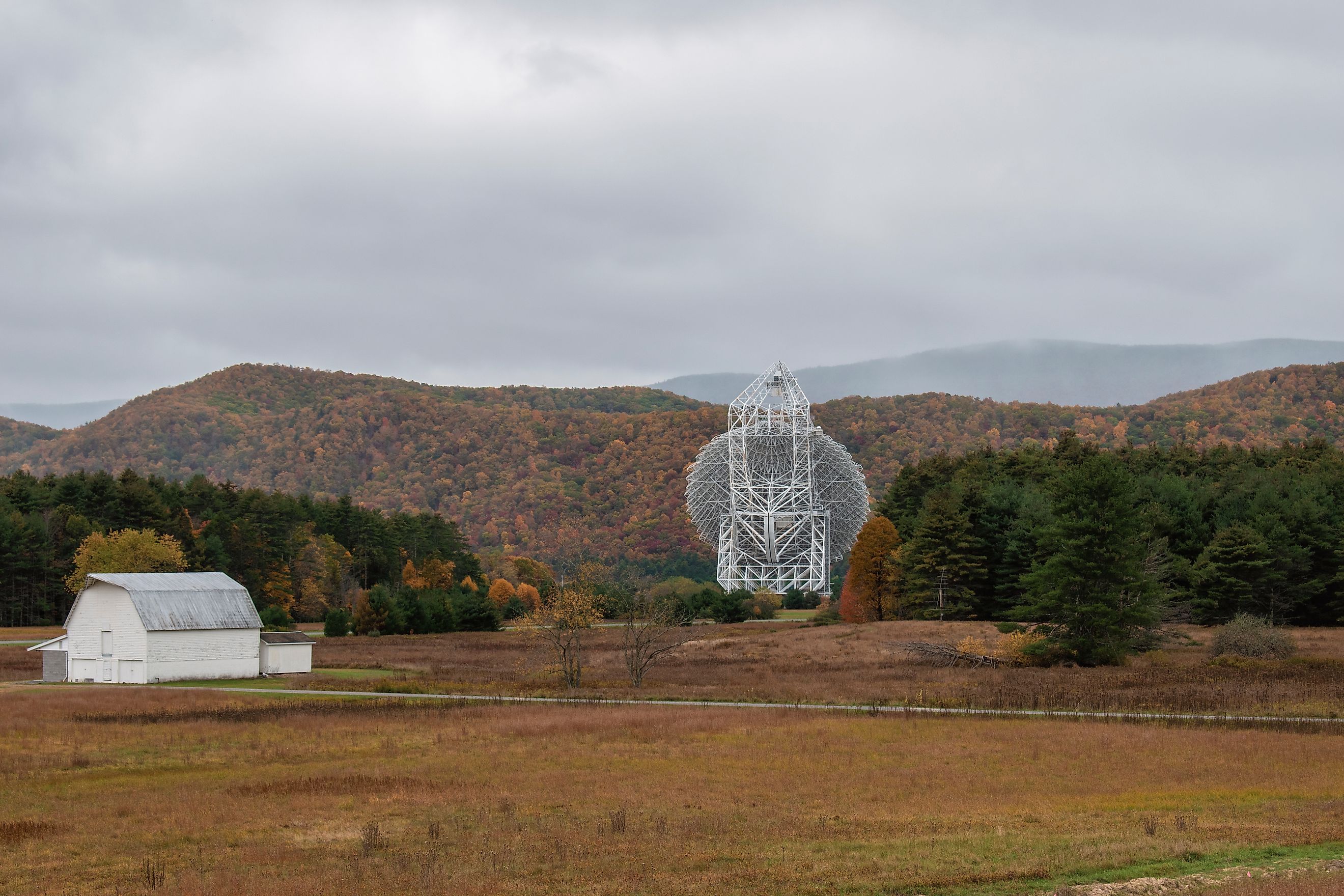
Obviously, the National Radio Quiet Zone isn't just imposed over a stretch of the country for no reason. It exists to allow for radio astronomy, like the kind done at the Green Bank Observatory. The Green Bank Observatory is the oldest National Science Foundation (NSF) observatory, founded in 1957. It houses the Robert C. Byrd Green Bank Telescope, or GBT, which describes itself as the "world’s premiere single-dish radio telescope operating at meter to millimeter wavelengths." It collects data for roughly 6,500 hours per year, which is more than any other observatory's radio telescope.
Because the GBT uses radio waves to track spacecraft and more, transmissions like those from wi-fi or even personal fitness devices can be picked up on it. This is especially true the closer the devices get to the intensely sensitive telescope. The National Radio Quiet Zone was established to prevent the telescope, and other, similar radio astronomy devices within the Zone, from accidentally picking up transmissions that would corrupt the data they collect.
The 2025 Compromise

Green Bank today has a population of only 84 people as of 2024. But those people have, with restrictions, the ability to use wireless technology. That's because in 2025, it was decided that Green Bank residents could use wi-fi, but were encouraged to all set it to the frequency of 2.4 GHz. This frequency meant that it wouldn't interfere with the radio signals from the observatory, but still allowed some wi-fi use, which local institutions like the school had been calling for. The compromise was in part to allow Green Bank residents to utilize modern technology in the same ways as their neighbors, but was also meant to provide a non-disruptive alternative to the "forbidden" routers many residents had already set up.
There are still additional restrictions around the observatory itself. The Green Bank Science Center, attached to the Green Bank Observatory, is open to visitors, and offers exhibits, guided tours, and regular family-friendly events. However, visitors must fully turn off or leave behind all "transmitting" devices including cell phones and fitness trackers, although medically necessary devices like pacemakers are allowed.
It's Not Just Wi-Fi
While the restricted wi-fi is a famous quirk in Green Bank, it's not the only oddity caused by the National Radio Quiet Zone. In fact, another issue may be even more impactful: the trouble with cell phones. Due to the Quiet Zone, cell phones, even when and where they're permitted, have limited or non-existent reception. This doesn't just impact Green Bank, but also nearby sites including the well-known Snowshoe Ski Resort.
The technological restrictions and small population haven't stopped the tiny mountain town of Green Bank, though. Today, visitors will not only find the Green Bank Observatory and Science Center to explore, but can also visit the local arts' center and farmer's market. And of course, on clear nights in Green Bank, anyone can look up at the stars, and know that nearby, a unique and fascinating machine is listening to the heavens.