What Dragonfly Will Look For When It Lands On Titan
When NASA's nuclear-powered space lab, aptly named Dragonfly, lands on Saturn's largest moon, Titan, in 2034, it will spend 3.3 years looking for very early signs of life. Scientists do not expect to find alien life forms resembling Earthlings (or imagined Martians of yore) on Titan. Previous fly-bys of Titan have revealed a foggy, yellowish world indicative of an approximately 95% nitrogen, 5% methane atmosphere, with rivers, lakes, and seas beneath its hazy atmosphere, plus bright and dark areas. Scientists are particularly curious about the complex organic compounds present on Titan. Dragonfly's unique ability to land and take off again and again, retrieving soil samples each time, is expected to give researchers unprecedented opportunities to study Titan in depth.
Unique Rotorcraft Design

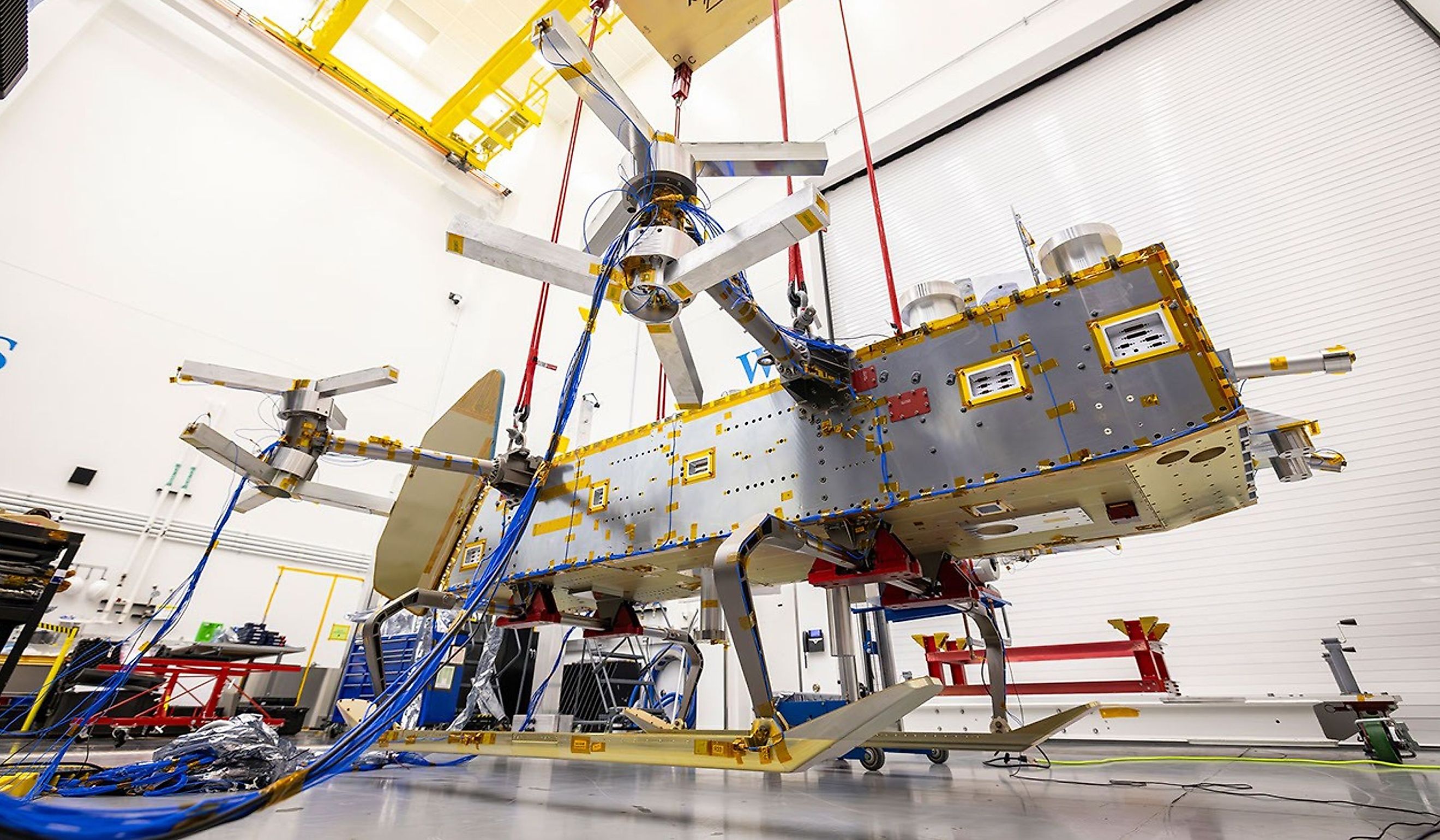
While previous spacecraft have been able to land on a surface and navigate the surrounding area, Dragonfly's design includes rotors that will lift it to fly several miles like a drone. Specifically, Dragonfly has eight rotors arranged in four coaxial pairs, and each of its four rotors has two rotating blades. With extra rotors and blades, the craft will be able to operate even if a blade or rotor fails during the 3+-year mission. Dragonfly has the ability to hop over sand dunes and explore the uneven terrain of Selk Crater, and take off to another location miles away. Scientists expect Dragonfly to fly to a new location every one or two Titan days, each of which is equal to about 16 Earth days.
Dragonfly is also a self-contained, mobile laboratory. Since it would take hours to send a signal from Earth to Saturn, Dragonfly is equipped to make its own decisions about where to fly next and what activities to undertake at each location. For example, it may take a soil sample at one location, analyze the sample on the spot in its internal lab, and decide what to do next based on what the analysis revealed. The nuclear-powered, car-sized craft is being designed at the Johns Hopkins Applied Science Laboratory in Laurel, Maryland. Dragonfly is now in the testing phase in preparation for its 2028 launch.
Why Titan was Chosen for Mission

Titan has been a curiosity to astronomers since Christiaan Huygens of the Netherlands accidentally discovered it in 1655 while studying Saturn's rings. In the late 1970s and well into the 1980s, Voyager 1 and Voyager 2 conducted flybys of Titan, finding that its atmosphere was obscured by haze. In 1994, the Hubble telescope's longer wavelengths detected lighter and darker areas. Ten years later, the Cassini orbiter performed some 127 flybys and, with the aid of radar and near-infrared wavelengths, mapped much of Titan's surface and left the Huygens probe behind.
This probe parachuted to Titan's surface in 2005 and measured wind speeds and other atmospheric conditions. By mapping a small area in greater detail, scientists learned of the salty ocean beneath its crust. Finding out that Titan is an "ocean world" with rivers, lakes, and seas increased the scientists' enthusiasm to learn more about it. In fact, Titan is the only known world (other than Earth) with liquid on the surface. They noted that Titan's heavy concentration of nitrogen molecules is split by sunlight and recombines into complex organic compounds. Titan's dense atmosphere--about four times more dense than Earth's-- and gravity about 1/7 as strong as Earth's will allow Dragonfly to move easily on its surface and fly well in its atmosphere. All of these factors make Titan enormously appealing for further exploration.
What Else We Know About Titan

With a diameter of 3,199 miles (5,149 km), Titan is larger than Mercury and about 50% wider than Earth's moon. It is about 60% ice/water and 40% rocky material. Its icy surface temperature of about -290°F (-179 degrees C) means life, as we know it, is not likely to be supported. However, Titan has rich resources, such as hydrocarbons, that might be future sources of fuel. Beneath its icy crust, scientists have identified water, including wide expanses of ocean. Besides Earth, Titan is the only known world in our solar system that has liquid on its surface.
What Scientists Hope to Discover
The fly-bys that uncovered information about Titan through the years have revealed numerous important similarities between Titan and Earth. Both have atmospheres that are nitrogen-heavy, and scientists believe that--billions of years ago--Earth was covered in a yellow nitrogen and methane haze similar to Titan's. It is possible that Titan is in a phase that Earth was in billions of years ago before life flourished on this planet. By comparing this and other similarities, scientists hope to discern if Titan's chemistry might, therefore, progress to being hospitable to living organisms. The water they have identified through the haze surrounding Titan, along with the presence of carbon, is a good indication that this moon might someday sustain life in some form.
When NASA's Dragonfly lands on Saturn's largest moon, Titan, in 2034, it will have traveled through space for 6 years. Scientists will watch eagerly as Dragonfly lands and begins to fulfill its mission of extracting soil samples and examining them in its internal lab. They will take note of how well Dragonfly moves on Titan's terrain and wanders through its atmosphere, all testaments to their painstaking calculations and estimations building up to these critical moments. Each time Dragonfly takes off and lands will be a new adventure. While scientists have their hypotheses, whatever Dragonfly uncovers will determine not only its next moves, but the future of US space missions.