Why Lucy Is Visiting Eight Asteroids Instead Of One
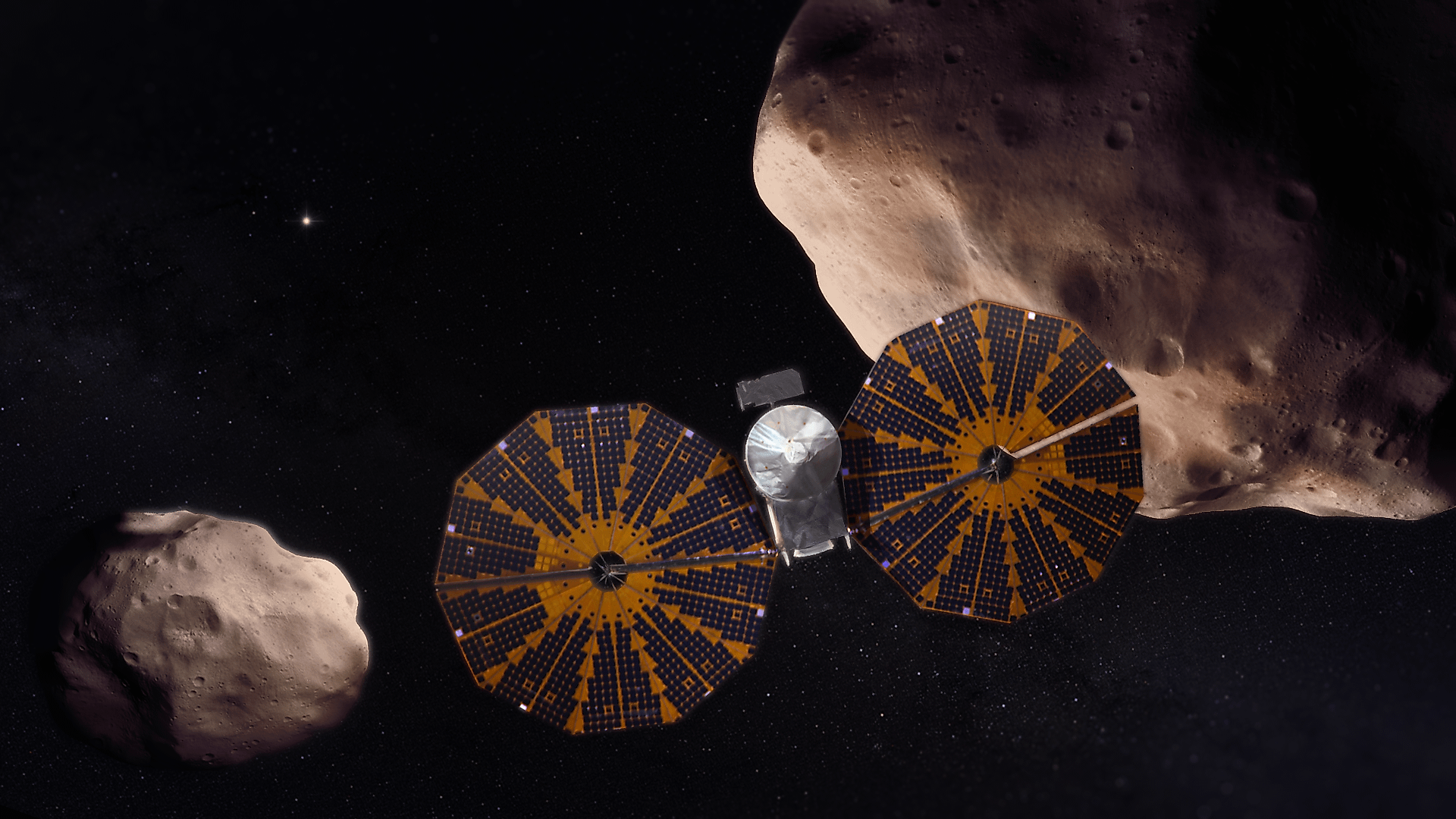
NASA's Lucy mission is investigating some of the oldest surviving material in the solar system. Launched on October 16, 2021, the spacecraft is on a nearly 12-year journey to study 11 asteroid bodies, including several small moons. Three of its targets lie in the main asteroid belt between Mars and Jupiter, and eight belong to the Jupiter Trojans, a population of asteroids that shares the gas giant's orbit around the Sun. By examining their geology, color, composition, temperatures, and other physical properties, Lucy aims to uncover clues about how the solar system formed more than four billion years ago.
The Trojan Asteroids

The Lucy mission focuses on Jupiter's Trojan asteroids, which are thought to preserve material left over from the formation of the solar system's giant planets. According to models of planetary formation and migration, some of these objects may have formed elsewhere in the early outer solar system before being captured into their present orbits. Studying them could help scientists understand how Jupiter, Saturn, Uranus, and Neptune developed and how the planets' movements shaped the formation of the solar system.

The Trojans are particularly interesting because observations have revealed considerable differences in their colors and other physical characteristics. Scientists do not yet know the precise composition or formation location of every object, but this diversity suggests the population may contain material from multiple regions of the early solar system. Lucy will examine individual asteroids up close, allowing scientists to compare their surfaces and physical properties. Its findings could help determine whether these objects share a common history or formed under different conditions.
The Trojans occupy two broad regions along Jupiter's orbit. One group travels ahead of the planet near the L4 Lagrange point, while the other follows behind near L5. These regions lie roughly 60 degrees ahead of and behind Jupiter, where the combined gravity of Jupiter and the Sun allows objects to remain in relatively stable orbits. Despite sharing Jupiter's orbital path, the Trojans are generally far from the planet itself. Lucy will be the first spacecraft to explore them directly.
The Mission

Lucy's primary mission is scheduled to last nearly 12 years, from October 2021 through 2033. During that time, the spacecraft will travel almost 4 billion miles, completing a series of large loops around the Sun. According to NASA's mission specifications, Lucy cruises at an average speed of about 39,000 miles per hour. During its encounters, it will pass the Trojan asteroids at an average relative speed of about 15,000 miles per hour.
Rather than orbiting individual asteroids, Lucy will gather data during close flybys. Orbiting multiple small bodies would require large amounts of fuel to brake at each one and then depart again. Instead, the spacecraft follows a carefully planned trajectory that uses Earth's gravity to redirect its path. The primary mission includes three Earth gravity assists, the last of which is scheduled for 2030. That maneuver will send Lucy toward the Trojan group trailing Jupiter, where it will complete its final planned encounters in 2033.

Lucy has already completed two encounters in the main asteroid belt. On November 1, 2023, it flew past the asteroid Dinkinesh and discovered a small satellite, later named Selam. Further observations showed that Selam is a contact binary made up of two connected lobes. On April 20, 2025, Lucy encountered the asteroid Donaldjohanson, revealing an elongated, peanut-shaped object with a complex rotational history. NASA's June 2026 analysis also found evidence suggesting that liquid water briefly existed within the material from which Donaldjohanson formed.
Lucy's first encounter with the Trojans is scheduled for August 11, 2027, when it will fly past Eurybates and its satellite Queta. The spacecraft will then observe Polymele and its moon in September 2027, followed by Leucus and Orus in 2028. Its final planned encounter will come in March 2033, at the binary Trojan system of Patroclus and Menoetius. In 2026, NASA began testing the spacecraft's cameras on distant views of these future targets to prepare for the flybys.
The Spacecraft

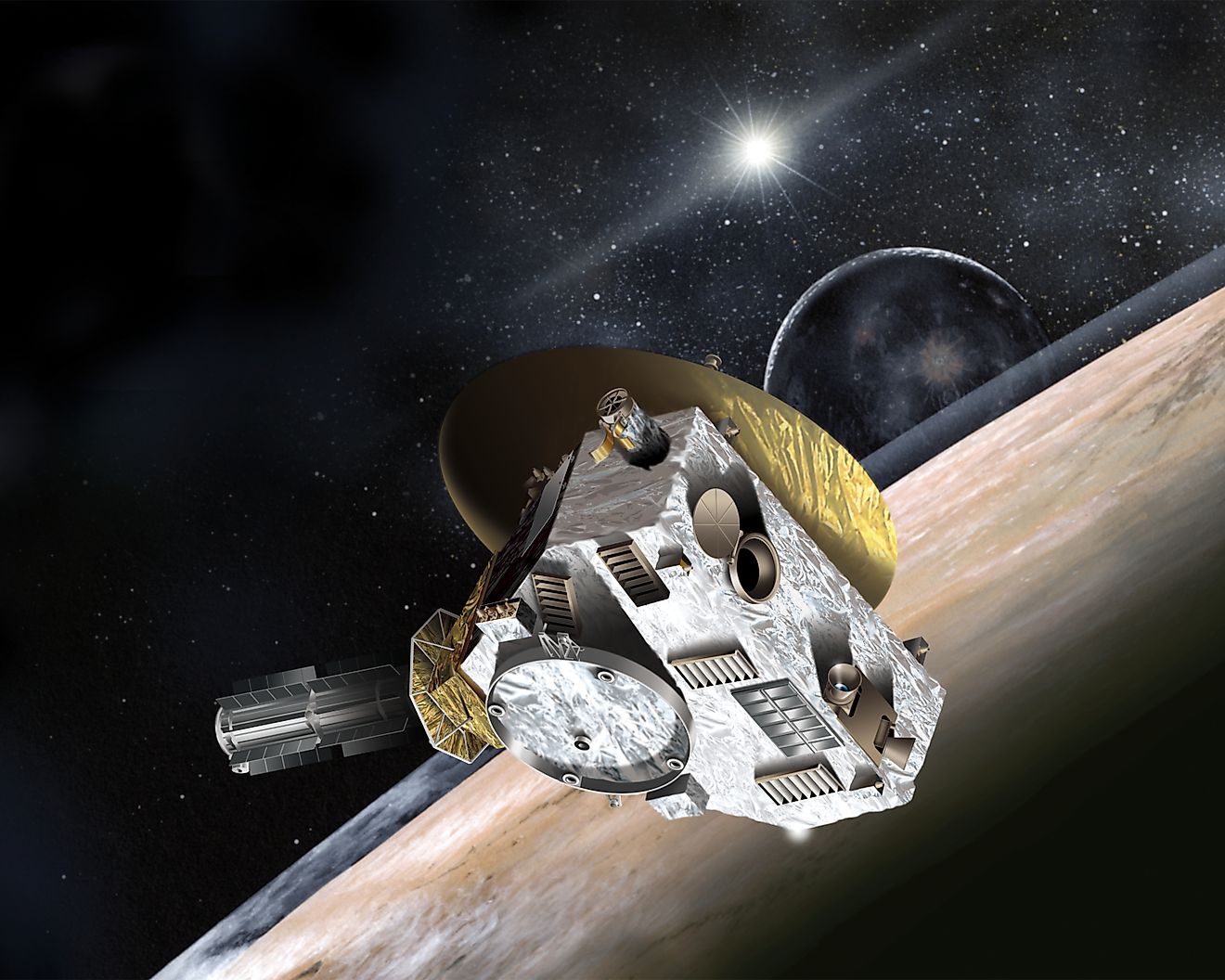
With its two large circular solar arrays deployed, Lucy measures more than 52 feet across. Each array is nearly 24 feet in diameter, allowing the spacecraft to generate electricity far from the Sun. Its main body carries a high-gain communications antenna about 6.5 feet wide. These systems keep Lucy operating and transmitting scientific data across the vast distance between Earth and the outer solar system.
The spacecraft carries several specialized scientific instruments. L'LORRI is a high-resolution camera that photographs asteroid surfaces in detail. L'Ralph combines a color imaging system with an infrared spectrometer to study surface properties and composition. L'TES measures thermal infrared radiation, helping scientists understand surface temperatures and the physical characteristics of asteroid materials. Lucy also uses its telecommunications system and imaging observations to help determine asteroid masses and search for possible satellites or rings. Together, these instruments allow scientists to compare the asteroids' physical and geological characteristics.

Lucy launched aboard a United Launch Alliance Atlas V 401 rocket from Space Launch Complex 41 at Cape Canaveral Space Force Station in Florida on October 16, 2021. Lockheed Martin Space built the spacecraft, and NASA's Goddard Space Flight Center manages the mission. The Southwest Research Institute leads the scientific investigation. Lucy is part of NASA's Discovery Program, which supports focused planetary science missions.
What's In A Name?

The Lucy spacecraft is named after a famous fossilized skeleton of Australopithecus afarensis, an early human relative that lived about 3.2 million years ago. Paleoanthropologist Donald Johanson and graduate student Tom Gray discovered the fossil at Hadar, Ethiopia, on November 24, 1974. According to Arizona State University's Institute of Human Origins, the team named the skeleton Lucy after the Beatles song "Lucy in the Sky With Diamonds," which played repeatedly during that evening's celebrations.
Lucy's fossilized remains provided important evidence about early human evolution, particularly the development of upright walking. NASA gave the spacecraft the same name because scientists hope the mission will offer comparable insights into the origins and development of the solar system. Just as the fossil helped researchers reconstruct part of humanity's distant past, the Trojan asteroids may preserve evidence of conditions that existed billions of years before Earth became the planet we know today.
A Fossil Hunt Across the Solar System
If you want to understand how the giant planets came to sit where they are today, Jupiter's Trojan asteroids are among the best places to look, and Lucy is the first spacecraft sent to study them up close. Its early flybys have already revealed Selam, the contact-binary moon of Dinkinesh, and signs that liquid water once briefly existed in the material that formed Donaldjohanson. The encounters ahead, starting with Eurybates and Queta in 2027 and ending at the binary pair of Patroclus and Menoetius in 2033, will give scientists their first detailed views of both Trojan swarms. For anyone curious about the origins of our solar system, Lucy offers the closest look yet at material left over from the birth of the planets.



.jpg)

.png)
