What's the Farthest We've Ever Seen?
Light traveling for 13.5 billion years reached the James Webb Space Telescope's mirrors in April 2025, carrying an image representing the farthest humans have ever looked across space. That light started its journey when the universe was only 280 million years old, a tiny fraction of its current age of 13.8 billion years. Astronomers named the galaxy MoM-z14 and spent approximately 4.4 hours studying its light with a spectrograph, an instrument that splits light apart the way a prism splits sunlight into a rainbow.
Through these measurements, they determined exactly how far it had traveled. The result places it 13.53 billion light-years away, meaning it took 13.53 billion years to reach Earth. But because space itself keeps stretching as that light travels, MoM-z14 is actually much farther away right now than it was when it first sent that light out. It currently sits about 34 billion light-years away from Earth. No galaxy or other space object found since has beaten this record.
How Astronomers Measured MoM-z14's Distance

Figuring out how far away MoM-z14 sat at the time of its discovery required scientists to measure its redshift. As the universe expands, it stretches the light traveling through it, the same way stretching a rubber band with stripes painted on it pulls those stripes farther apart. This stretching shifts light toward longer, redder wavelengths. The more a galaxy's light has been stretched, and the redder the light, the farther away and the older that light must be.
Astronomers assign each galaxy a redshift number, denoted as "z", to describe how much of its light has stretched. MoM-z14 carries a redshift factor of 14.44, the highest ever confirmed for a galaxy. Older telescopes such as Hubble struggle to detect galaxies at redshifts this high because their mirrors were not built to capture infrared light as efficiently.
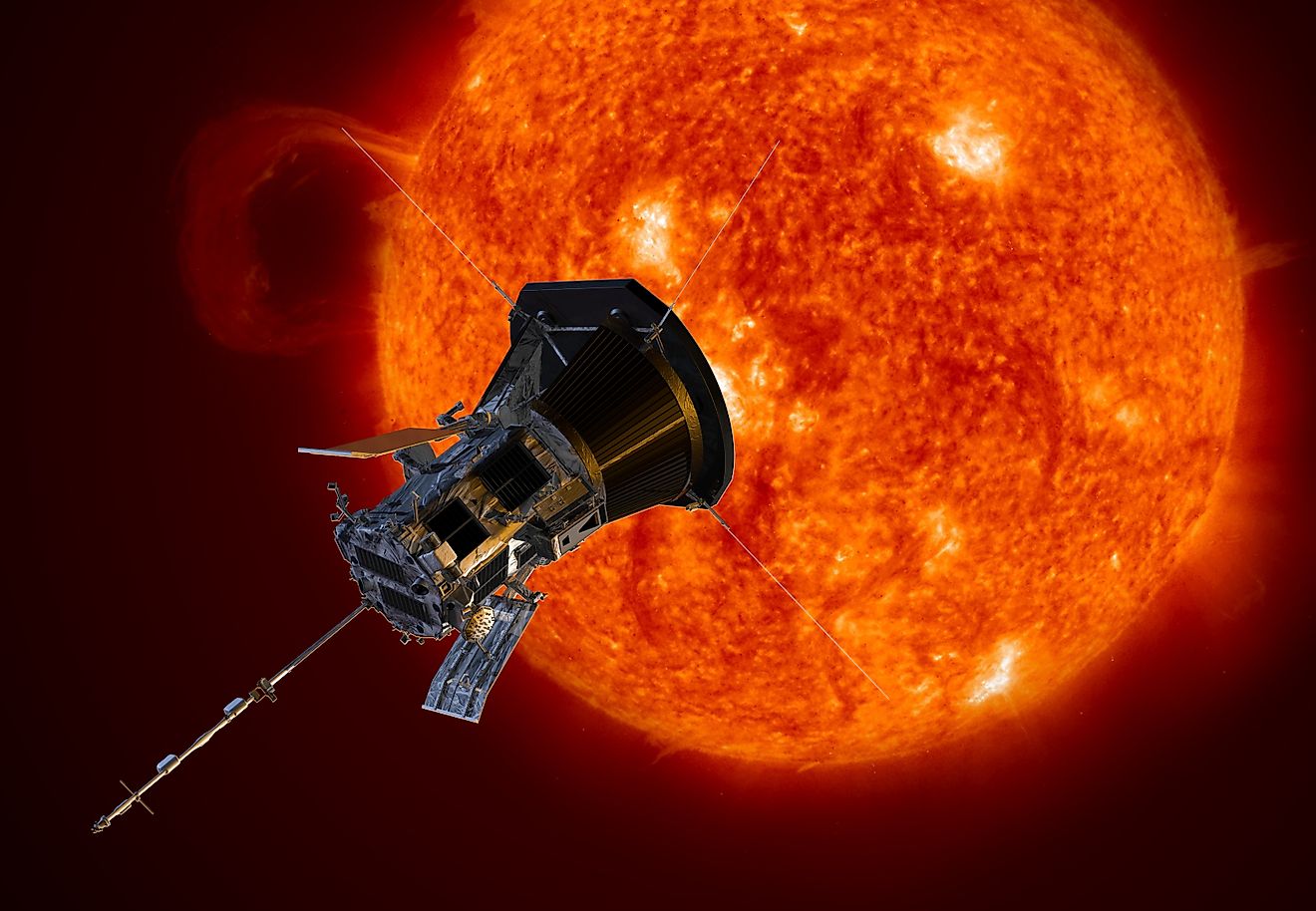
The James Webb Space Telescope solved this problem with a mirror over 21 feet wide, built specifically to detect infrared light. Engineers positioned it nearly one million miles from Earth, almost four times farther away than the Moon. That distance keeps it extremely cold and away from interference from the Sun's heat. One of its cameras first spotted MoM-z14 by noticing where its light abruptly cut off, a telltale sign of extreme distance. Scientists then used the spectrograph and redshift measurement to confirm exactly how far away the galaxy sat.
Finding a Galaxy This Faint

MoM-z14 turned up inside the COSMOS Legacy Field, a patch of sky about ten times larger than the full Moon that Webb had already photographed extensively as part of a wider survey. That single patch of sky holds hundreds of thousands of galaxies, and MoM-z14 was hiding somewhere among all of them, a needle buried in a cosmic haystack. A dedicated search called the "Mirage or Miracle" survey combed through that enormous dataset looking specifically for extremely distant and unusually bright galaxy candidates. The telescope scanned hundreds of possible sources, and MoM-z14 stood out as one of the cleanest, brightest candidates in the entire dataset.
It was visible in some of the telescope's infrared filters and completely invisible in others, a pattern called a dropout that happens because its light gets absorbed by hydrogen gas below a certain wavelength. That vanishing act in the bluer filters, combined with a faint glow in the redder ones, is actually how astronomers first flagged it as a promising candidate.
What an Image of MoM-z14 Looks Like

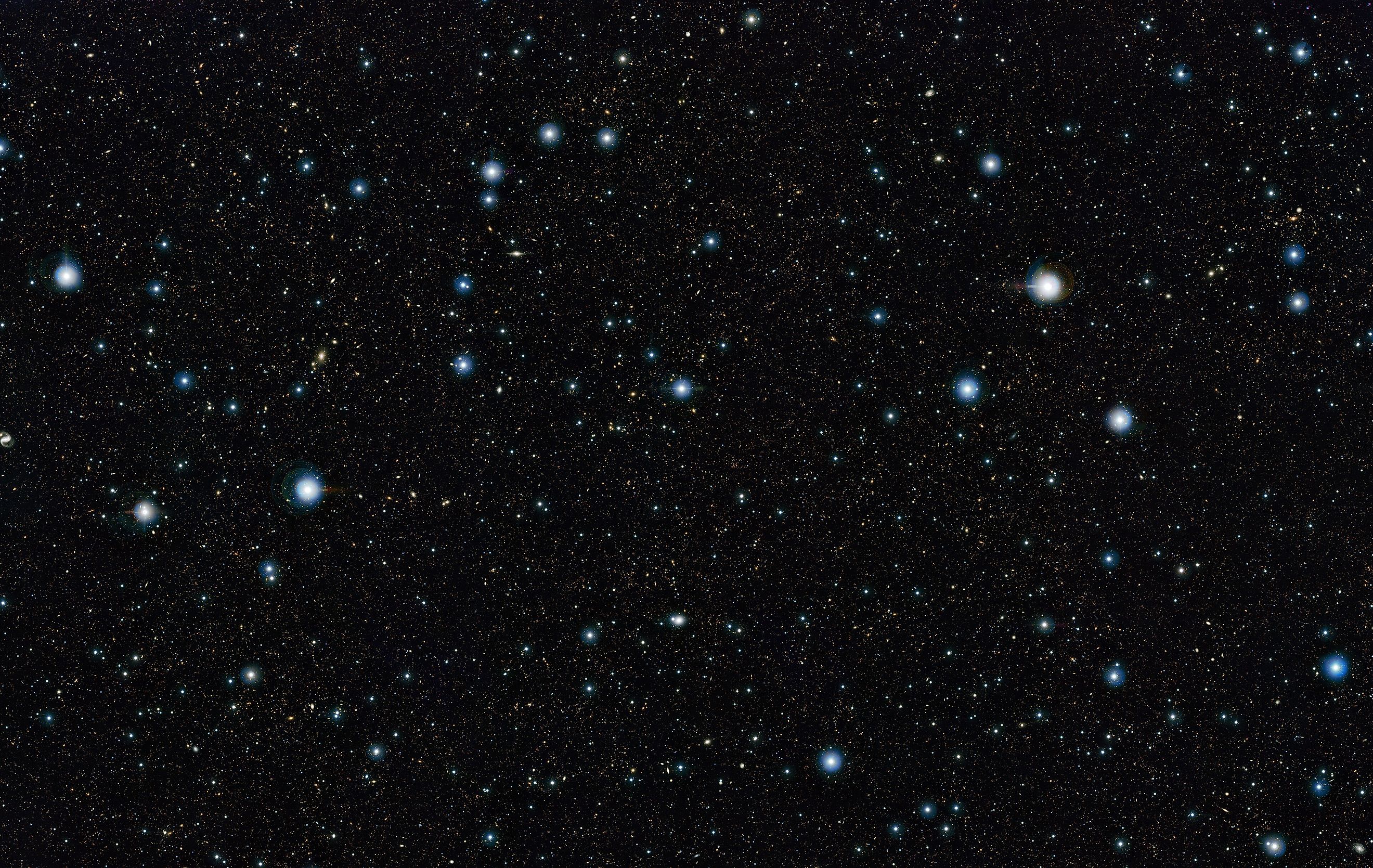
In Webb's actual images, MoM-z14 does not look much like a galaxy at all. It shows up more as a blurry, glowing green dot with a faint reddish speck. The space telescope's mirror, wide enough to span a two-lane residential street, still cannot pull out any internal details at this distance. The images reveal no spiraling arms, swirls of colors, or star clusters. Instead, the pictures show what mostly amounts to a glowing smudge, albeit an incredibly exciting, record-breaking smudge that presents a snapshot of the oldest space object ever observed.
If a spacecraft could somehow park itself next to MoM-z14 up close, the picture would look very different from a more modern galaxy like the Milky Way. With a radius of only about 240 light-years, a tiny fraction of the Milky Way's width, it is far too small and dense to have organized spiral arms or a flattened disk. Astronomers described it as compact and extremely luminous for its size and age, packed with hot stars formed rapidly during an intense burst of star formation.
Its chemical composition resembles ancient globular star clusters. These are tight, spherical clumps of stars, which hints that MoM-z14 may have looked more like an overgrown, blazing star cluster glowing blue-white than a fully structured galaxy. Some researchers have even raised the possibility that unusually massive, short-lived stars contributed to its surprising brightness, something never directly observed but long theorized to exist in the universe's earliest days.
MoM-z14 Sits Near a Permanent Boundary

MoM-z14 is not just the farthest galaxy imaged so far. It also sits close to a genuine wall that no telescope will ever see past. The wall exists because of what the universe looked like before MoM-z14 formed. For its first 380,000 years, the universe was filled with a hot, dense soup of particles so thick that light could not travel through it. Instead, light bounced off electrons almost as soon as it was released, the way fog scatters a car's headlights. Only after the universe cooled enough for electrons and protons to combine into atoms did that fog clear, allowing light to travel freely for the first time.
MoM-z14 shines from only about 280 million years after the Big Bang, not long after that clearing happened, meaning it comes from very close to the earliest moment any galaxy could have existed. That gap of 280 million years may sound enormous, but on the scale of the universe's full 13.8-billion-year history, it is like reaching page 20 of a thousand-page book. No telescope, regardless of size or sensitivity, will ever photograph a galaxy from before the fog of the universe cleared. This is because no light escaped that period at all, and therefore cannot travel to reach our telescopes. Trying to peer past it would be like trying to look straight through the Sun to see what lies on its far side. It is not just difficult, but permanently, physically impossible.
The faint glow astronomers can still detect across the entire sky today, the cosmic microwave background, is light released at the exact moment the fog lifted. Astronomers call its source the surface of last scattering, and it stands as a permanent curtain across the universe's past.
MoM-z14 Sits Near the Cosmic Horizon

A second boundary works alongside the surface of last scattering, known as the cosmic horizon. The universe has been expanding since the Big Bang, and the farther away an object sits, the faster the space between it and Earth stretches.
Past a certain distance, space stretches so quickly that light given off today can never cross the growing gap to reach Earth, no matter how much time passes. A spacecraft launched today at the speed of light, the fastest speed anything can travel, could still never catch up to a galaxy sitting beyond that horizon. MoM-z14 itself now lies beyond it, so the light it gives off today will never arrive, even though the ancient light it sent long ago already has. The observable universe has its own outer edge, about 46 billion light-years away, set by how far light has been able to travel since the Big Bang. Galaxies beyond that edge have never been seen by any telescope, no matter how advanced.
MoM-z14 sits deep within a narrow window of cosmic history that is still observable, squeezed between the surface of last scattering and the edge of the observable universe.
The Current Record Holder and the Possibility for Future Discoveries
MoM-z14 already sits deep within cosmic history, close to the boundary where no telescope can see beyond. But space telescopes may well find galaxies even older and fainter, closer to the surface of last scattering than MoM-z14.
The James Webb Space Telescope continues to search new patches of sky. For now, MoM-z14 stands as one of the closest snapshots astronomers have so far to that permanent cosmic wall. A record may be broken again, but only within limits the universe itself has already fixed in place.