What Enceladus's Plumes Are Made Of
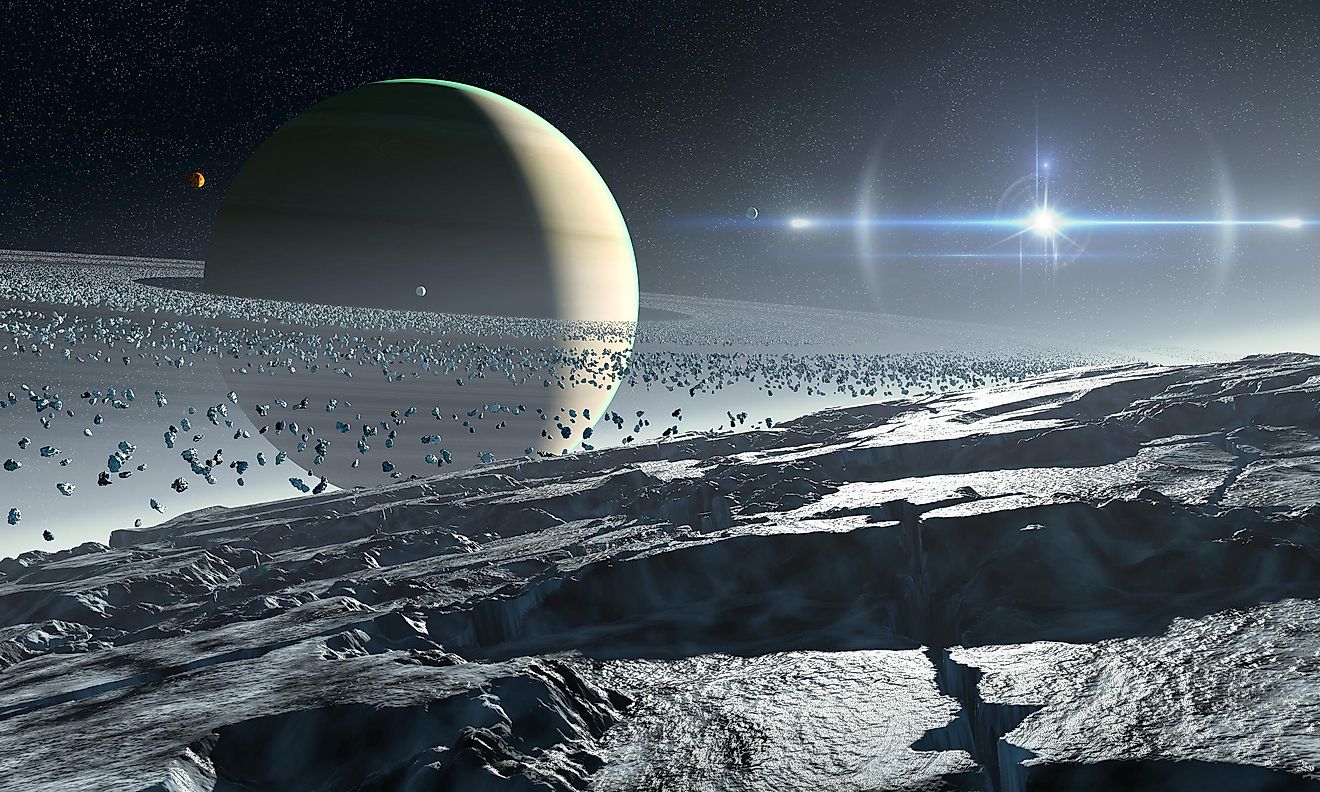
Saturn's moon, Enceladus, fires a jet of water into space that reaches roughly 6,000 miles from its surface, about twenty times the width of the moon itself, which may be the reason scientists still believe in life from above.
Nothing like it exists anywhere else that we can reach. The material coming out of those cracks is mostly water vapor and ice, mixed with methane, carbon dioxide, salts, and grains of silica, with traces of ammonia, carbon monoxide, and nitrogen.
Some of it falls back as snow. Some feeds one of Saturn's rings. All of it comes from an ocean hidden under the ice.
A Moon the Width of Arizona

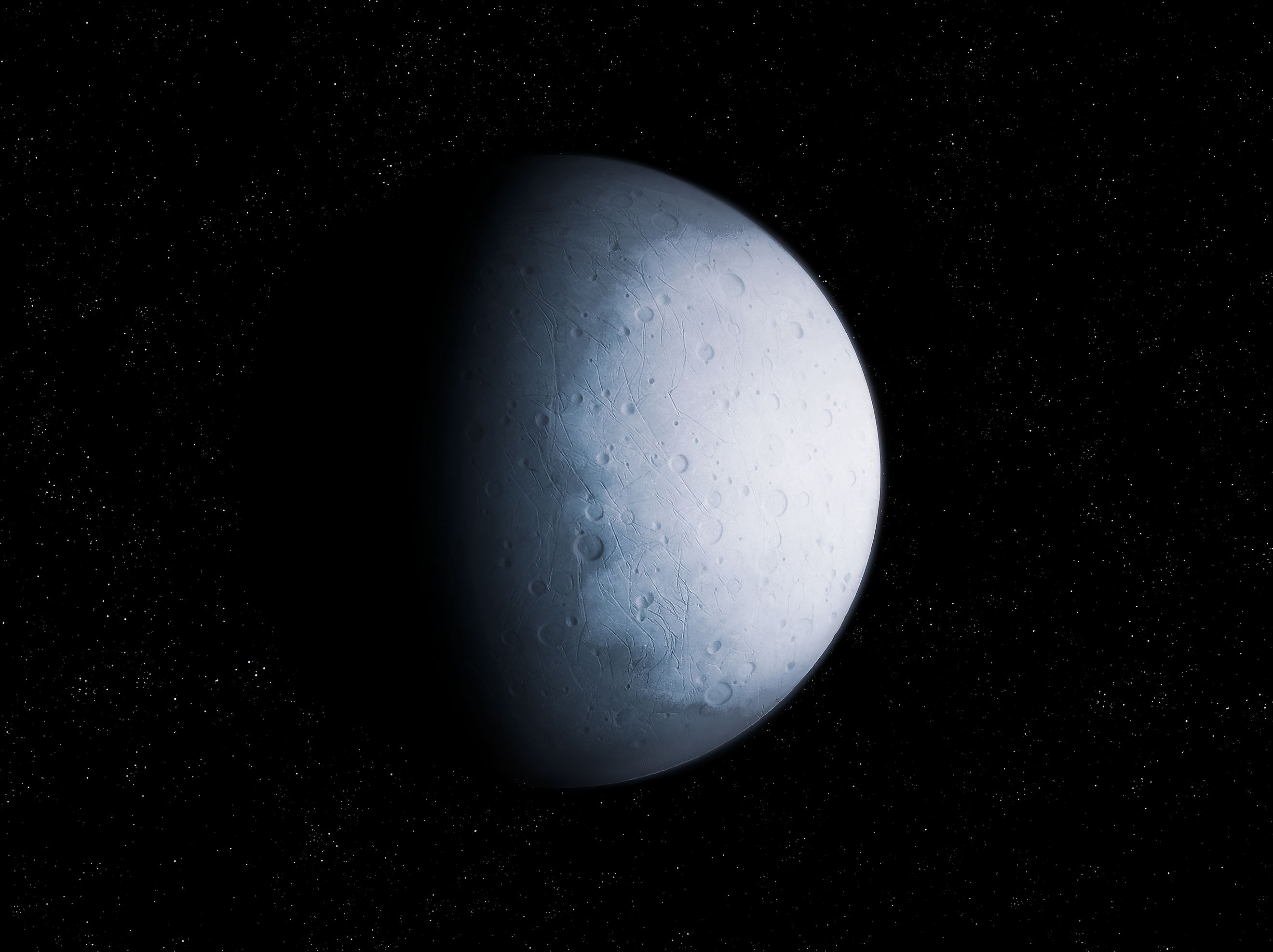
Enceladus is one of Saturn's 285 confirmed moons, a figure the International Astronomical Union's Minor Planet Center raised in March 2026 and one that keeps climbing. It is the sixth largest of them and still small at an estimated 310 miles across, roughly the width of Arizona, meaning you could drive its diameter in a day.
It was first spotted by German-British astronomer, William Herschel, in 1789, eight years after finding Uranus. He was using a telescope 40 feet long with a 49-inch mirror, but what made the moon findable at all was its brightness.
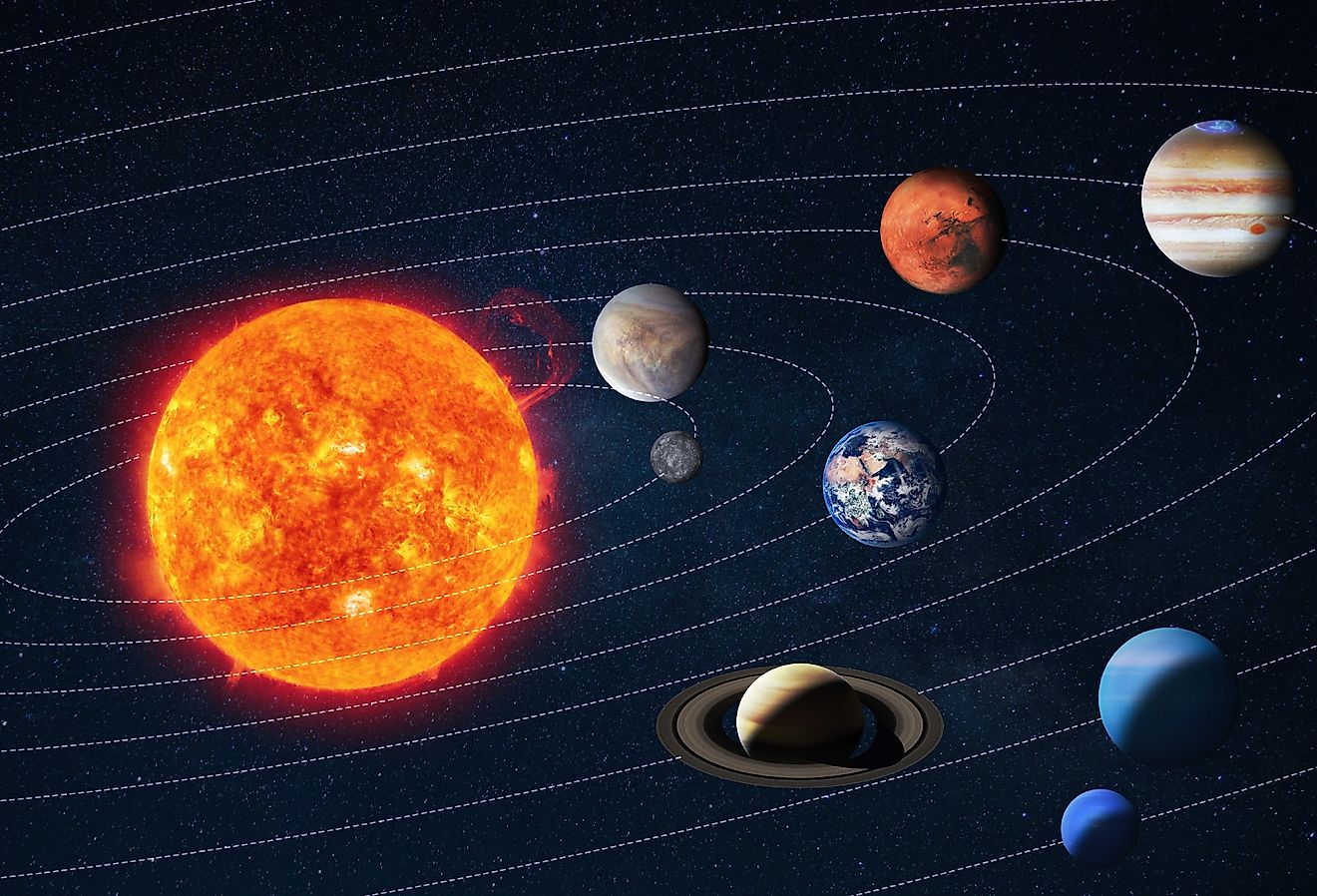
Enceladus is the most reflective body in the solar system, bouncing back very nearly all the sunlight that hits it. That sunlight is not much for Saturn orbits 886 million miles from the Sun, and Enceladus circles the planet another 148,000 miles out.
A surface that absorbs almost nothing, that far from any heat, ends up at about -330 degrees Fahrenheit. The coldest temperature ever recorded on Earth was -128.6 degrees. Under that frozen shell, sits a global ocean roughly six miles deep.
What Causes Its Geysers?

The jets escape through fractures near the south pole that scientists call "tiger stripes." Saturn's gravity pulls on the moon unevenly as it orbits, flexing the crust, working the cracks open and closed, with the water forcing its way out. The ice is thinnest exactly where the geysers are, somewhere between half a mile and three miles at the pole, against an average closer to 16 to 19 miles across the rest of the moon.
The Cassini-Huygens mission in 2005 found the plumes when its first close images of the south pole showed both the fractures and a haze of water vapor above them. On October 28, 2015, the spacecraft made its deepest dive yet, passing 30 miles above the surface and flying straight through the plume. It made one last Enceladus flyby that December and ended its mission in Saturn's atmosphere in 2017.
Particles leave the cracks at around 800 miles per hour, faster than a commercial jet at cruising altitude, and climb thousands of miles. Most of that material falls back as fine ice, which is what keeps the surface so bright. The rest escapes the moon entirely and becomes Saturn's E ring.
Is There Life on Enceladus?

The silica grains are the interesting part. Grains that size only form when water meets rock at temperatures above about 200 degrees Fahrenheit. Finding them in the plume means there is hot water touching stone at the bottom of the ocean, six miles down and 886 million miles from the Sun.
"We suspect that so-called hydrothermal fields exist there," said Nozair Khawaja of Freie Universität Berlin, who led a 2025 analysis of Cassini data published in Nature Astronomy.
"There is evidence that life on Earth originated in such fields."
That study pulled something new out of the plume itself. Grains caught during the high-speed flyby were fresh, minutes old rather than years, and they held esters, alkenes, and ether compounds that had never turned up in the older E ring material.
"Esters and ethers can be part of lipids, and lipids are key to life as we know it," said Fabian Klenner of the University of Washington and co-author of the 2025 analysis of Cassini data. The plume also carries salts, which is how we know the ocean below is salty.
Liquid water, an energy source, and the chemical building blocks of life: Enceladus has all three.
Are There Other Moons With Geysers?

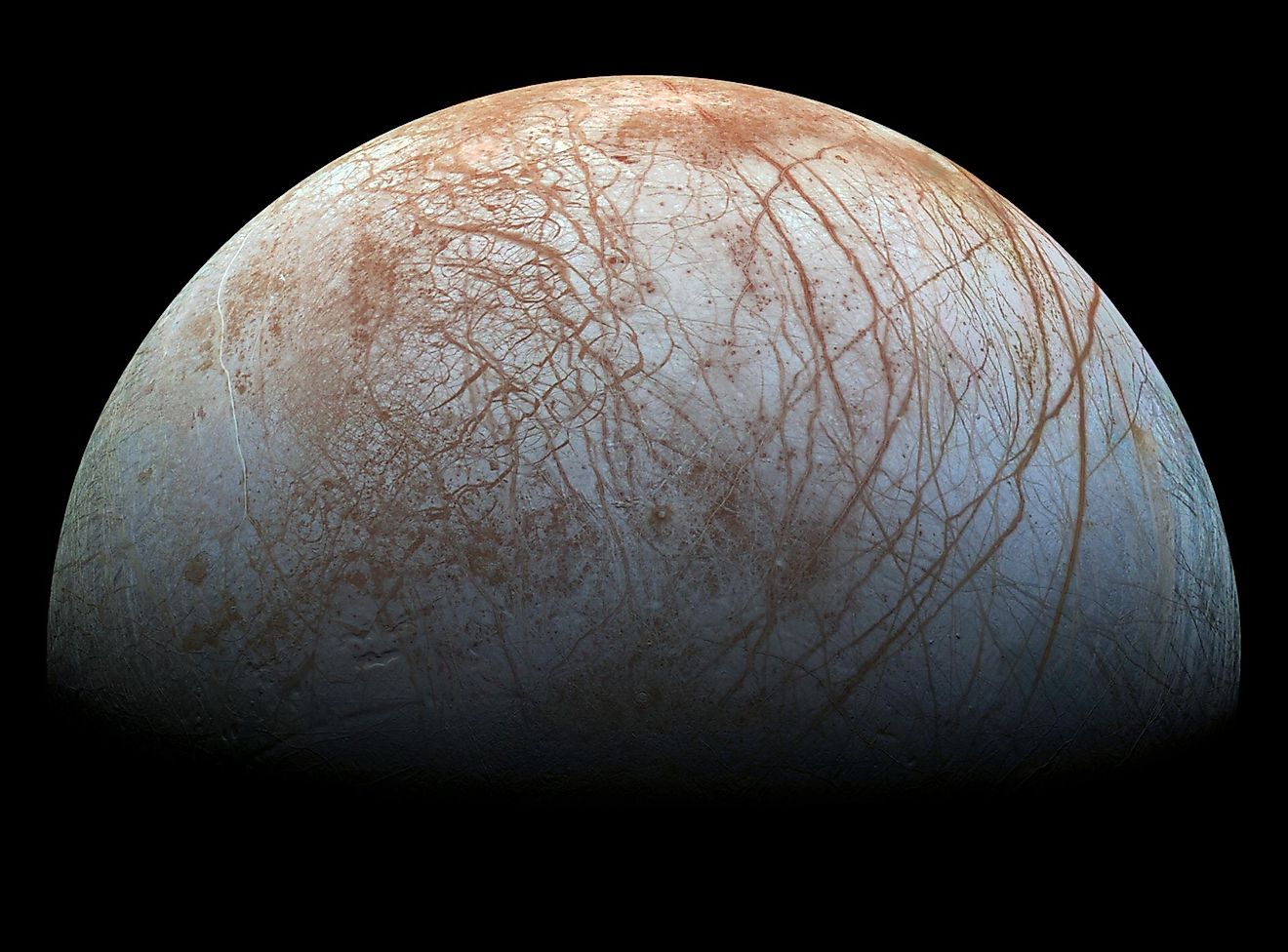
Another moon may be doing the same thing. Europa orbits Jupiter behind a shell of ice scored with reddish-brown cracks and observatories, including NASA's Goddard Space Flight Center in Greenbelt, Maryland, that has detected water vapor above it.
The mechanism would be familiar. Europa's orbit is elliptical, so Jupiter's pull rises and falls as the moon swings closer and farther away. That constant flexing generates heat, enough to keep an ocean liquid under the ice and possibly to drive plate tectonics of a kind Earth would recognize.
NASA launched the Europa Clipper on October 14, 2024, to find out. It has 1.8 billion miles to cover and arrives in April 2030, after which it will orbit Jupiter and make 49 passes over Europa, hunting for geysers and for any sign the moon could support life.
Will There Be Another Mission to Enceladus?

The European Space Agency (ESA) has picked Enceladus as the target of L4, its fourth Large-class mission and the first flagship of its Voyage 2050 program. The plan pairs an orbiter with a lander, which would set down near the south pole and work on the surface for at least a month, sampling the plume material where it comes out.
The timeline is long. Current planning points to a launch around 2042 using two Ariane 64 rockets, with the spacecraft assembled in Earth orbit before it leaves, then a cruise of roughly nine years and arrival in the Saturn system in the early 2050s.
Landing is pencilled in for around 2052. The mission is still a study rather than a commitment where the ESA does not expect to formally adopt it until about 2034. China has proposed a landing mission of its own.
What We Don't Know About Enceladus
Cassini's dust analyzer was never built to answer the question everyone now wants answered. It caught grains at 40,000 miles per hour and told us what elements were in them, but reading the finer chemistry of an alien ocean takes instruments that have not flown yet. That gap is most of the reason the ESA is willing to wait until the 2050s for a result.
The conditions for life are not life. As Klenner put it, being habitable and being inhabited are two very different things. Nothing has been found on Enceladus, and nothing may be.
However, a moon the width of Arizona is throwing the contents of its buried sea 6,000 miles into space, where a passing spacecraft can fly through and read them, and no other world in reach offers anything close to that.