What The Juno Spacecraft Found Hiding Under Jupiter’s Clouds
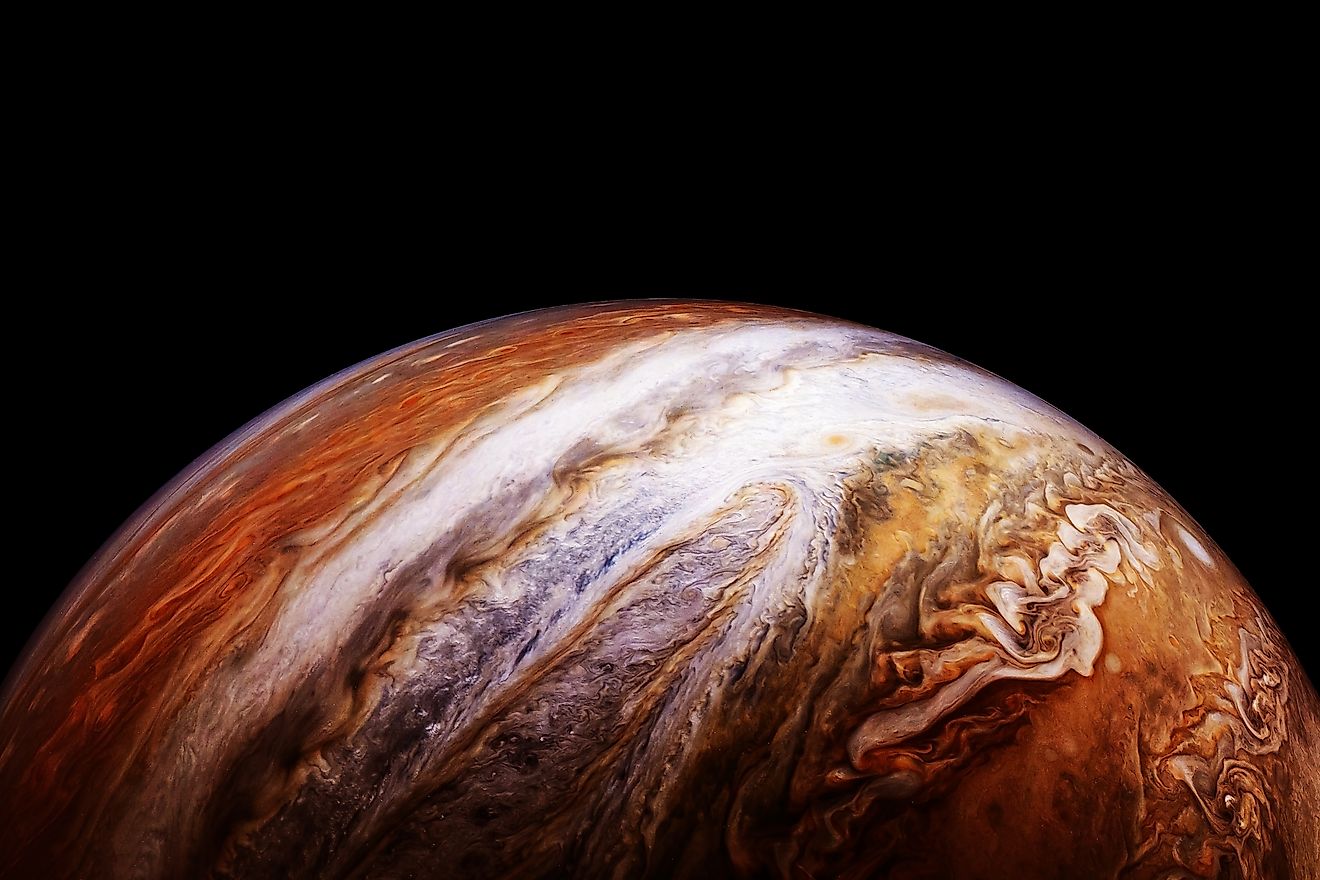
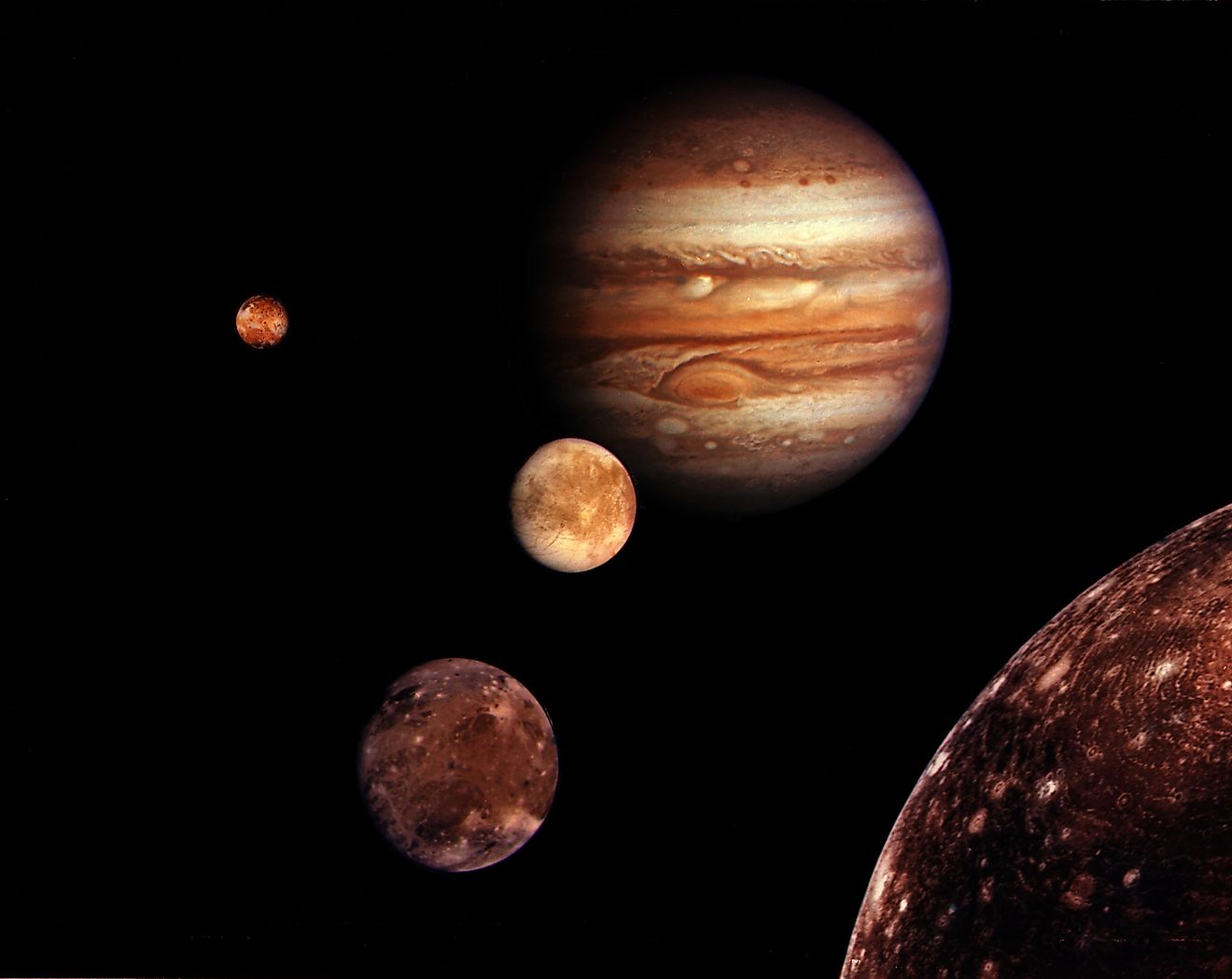
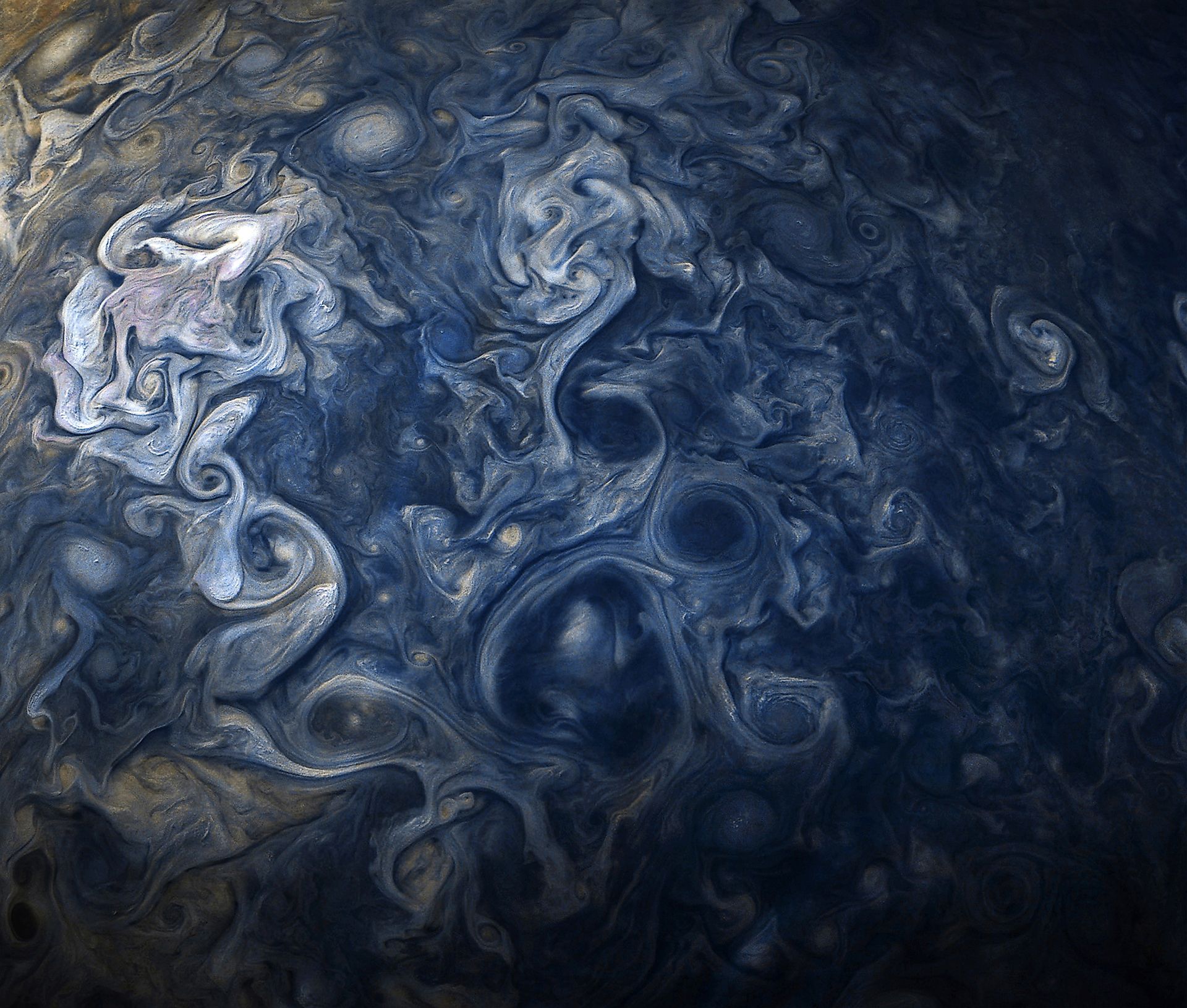
Jupiter's winds extend almost 1,900 miles beneath its clouds, according to NASA's Juno spacecraft. That is about a quarter of Earth's diameter. Since reaching the celestial juggernaut in 2016, this solar-powered storm chaser has uncovered evidence of ammonia hailstones and measured the buried roots of the Great Red Spot. Deeper still, its gravity measurements point to a "fuzzy" core whose origins scientists are still trying to explain.
The mission has a fitting namesake. Roman mythology tells how Jupiter concealed his misbehavior behind clouds, until his wife, Juno, saw through the disguise. NASA equipped its own cosmic detective with powerful instruments to investigate what the planetary heavyweight hides beneath its tempestuous exterior.
A Solar Sailor Built For Storm Chasing

Described by NASA as a "solar sailor," Juno became the first solar-powered spacecraft to operate at Jupiter, where sunlight reaches about 4% of its strength near Earth. Three huge solar arrays extend around the spacecraft like the blades of a windmill. Fully spread, the orbiter spans about the dimensions of a basketball court.
Those panels power specialized instruments on board Juno, such as its microwave radiometer, an instrument that picks up energy escaping from deep in Jupiter's atmosphere. Scientists use those readings to estimate temperatures and the amounts of water and ammonia beneath the clouds. Magnetic sensors map the field generated within the planet. Radio signals reveal tiny changes in Juno's motion caused by Jupiter's uneven gravitational pull.
The scientific harvest reaches beyond weather. Jupiter formed early in the solar system's history, gathering material left over after the Sun formed. Its composition and internal structure preserve clues about that early process.
"Jupiter is the Rosetta Stone of our solar system," said Scott Bolton, Juno's principal investigator at the Southwest Research Institute in San Antonio. He described Juno as an emissary sent to interpret the planet's story.
Winds With Almost 1,900 Miles Of Depth

Jupiter's stripes mark an atmosphere driven by powerful currents flowing east and west. Before Juno, scientists debated how far those winds extended beneath the visible clouds. Gravity measurements put their depth at about 1,860 miles.
Researchers determined that depth by tracking Juno as it swept past the planet at about 130,000 mph. Differences in the distribution of mass slightly changed the spacecraft's speed. Radio tracking detected changes as small as 0.01 millimeter per second, allowing scientists to test the hidden structures responsible.
A 2023 study clarified the arrangement of those deep currents. They follow cylindrical structures aligned with Jupiter's rotation axis. Nested tubes running through a spinning globe give a rough picture of the geometry. A current's position therefore shifts in latitude with depth, following the cylinder instead of plunging straight toward the center.
The Great Red Spot Has Buried Roots
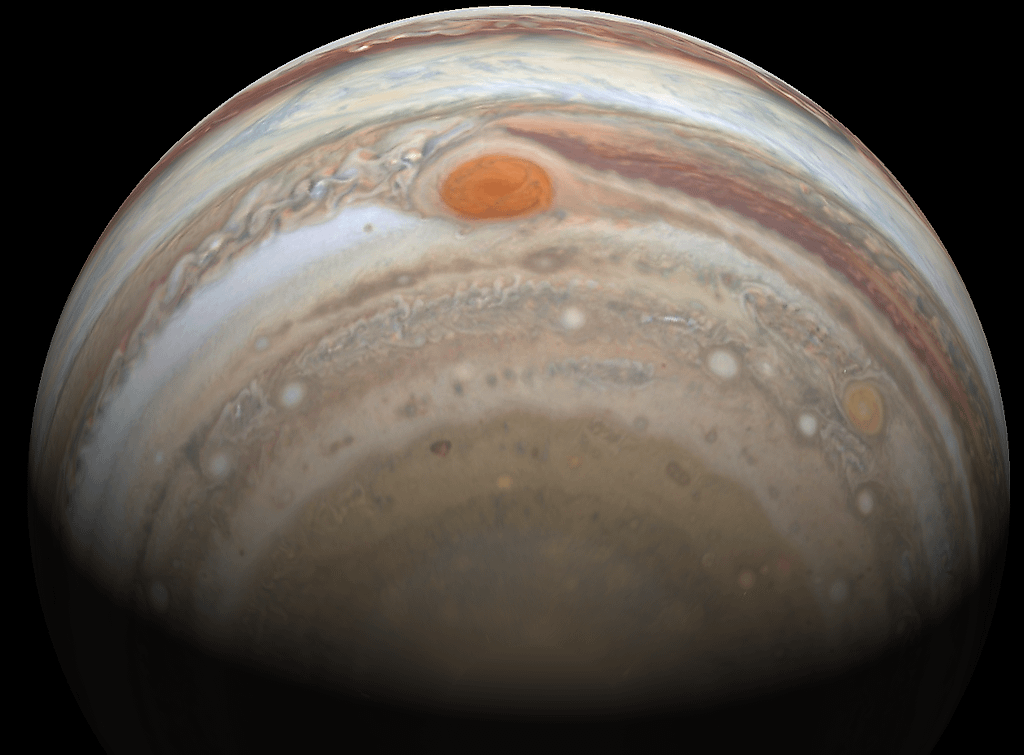
The Great Red Spot is wider than Earth, but its breadth tells part of the story. Juno's microwave measurements showed that the rotating storm extends hundreds of miles beneath the cloud tops. Gravity observations placed its lower boundary about 300 miles below those clouds.
The familiar red oval is the exposed top of a much taller structure. Its roots stretch below the levels where water condenses and clouds form, penetrating beneath the atmospheric region warmed by sunlight.
Researchers detected the storm through its gravitational influence on Juno as well. During close passes, they searched for the minute changes in the spacecraft's motion caused by the mass associated with the Great Red Spot. Combined with microwave observations, that signal supplied another way to measure a storm whose bottom remains hidden from cameras.
Cyclones Crowding The Poles

Juno's polar orbit revealed storm arrangements that earlier missions had never captured so clearly. Eight cyclones surrounded a central northern cyclone. Around the south pole, five storms formed a pentagonal pattern around a sixth. These arrangements persisted through years of observations, despite the violence within each swirling system.
Jupiter's southern storm cluster briefly gained another member in November 2019. About the size of Texas, the newcomer joined the five cyclones surrounding a central storm, turning their pentagonal arrangement into a hexagon.
Within months, the smaller cyclone moved away and disappeared. The original arrangement held. Tracking which storms persist and which break apart helps scientists understand how these giant cyclones interact.
Lightning And Hail Made With Ammonia

Juno detected lightning high in Jupiter's atmosphere where temperatures fall below minus 126°F. That may seem odd because on Earth, thunderstorms generate electrical charges through collisions involving ice crystals and soft hail, with liquid water helping those particles grow. Jupiter's flashes appeared where pure water cannot remain liquid, leaving scientists to explain how the clouds became electrified. Ammonia changes the chemistry.
Scientists propose that violent updrafts throw water ice into higher atmospheric layers containing ammonia vapor. The ammonia lowers the ice's melting point, acting like antifreeze. Droplets of the resulting mixture collide with rising ice crystals and help electrically charge the clouds.
That mixture helps explain an apparent shortage of ammonia gas as well. Juno measured depleted regions extending about 93 miles beneath the clouds. Researchers proposed that slushy hailstones, called "mushballs," collect ammonia and carry it downward. Beneath an icy crust, each contains a mixture of water and ammonia.
A microwave signal detected beneath a storm in 2025 was consistent with melting ice or the release of ammonia, both supporting the mushball explanation. These hailstones may grow to about the size of softballs before falling into warmer layers. There, they melt and evaporate, releasing water and ammonia deep in the atmosphere.
A Magnetic Field That Reveals The Interior

Juno's early measurements showed that Jupiter's magnetic field was stronger and more uneven than researchers expected. Described as lumpy, with stronger and weaker regions, that irregularity helped supply scientists with clues about the depth and structure of the processes generating the planet's magnetic field.
Deep inside Jupiter, crushing pressure turns hydrogen into a metallic fluid capable of conducting electricity. Moving electrical conductors can generate magnetic fields, making the behavior of this metallic hydrogen central to understanding Jupiter's magnetism. Mapping the field offers scientists an avenue to investigate material far beyond the reach of a camera.
Juno mapped an intense magnetic patch near Jupiter's equator as well, nicknamed the Great Blue Spot for its color on scientific maps. The patch is invisible to the eye, but changes around it revealed something about the planet's hidden motion. Deep winds appear to stretch and carry the magnetic field as they move through electrically conducting material. Tracking those changes helps scientists investigate currents thousands of miles beneath Jupiter's clouds.
Radiation Powerful Enough To Threaten The Spacecraft

Jupiter's magnetic field traps charged particles in radiation belts that can damage spacecraft electronics. Juno shields its computers and other sensitive equipment inside a titanium vault. Its looping orbit limits exposure to the most intense radiation.
Some of that radiation became useful data. High-energy electrons leave bright marks in Juno's star-camera images, the same images that normally help determine the spacecraft's orientation. Researchers used those marks to measure radiation levels in areas earlier spacecraft had barely explored. A study published in 2025 detailed the results. Knowing where these particles concentrate helps engineers assess radiation exposure and design protection for future missions to Jupiter and its moons.
Above Jupiter's poles, Juno investigated the particles powering its auroras. On Earth, electric fields accelerate electrons into the atmosphere to produce some of the brightest northern and southern lights. Juno detected a similar process at Jupiter, operating at much higher energies. Yet it could not account for the planet's brightest displays. Those appear to depend on a more turbulent process that accelerates particles, leaving scientists working to explain exactly how Jupiter powers its vivid light show.
The Fuzzy Core Remains An Unfinished Story

Juno's gravity measurements suggest that heavy material mixes with hydrogen and helium throughout a broad central region. Scientists call this a dilute or "fuzzy" core because it has no sharply defined outer edge. Some models suggest this region reaches about halfway from the planet's center to its surface.
An ancient collision could explain Jupiter's fuzzy core. A 2019 study suggested that an emerging planet could have struck the young Jupiter, disrupting its compact core and mixing heavy material into the surrounding hydrogen and helium. Simulations published in 2025 challenged that explanation. Every impact tested showed the displaced material quickly settling back into a separate core.
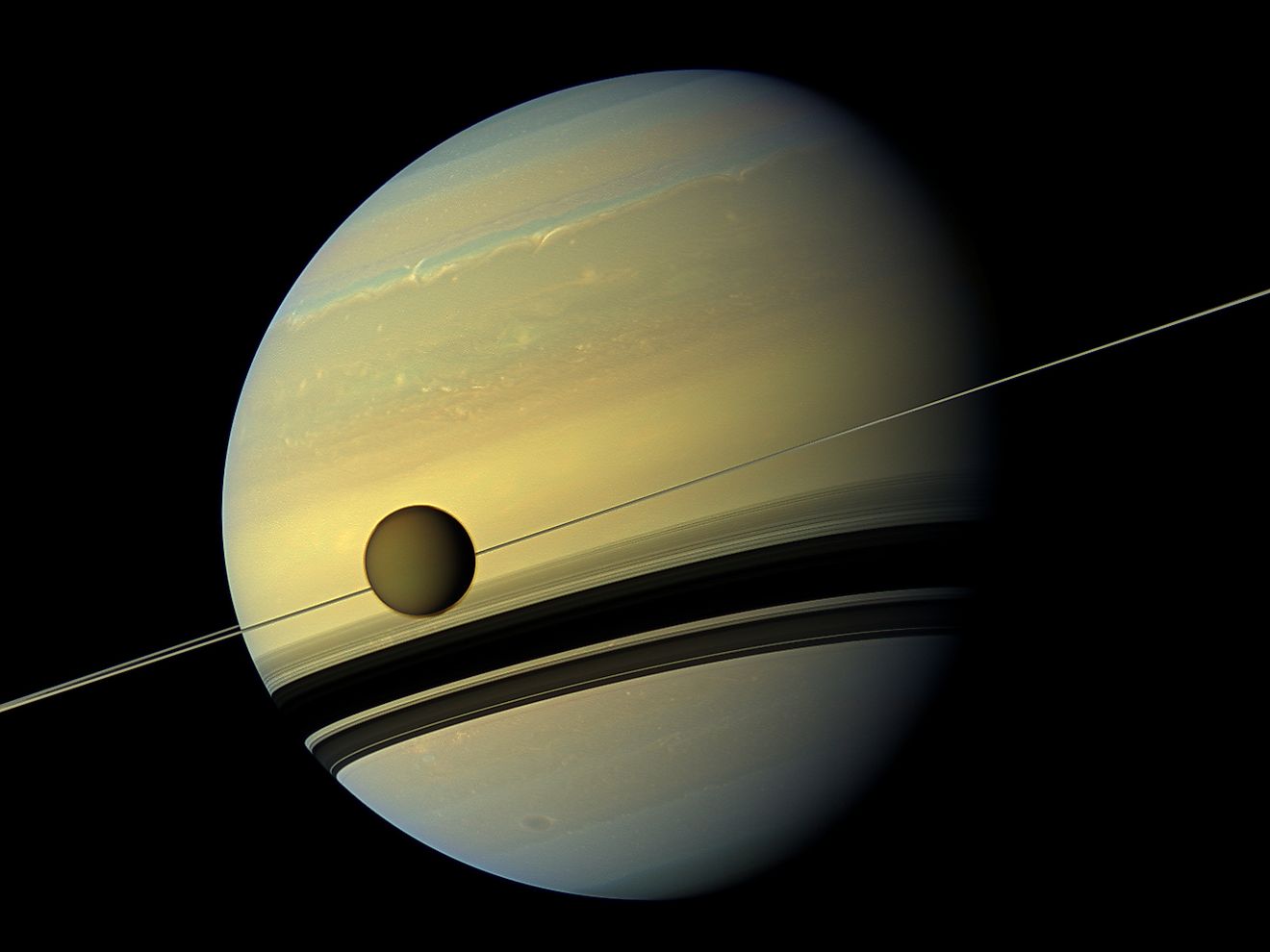
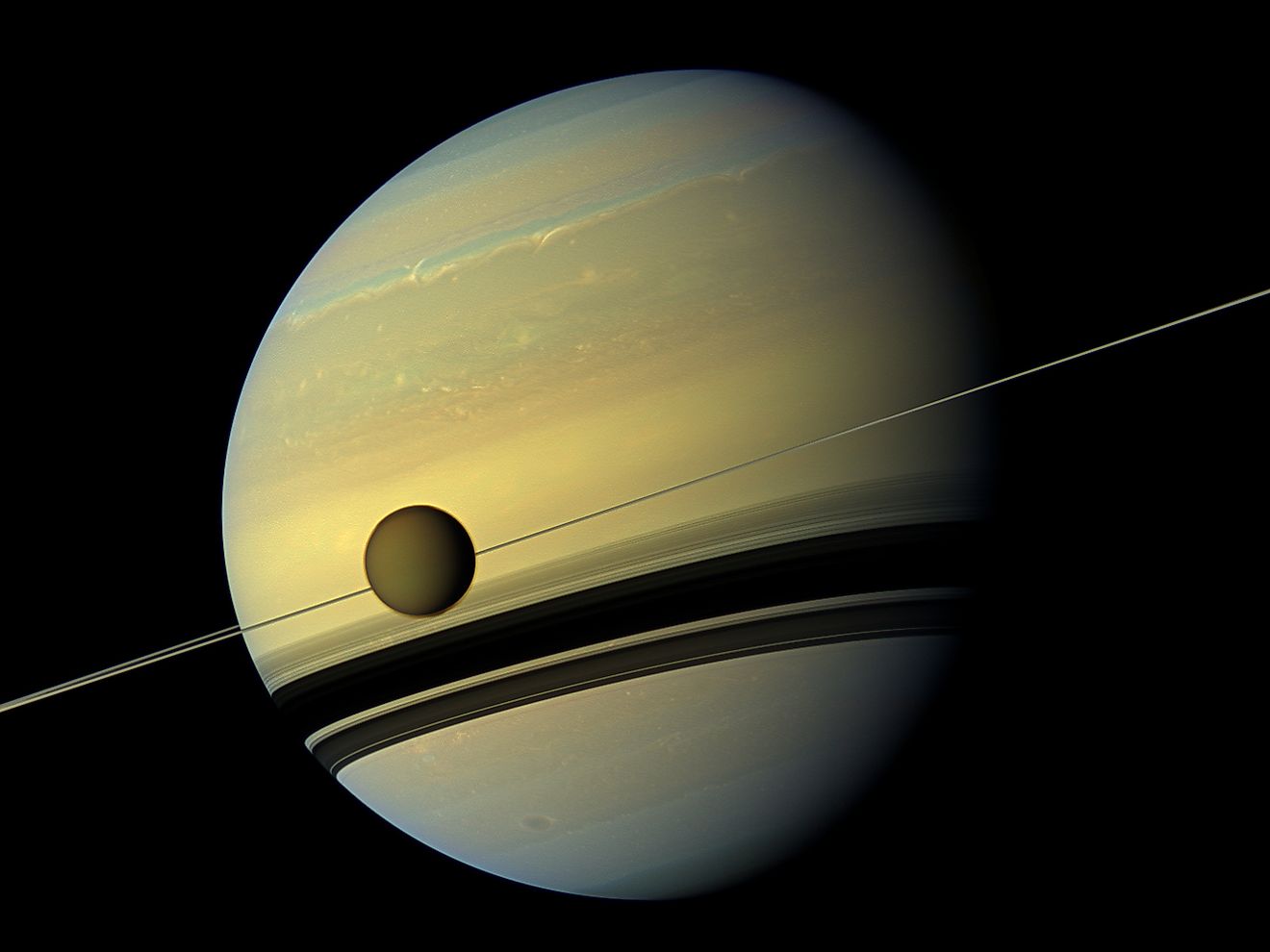
Saturn supplies another clue. Evidence suggests that it has a diffuse core as well, raising the possibility that these structures develop as giant planets grow and evolve. The researchers behind the 2025 study suggest that the way a growing planet accumulates heavy and light material may help explain its fuzzy interior.
Juno has left scientists with a question that reaches beyond Jupiter. If both of the solar system's largest planets have fuzzy cores, similar structures may exist inside giant worlds around other stars. Explaining how rock, ice, and gas assembled into those interiors could change the scientific understanding of how giant planets form. It could help scientists decide what future missions should investigate beneath their clouds.
The Detective's Work Continues
Juno set out to see through Jupiter's disguise, and the planet's clouds have given up more than scientists expected. Winds plunge nearly 1,900 miles, storms sink their roots below the sunlit layers, slushy hailstones drag ammonia into the depths, and a lumpy magnetic field bends with hidden currents. Every answer has opened a new question, including what powers the planet's brightest auroras and how its fuzzy core formed. Like the goddess it was named for, Juno has looked past the clouds, and the gas giant has shown that its true character is buried far below the surface.