Which Moon Orbits The Fastest?
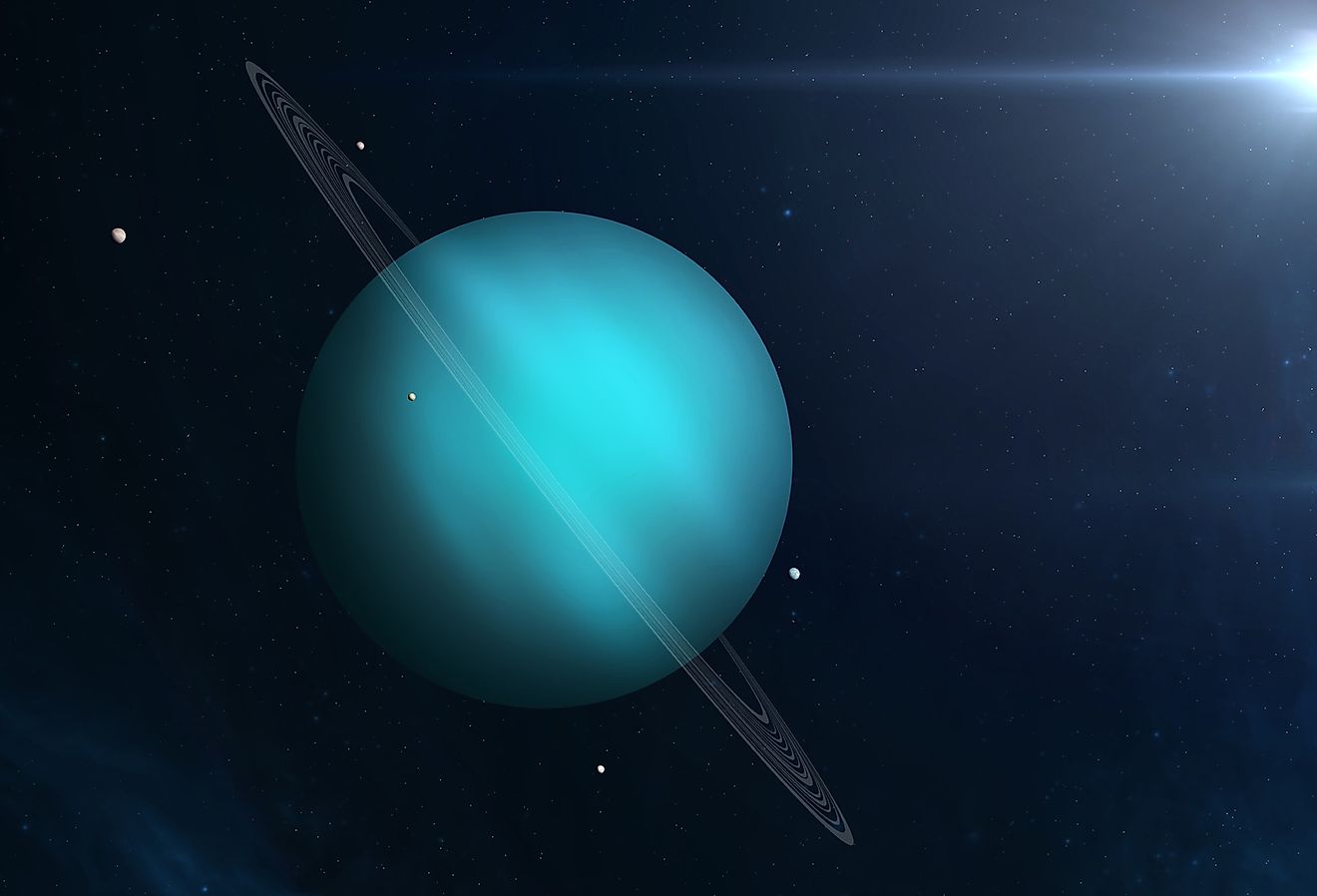
Neptune's tiny moon Naiad completes an entire orbit in just over seven hours, finishing a full circuit faster than any other known moon in the solar system. It races around the distant blue planet at nearly 27,000 miles per hour, completing more than three revolutions during a single Earth day. Stranger still, Naiad follows an unusual path that makes it appear to zigzag above and below a neighboring moon.
In terms of sheer speed however, even Naiad doesn't come close to Jupiter's small moon, Metis, which races around the gas giant at more than 70,000 miles per hour. That's fast enough to circle Earth in about 21 minutes. Here's what makes these two tiny satellites the solar system's most remarkable orbital record-holders.
Naiad: The Fastest-Orbiting Moon

Naiad is Neptune's innermost known moon and holds the record for the shortest orbital period among known natural satellites. According to NASA's Jet Propulsion Laboratory orbital data, it completes one revolution in approximately 7 hours and 3 minutes. Its average distance from Neptune's center is about 30,000 miles, placing it less than 15,000 miles above the planet's visible cloud tops.
Despite its extraordinary orbital period, Naiad is not particularly large. Its irregular, elongated body measures approximately 60 miles along its longest dimension. Rather than resembling Earth's nearly spherical Moon, it looks more like a battered piece of rock or ice. Scientists believe it may have formed from debris left behind when Neptune's original satellite system was disrupted following the capture of its largest moon, Triton.
Naiad's orbital speed is approximately 26,700 miles per hour. At that pace, it could theoretically circle Earth's equator in less than an hour. The moon completes its journey around Neptune so quickly because it follows an extremely tight orbit around the planet. One revolution covers approximately 188,000 miles, considerably less than the distance traveled by Jupiter's Metis.
Discovered by NASA's Voyager 2 spacecraft in 1989, Naiad remains poorly understood compared with larger moons such as Triton. Nevertheless, its remarkably short orbital period and unusual interactions with neighboring satellites make it one of the most intriguing small moons in the solar system.
Metis: The Fastest-Orbiting Moon By Speed

Metis is Jupiter's innermost known moon, orbiting approximately 79,500 miles from the planet's center. According to NASA's orbital data, it completes one revolution every 7 hours and 4.5 minutes. During that time, it travels roughly 500,000 miles, covering a distance equivalent to circling Earth's equator about 20 times.
Its average orbital speed is approximately 70,500 miles per hour, nearly 30 times faster than Earth's Moon travels around our planet. Even at that incredible velocity, Metis remains gravitationally bound to Jupiter, following a nearly circular path around the gas giant.
Metis is exceptionally small. Its mean radius is approximately 13.3 miles, giving it an average diameter of just under 27 miles. Its irregular shape makes it resemble a battered asteroid more than Earth's nearly spherical Moon. NASA's Galileo spacecraft revealed evidence of impact craters, hills, and valleys across Jupiter's small inner satellites.
Why Metis Moves So Quickly

Jupiter contains more than 300 times Earth's mass, giving it an immense gravitational pull. The closer an object travels to the giant planet, the greater the orbital speed generally needed to keep it circling instead of plunging toward Jupiter.
Metis follows this principle. It orbits only about 35,000 miles above Jupiter's visible cloud tops, an extraordinarily close distance considering the planet's enormous size. At this altitude, its orbital speed reaches approximately 19.6 miles per second. Jupiter's rotation creates an additional oddity. The planet takes about 9.9 hours to rotate once, while Metis completes an orbit in just over seven hours. That means the moon circles Jupiter faster than the giant planet turns beneath it.
Imagine watching Metis travel across Jupiter's sky from a fixed point above the clouds. The moon would continually gain ground on the planet's rotation. Unlike Earth's Moon, which takes more than 27 days to orbit our planet, Metis could complete three full revolutions before an Earth day ended.
The Strange Relationship Between Metis And Jupiter's Rings

Metis travels through Jupiter's faint main ring, surrounded by particles of dust produced partly by collisions with small moons. Jupiter's rings are much harder to see than Saturn's brilliant icy rings because they consist largely of extremely fine, dark material. The moon plays an important role in maintaining this dusty environment. When tiny meteoroids strike Metis, they can eject particles from its surface. Because Metis has such weak gravity, some of this debris escapes into orbit around Jupiter and becomes part of the ring system.
Its close neighbor, Adrastea, contributes material through the same process. These two moons help replenish Jupiter's main ring, while the more distant moons Amalthea and Thebe supply dust to the planet's diffuse gossamer rings.
How Scientists Found the Fastest Moon

Metis was discovered in March 1979 using images obtained during NASA's Voyager 1 encounter with Jupiter. The spacecraft revealed several previously unknown features of the Jovian system, including the planet's faint rings and small inner satellites.
Later observations by the Galileo spacecraft provided much clearer views. Images captured in January 2000 remain among the highest-resolution observations of Metis, revealing its irregular shape and some of its surface features.
Despite these discoveries, important questions remain. Scientists have limited information about Metis's internal structure and composition. Its precise rotational period has not been directly established, although it is thought to rotate in step with its orbit, keeping approximately the same face pointed toward Jupiter.
Small Moons Moving at a Giant's Pace
Jupiter's Metis may travel at the greatest orbital speed of any known moon, but Neptune's Naiad wins the race around its planet. Completing a full revolution in barely seven hours, Naiad follows an extraordinary path that keeps it in a carefully synchronized dance with its neighboring moons. Yet its current orbit may not last forever. NASA suggests that Naiad could eventually fall into Neptune's atmosphere or be torn apart by gravitational forces, leaving its remains scattered around the planet as a new ring. For now, this tiny, misshapen moon holds one of the solar system's most surprising records, completing nearly 100 orbits in the time Earth's Moon takes to circle our planet just once.