Which Moon Is The Most Volcanic?
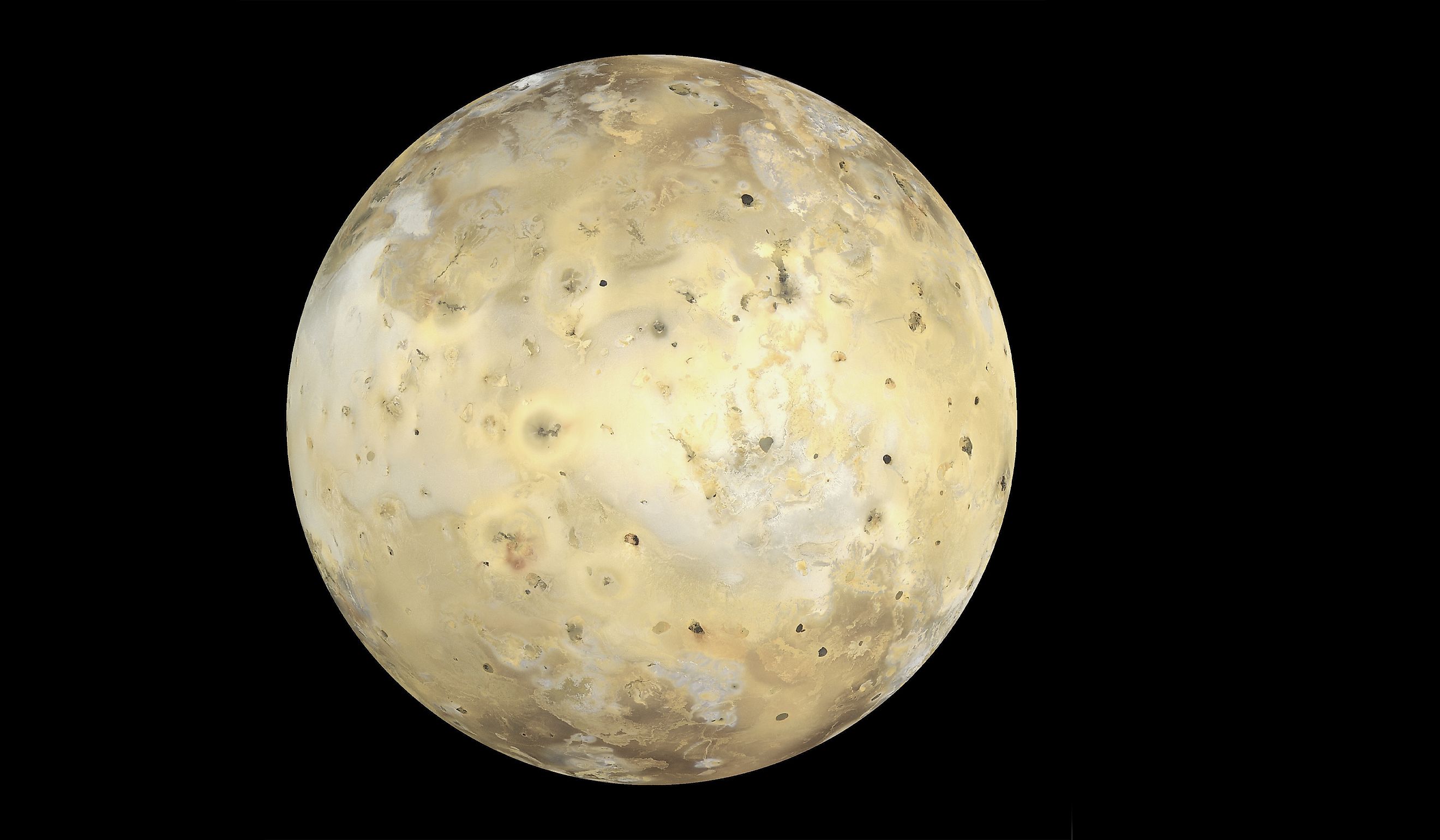
There is a moon in our galaxy with about 400 volcanoes. This is Io, one of the moons of Jupiter. When some of these volcanoes on this lunar surface erupt, it sends material flying far above the moon's surface. This is what scientists consider the most active volcanic world we know of. Io is about the size of our moon but behaves more like a lunar oven.
Why is this Moon so Hot?

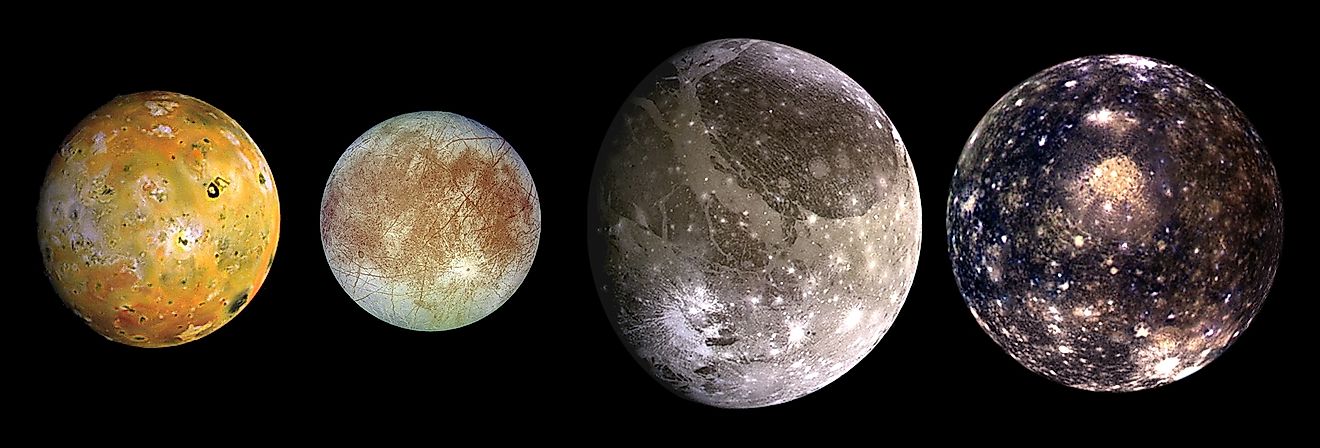
Io is one of Jupiter's four large Galilean moons. Unlike our moon, it lacks recognizable craters because the constant volcanic activity fills the lunar surface with volcanic material. This moon is not mostly gray like ours, but yellow, orange, red, black, and white from sulfur compounds and freshly deposited volcanic material. But what is strange about this is that this moon should not be this hot, as it exists hundreds of millions of miles away from the sun. So what gives?
Io orbits Jupiter about once every 42.5 hours. Europa and Ganymede gravitationally disturb Io enough to keep its orbit slightly elliptical rather than circular. Because its distance from Jupiter changes, Jupiter's enormous gravity pulls on Io with different strengths throughout each orbit. This repeated flexing creates friction and heat inside the moon. This process is called tidal heating.
NASA says Io's solid surface can rise and fall by as much as about 330 feet, or 100 meters. For comparison, even some of Earth's largest ocean tides are around 60 feet, and those involve liquid water rather than solid rock.
So every orbit around Jupiter, the ground itself is effectively being kneaded by Jupiter. Scientists estimate Io releases roughly 100 terawatts of internal heat, according to research published in Nature. Therefore, in short, gravity causes this moon to heat up because of gravity.
Io's Eruptions Can Dwarf Volcanoes On Earth
All of this internal heat has to escape somewhere, and this escape is usually violent on Io. Eruptions on the moon can shoot enormous plumes of gas and dust up hundreds of miles above its surface. NASA's Cassini spacecraft observed a plume from the volcano Pele reaching about 242 miles into space. For comparison, that is almost as high as the International Space Station typically orbits above Earth.
These plumes can grow so large because Io does not have the atmosphere to slow them down. Its gravity is also much weaker than Earth's, allowing volcanic material to travel farther before falling back toward the surface.
The lava itself can also reach temperatures. Observations of Pele have measured temperatures of at least 2,000 degrees Fahrenheit, while some studies suggest that certain eruptions on Io may become even hotter. These temperatures exceed those of many modern volcanic eruptions on Earth.
One of Io's famous volcanic features is Loki Patera, an enormous volcanic depression about 125 miles across. If placed on Earth, it would stretch across an area larger than many major metropolitan regions. Scientists believe much of Loki's surface repeatedly overturns as cooling crust sinks and hotter material rises from beneath it.
Scientists Found An Eruption Larger Than Lake Superior

In December 2024, NASA's Juno spacecraft picked up a volcanic hot spot in the southern hemisphere of Io. The area covered about 40,000 square miles. The eruption was releasing more than 80 trillion watts of energy. That's six times the total energy output from all the power plants on Earth combined.
The signal was so strong that part of Juno's instrument got overloaded while trying to observe it. Scientists think this huge hot spot might actually be made up of volcanoes erupting at the same time. They suspect these eruptions could be linked to an underground network of molten rock beneath Io's surface.
This discovery stood out for Io. It's already known as one of the geologically active places in the solar system, with hundreds of volcanoes going off. This event was different. It was unlike anything scientists had seen before on Io.
Is There An Ocean Of Magma Beneath Io?

For years, scientists asked if Io's strong volcanic activity came from a huge ocean of magma underneath its crust. That idea seemed logical at first. A moon with active volcanoes and great heat coming from inside it appears as if it should have a large layer of molten rock below it.
Recent data from NASA's Juno spacecraft, however, indicate that this might not be true. Research published in Nature shows that Io's mantle is likely mainly solid, not resting above a global magma ocean. Instead, molten rock may be found in pockets and channels inside the moon. This makes Io more mysterious. Somehow, the moon creates the intense volcanic activity in the solar system without just floating on a huge sea of magma.
Scientists are still trying to learn how heat travels through Io and how its interior fuels so many volcanoes at once. Juno's observations help researchers form a picture, but Io still holds many mysteries beneath its bright surface.
Io is unlike any moon most people imagine. It is roughly the size of Earth's Moon, yet its surface is covered with hundreds of volcanoes, enormous lava fields, and plumes that can stretch hundreds of miles into space. Jupiter's gravity constantly flexes the moon, heating its interior and driving eruptions powerful enough to reshape the surface again and again.
What makes Io especially fascinating is that scientists are still figuring out how all of this works. Even without a shallow global magma ocean, Io continues to produce some of the most violent volcanic activity anywhere in the solar system.
For a moon so small, Io is a reminder that gravity alone can turn an otherwise ordinary-looking world into one of the most extreme places humanity has ever observed.