Why The International Space Station Will Be Pushed Into The Ocean
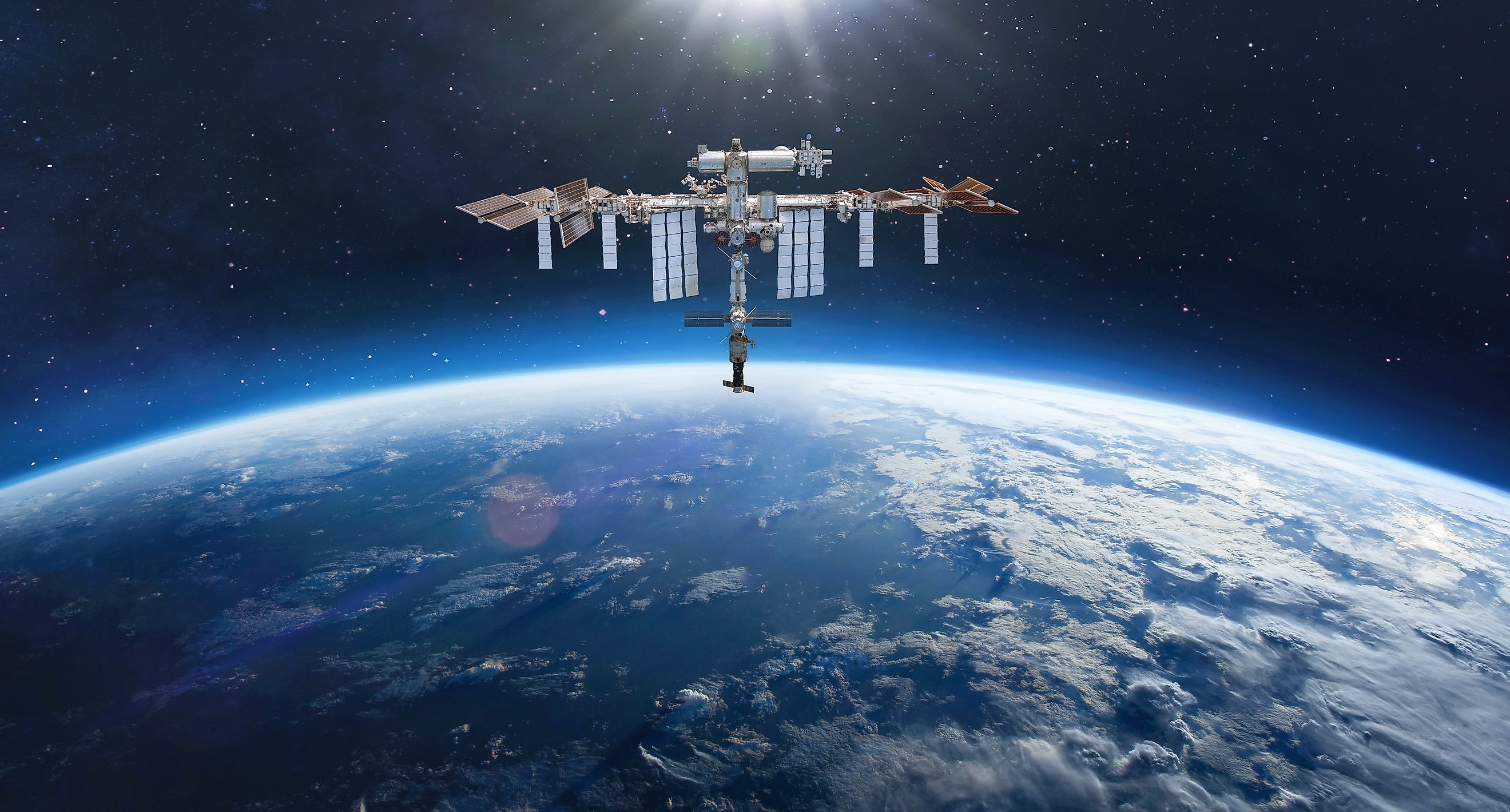
In the year 2030, or early 2031, the International Space Station (ISS), the length of an entire American football field, will be pushed out of its orbit towards Earth and allowed to burn up when it hits the atmosphere. Whatever pieces of it are left after that will drop into the Pacific Ocean and sink to the ocean floor.
For millions of people who follow the advances of space exploration, not to mention the scientists and engineers who helped develop and build the ISS, this will be a bittersweet moment. The aging station will have reached the viable extent of its service. What to do with the ISS once it has retired has been extensively researched and planned by NASA and its international partners. Ultimately, dropping it into the Pacific has been deemed the best viable option.
The Concept Of Space Stations

The ISS was not the first space station to be launched into Earth’s orbit, but it is the longest lasting at 26 years, as of November 2026. The construction of the ISS was borne out of the rivalry that took place between the US and the Soviet Union during the Cold War. The concept of a space station, controlled by a single superpower, grabbed hold of the imaginations of both countries. It would mean military superiority and advanced scientific study of outer space that had been unattainable to that point in time.
In 1971, the Soviet Union launched the first-ever space station, Salyut 1. They continued to build and launch stations. In 1973, the US launched Skylab, their very first space station. It was actively used for just one year and then left in orbit. In 1979 if fell back to Earth, scattering debris across parts of Australia. The Soviet Union then launched Mir in 1986. In 2001, the aging craft was deorbited after 15 years in service and dropped into the Pacific Ocean, much as the ISS will be.
Mir was the true inspiration for the ISS project in two important ways. One, Mir was constructed in space in modules over a 10-year period. And secondly, the US Space Shuttle docked on to Mir nine times, planting the seed for the idea of an internationally used station.
History Of The International Space Station

Ronald Reagan announced plans to build a space station in 1984. It was initially going to be called Space Station Freedom, and a few partner countries were invited to be a part of the project, including Canada, Japan, and European countries operating under the auspices of the European Space Agency (ESA).
The project was immediately beset with problems due to its extreme costs. However, in 1991, when the Soviet Union collapsed and the Cold War ended, efforts were begun to find ways for the US and newly formed Russia to work together. In 1993, President Bill Clinton formally included Russia into the project.
Similarly to Mir, the plans for the ISS was to build it in space, a piece at a time. In 1998 the first module was launched from Kazakhstan. Three weeks later, the US used the Space Shuttle Endeavour to bring the second piece into space, where astronauts connected it to the first module.
On November 2nd, 2000 two Russian cosmonauts and one American astronaut, William Shepard, arrived at the station in a Russian Soyuz craft. Since that time the ISS has been continuously occupied by two to seven astronauts at a time. Starting in 2001, numerous “space tourists” have also entered the station and stayed for several days.
Upon completion, the ISS become a conglomerate of 43 different modules and elements, including its signature solar paneled “wings.” The last piece was installed in 2023. When it was done, it was about 356 feet long, slightly less than an American football field, and 356 feet wide, including its solar array. It contains six sleeping quarters, two bathrooms, a gym, and a 360-degree bay window. It travels at a dizzying speed of five miles per second. In a single day, it will orbit the Earth 16 times and can be viewed by the naked eye from below.
Numerous firsts have occurred on the ISS: the longest time a human has spent in space at 371 days, the longest cumulative days an astronaut has been in space, 675, and hundreds of scientific experiments. One of the more interesting of these was the comparison between identical twins. Astronaut Scott Kelly spent 340 days in space while his twin, Mark, stayed on the ground in order to research how human bodies changed as a result of being in space.
The Decision To Drop It Into The Ocean

When the space station is completely decommissioned in 2030, it will have been in service for 30 years. During its time in space, it has been exposed to extreme temperature changes and constantly bombarded with tiny pieces of space debris. As with any large structure, electrical systems, life-support systems, and plumbing have been in constant need of maintenance. Over time, as critical parts become older and older, it is harder and more expensive to repair. More importantly, ensuring its safety for human habitation will become a concern.
Once the station’s mission is completely ended and the small amounts of propulsion that keep it in space have also stopped, it would begin to descend to Earth if it were simply abandoned. Since no one would know for certain where it might break apart once it hits the atmosphere, an uncontrolled reentry would mean it could drop dangerous debris across unanticipated parts of Earth.
Since simply abandoning it would not be a good idea, other solutions for ending the useful life of the station have been explored by NASA. One would be to send it into a higher orbit, as a sort of space memorial, leaving it to add to the already large amounts of space debris circling Earth. That plan would also burn up tremendous amounts of fuel. Another idea would be to take it apart in space a piece at a time. This would be prohibitively expensive as well, because it was not designed to be taken apart or resued. A third option would be to sell it to a private company. It’s age and the fact that it is owned by numerous countries make this an option that is complex and ultimately not viable.
How The ISS Will Be Brought Down

NASA has hired Space X to build a new rocket that will be called the U.S. Deorbit Vehicle. No ship currently in existence has the ability to push the massive structure into a controlled descent. In 2030 or early 2031, the deorbit vehicle will dock on to the ISS. The astronauts living in it at that time will facilitate this docking and at some point after that will return to Earth in another craft. The deorbit vehicle will fire its engines and the controlled descent will begin.
It is expected that as it enters the Earth’s atmosphere much of it will burn up. However, large pieces may survive. Whatever remains will drop into a remote part of the South Pacific, where other spacecrafts have also disposed of. This “graveyard” is known as Point Nemo.
Environmental Consequences Of Sending It Into The Sea

NASA has concluded that the disposal of the ISS into the ocean will not cause long-term negative environmental issues. However, other scientists disagree with this assessment. Some scientists and environmental protection groups are concerned about the impact on ocean life. This is not the only spacecraft that has been dumped in this spot in the Pacific Ocean and there will likely be more. Some argue that the effect of different metals and chemicals will harm the ocean’s ecosystem over time. They also contend that no long-term research studies have been conducted to better understand this potential impact.
Will There Be Another Space Station?

NASA currently has several projects that are either in the planning stages or are already under construction. Some of these are joint projects with private commercial organizations.
One that already exists is the Axiom. It has been used to attach modules to the ISS and will detach to become a separate lab on its own. One exciting project is the Lunar Gateway, a small space station which NASA, along with several partners, intends to orbit around the Moon to support future Artemis voyages. Independent projects by private companies, without partnering with NASA, are also in the works, including a joint project between Blue Origin and Sierra Space to do research for potential commercial future uses.
The End Of An Era
Even scientists in the early stages of the space program at NASA could not have envisioned a craft like the International Space Station actually launching into space, or the collaborative effort of its inception. In the decades since its launch, it has made countless contributions to science. When the ISS is brought back to Earth, millions of people will watch it happen in the moment. As a landmark human achievement, its legacy will live on in future space research and innovation.