The Closest Asteroid Flybys Ever Recorded
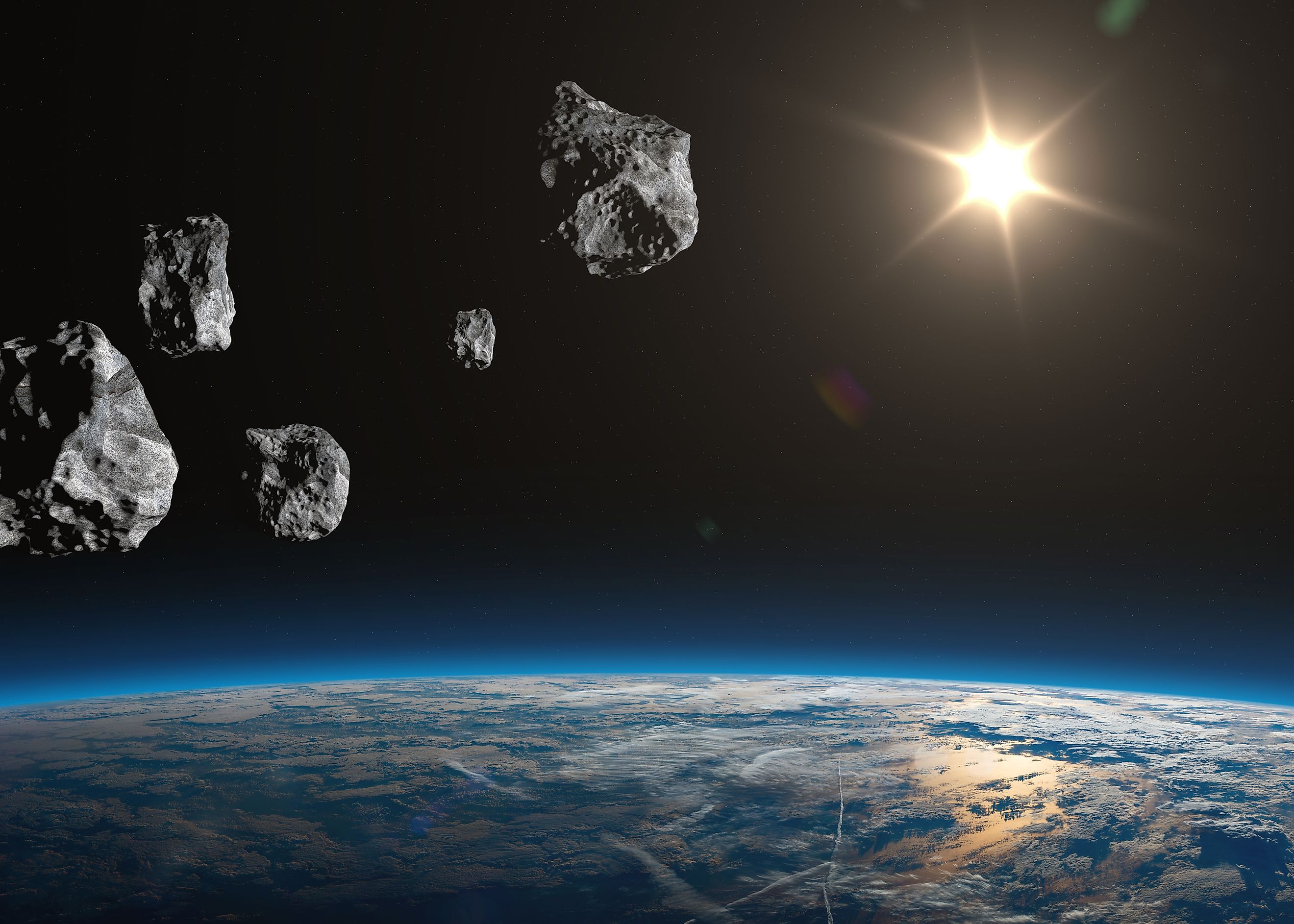
In 1957, an asteroid roughly 800 to 1,850 feet (250 to 566 meters) across passed about 47,000 miles (75,000 kilometers) from Earth's center. Traveling at 44,700 miles per hour (72,000 kilometers per hour), the space rock came within one-fifth of the distance to the Moon. Nobody noticed. Astronomers didn't realize the asteroid had made the close call until 2019, more than six decades later. Had this asteroid struck Earth, it would have caused regional destruction. The truly chilling part is that it wasn't alone. Several other potentially hazardous asteroids (PHA) have passed closer to Earth than the Moon, with some encounters only reconstructed years after the objects had disappeared into deep space. These eight PHAs are the ones that have come closest to striking Earth, at least the ones we know about.
2019 CD2: The Closest Call Of All

This asteroid, known as 2019 CD2, came the closest of them all. On February 1, 1957, it passed 46,791 miles (75,303 kilometers) from Earth's center while traveling at around 44,000 miles per hour (71,000 kilometers per hour). With an estimated diameter of 820 to 1,857 feet (250 to 566 meters), 2019 CD2 is about as big as the US Capitol Building. An object of this size and speed would have released thousands of megatons of energy had it hit our planet, potentially devastating an entire region. Instead, it passed unnoticed, and researchers reconstructed its 1957 trajectory in February 2019, when modern near-Earth-object surveys identified it. It does not appear on NASA JPL's Sentry impact-monitoring list, meaning no potential impacts have been identified over the next century.
2017 VW13: Discovered 16 Years Too Late

Another large asteroid passed between Earth and the Moon on November 8, 2001, and once again, nobody knew it was there. Designated 2017 VW13, this asteroid was discovered by astronomers in November 2017, 16 years after its close approach. Measuring an estimated 630 to 1,410 feet (194 to 430 meters) across, it followed a nominal trajectory that placed it 74,665 miles (120,162 kilometers) from Earth's center, less than half the distance to the Moon.
Scientists say there is an important uncertainty surrounding this flyby. The asteroid's orbit was calculated using a relatively short observation period, leaving considerable uncertainty about its precise trajectory. The best-fit calculation gives the distance above, but the asteroid could have passed anywhere from about 73,400 miles (118,000 kilometers) to 748,000 miles (1.2 million kilometers) away. Nevertheless, its calculated trajectory illustrates how an object capable of causing major damage can slip through Earth's neighborhood undetected for years.
1998 KJ9: A New Year's Eve Visitor

It would have been a party crasher for the ages. On December 31, 1914, this massive slab of space rock passed 144,454 miles (232,475 kilometers) from Earth's center, just more than halfway to the Moon, and, like 2019 CD2 and 2017 VW13, it went unnoticed. With an estimated diameter of 1,142 to 2,559 feet (348 to 780 meters), the impact would have had severe consequences for the region it struck. Its flyby occurred long before modern automated asteroid-surveillance programs existed, and astronomers did not discover 1998 KJ9 until 1998, more than eight decades later. Even today, with improved telescopes and detection systems, finding dark objects drifting in space against the Sun's brightness remains a challenge.
2002 JE9: A Quiet Threat

On April 11, 1971, 2002 JE9 passed 163,791 miles (263,597 kilometers) from Earth's center. Although its closest approach was farther than that of the preceding asteroids on this list, its size makes the encounter noteworthy. Its estimated diameter of 505 to 1,122 feet (154 to 342 meters) places it above the PHA size threshold, and an impact would cause widespread destruction. A space rock this size traveling at tens of thousands of miles an hour is not a meteor that might produce a spectacular streak of light across the sky. It can survive atmospheric entry and release a vast amount of energy if it strikes Earth at about 11 miles per second (nearly 18 kilometers per second). This asteroid, like the others, wasn't detected until well after it passed. Scientists reconstructed its 1971 passing after its discovery in 2002, more than 30 years later.
2025 ME90: Two Decades In The Dark

The newest addition to this list shows that the catalog of close calls is still growing. Asteroid 2025 ME90 slipped past Earth on June 30, 2004, passing 170,769 miles (274,826 kilometers) from Earth's center, well inside the Moon's orbit. It was not designated until 2025, more than two decades later. Archival observations reaching back to 2011 have since helped pin down its path, and its 590-day orbit marks it as an Apollo-class asteroid that crosses Earth's orbit. Its estimated diameter of 548 to 1,225 feet (167 to 373 meters) is typical for this list, but its speed sets it apart. At closest approach, it was moving about 18 miles per second relative to Earth, faster than any other asteroid on this list, so an impact would carry more energy than its size alone suggests.
2012 TY52: A Close Encounter From 1982

On November 4, 1982, 2012 TY52 passed 195,414 miles (314,484 kilometers) from Earth's center, at about the same distance as the Moon. With an estimated diameter of 453 to 1,030 feet (138 to 314 meters), this asteroid is comparable in size to a professional football stadium, and it completes a trip around the Sun every 784 days. An Apollo-class near-Earth asteroid, it is classified as a PHA but poses no threat to Earth. Traveling at 11 miles per second, should it strike Earth, it would be the equivalent of unleashing 1,450 megatons of TNT, about 29 times more powerful than the largest nuclear weapon ever detonated, easily wiping out a major metropolitan city but not causing a global mass extinction. Its 1982 pass went unrecorded, and astronomers reconstructed it only after the asteroid was discovered in 2012, 30 years later.
2005 YU55: The One Astronomers Saw Coming

Unlike most of the asteroids on this list, 2005 YU55 did not sneak past. The Spacewatch survey discovered it from Kitt Peak, Arizona, in December 2005, almost six years before it passed 201,903 miles (324,931 kilometers) from Earth's center on November 8, 2011. Astronomers were ready when it arrived. NASA's Goldstone radar antenna in California began tracking it days before the flyby and produced what were then the highest-resolution radar images ever made of a near-Earth object. They revealed a roughly spherical, dark, carbon-rich body, estimated at 1,180 to 1,310 feet (360 to 400 meters) across, with ridges, hollows, and boulders on its surface. The Arecibo Observatory in Puerto Rico joined the effort, and the radar measurements pinned down the asteroid's path for decades to come.
2002 CU11: Too Close For Comfort

The final entry on this list, 2002 CU11, is also the largest, measuring about 1,510 feet (460 meters) across. On August 30, 1925, it passed 215,950 miles (347,537 kilometers) from Earth's center, though astronomers did not discover it until February 2002. The asteroid is historically notable as the first to receive a positive rating on the Torino Impact Hazard Scale, a system designed to communicate asteroid impact risks to the public. Following its discovery, calculations suggested it had a one-in-9,300 chance of striking Earth in 2049, though additional information has since reduced the threat to zero, at least for now. Its 492-day orbit brings it back toward Earth every few years, including a safe flyby in 2014. At its size, an impact would cause regional devastation, while NASA and the National Academies reserve global effects for kilometer-scale asteroids.
City-killers That Don't Make The List

Not every asteroid capable of causing serious damage to Earth qualifies as potentially hazardous. The official classification has a size threshold of 450 feet (140 meters), but smaller objects, often called city-killers, can still destroy an area the size of a large metropolitan region. Asteroid 2019 OK is a striking example. Measuring about 200-425 feet (60-130 meters) across, it passed within 40,000 miles (65,000 kilometers) of Earth's surface on July 25, 2019 (UTC), and astronomers discovered it only a day before its closest approach.
The 1908 Tunguska event in Siberia shows what an object of that size can do. An asteroid estimated at 130-200 feet (40-60 meters) across exploded above the forest, flattening trees across more than 770 square miles (2,000 square kilometers). Had the explosion occurred above a city, the consequences would have been horrific. These examples show why astronomers monitor smaller near-Earth objects alongside the big ones, since an asteroid need not threaten the entire planet to cause destruction on a vast scale.
Three Enormous Asteroids That Will Pass Earth Soon

The above historical encounters are cautionary tales of what could happen in the future. Several large asteroids are scheduled to pass Earth over the next few years. Astronomers already know their orbits, and none of these poses any threat to Earth. The first to arrive is 1999 AN10, on August 7, 2027. Estimated to measure between 1,960-4,500 feet (600-1,400 meters) across, AN10 will pass about 242,000 miles (390,000 kilometers) from Earth's center, about the same distance as the Moon. Astronomers know it's coming, and it will provide an excellent opportunity to study a large near-Earth asteroid. Next comes 2001 WN5, on June 26, 2028. Almost 3,300 feet (1,000 meters) across, this asteroid will pass about 155,000 miles (250,000 kilometers) from Earth's center. Astronomers expect it to become bright enough to observe with relatively modest telescopes, providing another opportunity for radar observations.

The most anticipated flyby will come on April 13, 2029, from Apophis, which measures about 1,110 feet (340 meters) across. Apophis is expected to pass about 19,600 miles (31,600 kilometers) above Earth's surface, inside the ring of geostationary satellites, which orbit about 22,200 miles (35,800 kilometers) above the planet. For a short time, Apophis will be visible with the naked eye from parts of Europe, Africa, and Asia, appearing in the sky as a point of light moving faster than a satellite but not as fast as a shooting star. Scientists expect Earth's gravitational pull to alter Apophis's orbit and may affect its rotation and physical structure, making it difficult to predict its future path.
Keeping Our Eyes To The Sky
Earth's cosmic neighborhood can be busy. Fast-moving, large objects have routinely passed within the Moon's orbit without astronomers discovering them until years or decades later. Even with modern technology, large asteroids still slip past nearby undetected. Fortunately, scientists are getting better at finding these space travelers. Ground-based surveys, telescopes, and radar observations help scientists identify asteroids, calculate their trajectories, and determine whether they pose a threat. NASA's planetary defense program also investigates technologies that could one day alter the trajectory of a threatening asteroid. The challenge is finding these visitors early enough. Earth has had some remarkably close calls. The next generation of asteroid hunters will be watching the skies with advanced technology to make sure the next visitor rolling in from the cosmos doesn't catch us by surprise.