How Far The Human Eye Can See Into Space
Walk outside tonight, find a dark enough patch of ground, and look toward Cassiopeia. A faint oval smudge sits below it. That is the Andromeda Galaxy, and the light landing on your retina left it about 2.5 million years ago, long before anything recognisably human existed to look back.
No equipment, no training. The unaided eye reaches 2.5 million light-years as a matter of routine. Once, for roughly thirty seconds in 2008, it reached 7.5 billion.
The Standing Answer Is Andromeda
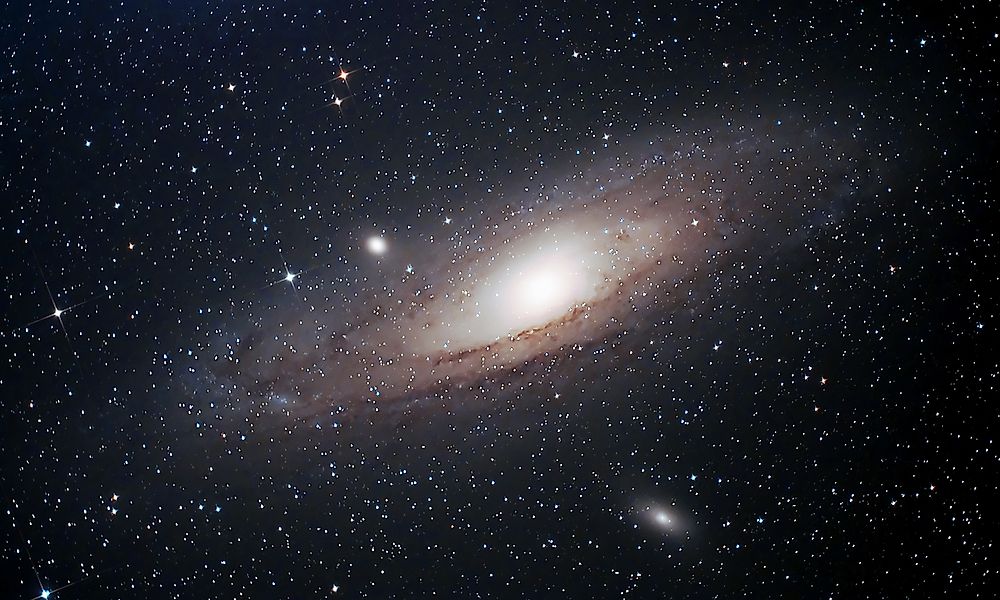
Catalogued as M31, Andromeda is the nearest large spiral galaxy to ours and shines at magnitude 3.1 to 3.4, which puts it comfortably inside naked-eye range under a dark sky. It is also enormous in angular terms, spanning roughly three degrees, about six full moons laid side by side.
Most people never notice this because the outer regions are far too faint to register. What you actually see is the bright core, a grey smudge that disappears if you look straight at it and reappears when you glance slightly away, a trick called averted vision that works because the edges of your retina are more light-sensitive than the centre.
A handful of observers claim further. M33 in Triangulum sits at about 2.9 million light-years and held the naked-eye record before 2008. Reports of M81 at roughly 12 million and M83 at about 15 million exist, but both require exceptional skies, exceptional eyes, and a degree of faith in the observer.
Brightness Decides This, Not Distance

Your eye does not measure distance. It measures how many photons arrive, and that is the whole explanation for everything odd about this question.
Astronomers use apparent magnitude, a scale where lower numbers mean brighter objects and each step of one is a factor of about 2.5 in brightness. Under genuinely dark skies, a person with normal vision reaches magnitude 6 or a little past it. Roughly 9,000 stars across the entire sky clear that bar, against well over a million that do not.
This is why Proxima Centauri, the nearest star to the Sun at 4.2 light-years, is invisible without a telescope while stars thousands of times further away are obvious. Proxima is a dim red dwarf. Everything you can see unaided is substantially more luminous than the Sun.
The Thirty Seconds That Broke The Record

At 06:12 UTC on 19 March 2008, NASA's Swift satellite registered a gamma-ray burst in Boötes. It was the second detected that day, so it was designated GRB 080319B, and it turned out to be the most intrinsically luminous object ever recorded by anyone.
The optical afterglow peaked at magnitude 5.8 and stayed within naked-eye range for about thirty seconds. The source was roughly 7.5 billion light-years away, which Guinness World Records recognises as the furthest object ever visible to the unaided human eye.
A necessary caveat: nobody is known to have actually been looking at that patch of sky during the window. Robotic telescopes caught it. The record is that it was bright enough to see, not that anyone saw it.
The scale of the thing is difficult to hold onto. That afterglow was around 2.5 million times more luminous than the brightest supernova ever recorded. The light left its galaxy before the Sun and the Earth existed.
One Point Of Care With The Numbers
Saying an object is 7.5 billion light-years away is shorthand for how long its light travelled, not for how far away it sits now. The universe expanded during the journey, so the galaxy that produced that burst is considerably further off today than the number suggests.
For Andromeda the distinction barely matters, since 2.5 million years is nothing on a cosmic timescale. For anything at billions of light-years it matters a great deal, and lookback time and present distance are genuinely different quantities.
What your eye actually receives is old light. The Sun is eight minutes and twenty seconds in the past. Andromeda is 2.5 million years in the past. Nothing you see in the night sky is current.
Nobody Agrees On The Furthest Star
Galaxies are easy by comparison, because they are the combined output of hundreds of billions of stars. Individual stars are a much tighter constraint, and the record is disputed.
V762 Cassiopeiae gets cited constantly at 16,000 light-years, but revised parallax measurements suggest it may sit closer to 2,500, which would remove it from the running entirely. The better-supported candidate is Rho Cassiopeiae, a rare yellow hypergiant around 8,000 light-years out and some 300,000 times more luminous than the Sun.
Either way, the overwhelming majority of stars you can pick out are within a few thousand light-years, which is a small corner of a galaxy about 100,000 light-years across. The galactic centre itself, 26,000 light-years away, is hidden behind dust.
Most People Cannot Do Any Of This Anymore

Every figure above assumes a genuinely dark sky, and that assumption is getting harder to meet. Analysis of more than a decade of citizen-science observations published in Science found night-sky brightness increasing by close to 10 percent a year, which compounds fast.
In practice that means a child born in a place with 250 visible stars could be left with around 100 by adulthood. From a well-lit suburb the naked-eye limit drops to magnitude 4 or so, and Andromeda vanishes long before that. From a city centre you may see a few dozen of the brightest stars and nothing else.
The eye has not changed. A dark-adapted retina can register a single photon under laboratory conditions, which is close to the physical floor. What has changed is the background it has to compete against.
How To Actually See It

Get away from town, wait at least twenty minutes for your eyes to dark-adapt, and avoid looking at a phone, which undoes the adaptation in a second. Autumn evenings in the Northern Hemisphere put Andromeda high overhead, and a moonless night matters more than a cloudless one.
Find Cassiopeia's W, use it as a pointer, and then look slightly to the side of where you expect the galaxy to be. Averted vision is the whole technique, and it is the difference between seeing nothing and seeing another galaxy.
It will look like a faint grey smudge. That smudge is a trillion stars, and the light carrying it has been in transit since before our species existed. There is nothing else you can do with your eyes alone that comes close.