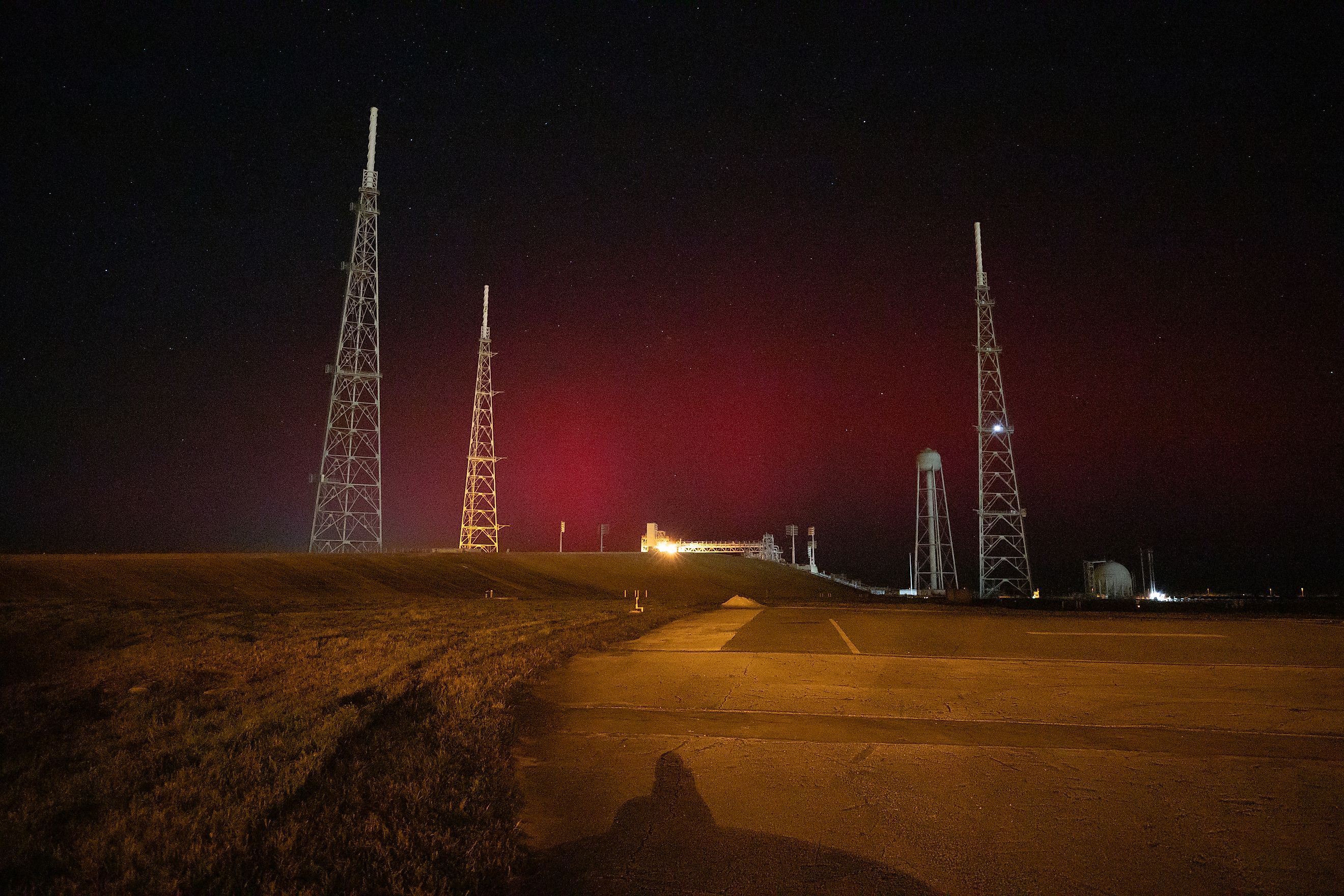
Why The Aurora Reached Florida
Six hundred miles is how far north the northern lights can be burning and still show in the sky overhead. That distance is the whole answer to what Florida saw on November 11, 2025. People across the state photographed a red glow above the northern horizon that night. The aurora never reached them, and Florida watched the top of it clear the curve of the Earth from far to the north. The gap explains the red color, the low glow, and the cameras that caught what eyes could not.
Two Nights Florida Looked North

Three days of solar eruptions in May 2024 ended with the largest geomagnetic storm in over 20 years. The Sun threw off a string of coronal mass ejections, or CMEs. The National Oceanic and Atmospheric Administration (NOAA) describes a single one as about a billion tons of plasma traveling at a million miles per hour. G5 conditions arrived at 6:54 pm Eastern on May 10. G5 caps the five-step storm scale.
Eighteen months later the sky went strange again. An X5.1 solar flare erupted on the morning of November 11, 2025. The cloud it launched reached Earth suddenly at 7:10 pm Eastern, and severe G4 conditions followed at 8:20 pm. Florida photographers posted red horizons that night, and NASA ran one frame as its Astronomy Picture of the Day. The frame came from Shired Island, with a Northern Taurid meteor slicing across the glow. The Taurids arrive every year at that season. The aurora did not.
Where The Auroral Oval Stops

One number in NOAA's viewing guidance undercuts the popular version of these nights. The auroral oval is the ring of light centered on the magnetic pole, and its edge sits near 66 degrees when the planetary K index, or Kp, reads zero. Every step up the scale drags that edge about 2 degrees toward the equator. At Kp 9, the ceiling of the scale and the trigger for a G5 rating, the edge reaches 48 degrees. It goes no further.
Two things about the number matter more than the number itself. The scale runs in geomagnetic latitude rather than geographic latitude, so it does not map onto a school atlas. And 48 degrees is a long way from the Florida peninsula. The oval at its most swollen reaches the northern half of the country. On a Kp 8 or 9 night, by its reckoning, people in the northern states may find the lights directly overhead. Everyone farther south is watching something happen somewhere else.
Seeing A Light You Are Not Standing Under

Height rescues the view. An aurora is not a searchlight on the ground. The curtain burns between roughly 60 and 250 miles up, and something that tall stays visible long after the ground beneath it drops out of sight. The working figure NOAA gives is 600 miles. From a dark spot with a clear view north, a person can watch an aurora burning 600 miles further north.
The agency states the consequence plainly, in a caption printed beneath its viewing maps. Those maps do not show where the aurora is. They show the point from which it may be seen, and aurora is often visible hundreds of miles equatorward of where it burns. Read that way, the puzzle dissolves. Satellite imagery from the November 2025 storm shows precisely this, because NOAA's Joint Polar Satellite System tracked the display overnight with a day-night sensor. The band of light lay near the United States border with Canada, then pushed south only as far as the northern high plains. Florida photographed it anyway, seen end-on across a curved planet, the way a coastal town watches a thunderhead far out to sea.
The storm scale reads the same way. Its G5 row notes aurora seen as low as Florida and southern Texas, typically near 40 degrees geomagnetic latitude. The oval's own edge at that storm level stops around 48, and the gap between those two figures is roughly that same 600 miles.
Why The Glow Was Red And Low

Color follows altitude. Green comes from oxygen struck low in the curtain, and it fails below about 59 miles up. Down there the air is dense enough that collisions steal the energy before the atom can release it as light. An excited oxygen atom sheds green light in about 0.7 seconds. Red takes 100, so it survives only where the air is thin enough to leave the atom alone. That puts deep red around 120 to 180 miles up.
An observer beyond the oval sees only the upper reaches of the curtain. The low green never clears the horizon. The National Park Service writes from Alaska, where the lights pass overhead. Its account puts the matter without hedging: aurora is visible at mid-latitudes during the largest magnetic storms, and red dominates it. That same account names the 2003 storms, when red aurora appeared over Florida, the Mediterranean, and the rest of the country. Red also erases structure. Those long-lived oxygen atoms drift on the wind before they radiate, so curtains and rays smear into a diffuse wash. A wash is what Floridians described.
The Camera Saw More Than The Eye Did

Human night vision explains the rest, and NOAA is blunt about it. People often report that an aurora looked pale white. The agency says outright that this is wrong. The eye registers brightness before color, so a faint display reads as a colorless smudge until it brightens enough for the retina to resolve a hue. Only a fairly bright aurora lets the eye pull out true green or red.
Digital sensors carry no such limit. Modern cameras are frequently more sensitive than the eye, NOAA notes, and they record the display and its colors on nights when a viewer finds nothing. A full moon dims the apparent brightness of a display without touching its real brightness, which makes a marginal night worse. NASA's caption on the Shired Island frame credits the camera exposure with catching the glow, a phenomenon it notes is usually seen from far higher latitudes. The photograph exists. What a person standing on that beach saw was fainter.
The Forecast Cannot Find The Edge

Warning time is the hard part of this science, and it is why the southern limit keeps surprising people. Forecasters read the solar wind from satellites parked at the first Lagrange point (L1), a gravitational balance about 1 million miles sunward of Earth. Readings there give an accurate picture of the aurora 15 to 45 minutes later. Those minutes are the whole reliable window.
Anything longer is inference. Coronagraphs are instruments that mask the Sun's disk to photograph what surrounds it, and they can watch a CME leave days ahead. They cannot measure the magnetic field wrapped inside it, and that field decides how hard the cloud hits. Forecasters said as much on the night itself, calling the situation difficult and noting that the storm's real strength would stay unknown until the cloud reached the L1 satellites. A G4 event, by that same scale, has put the lights within reach of watchers in Alabama and northern California, around 45 degrees on the magnetic grid. In November 2025 the glow ran several hundred miles past that, and the record from that night shows how fast the picture moved. A US Geological Survey summary timed at 10:00 pm Eastern put press reports of the aurora as far south as Utah and Pennsylvania. By the following morning NOAA was logging sightings from Florida.
Florida Had Seen This Before

Fear was the reaction in 1859, by NOAA's own telling, when red and green curtains rose over Florida on a humid August night. Residents wondered whether the swamp had caught fire. Almost nobody in the state had ever seen an aurora.
Days later, on September 1, the English astronomer Richard C. Carrington watched a white flash erupt from a sunspot group at about 11:00 am. Seventeen hours after that, the sky across North America lit up a second time and far brighter, with the glow reaching Panama. People read newspapers outdoors by it. Telegraph systems around the world took surges of current, and nobody could send a message. Gold miners in the Rocky Mountains rose at 1:00 am and cooked breakfast, certain that dawn had broken behind cloud. A storm that size arrives roughly every 500 years, and storms half as strong about every 50. By that math, what Florida saw in 2024 and 2025 was the ordinary kind.
What The Sun Has Left

Solar activity has passed its peak, and the US Geological Survey places the cycle in its early decline. The phrase is less reassuring than it sounds. The largest flares and the fastest CMEs often come as a cycle winds down. A G4 arrives about 100 times per solar cycle, and a G5 four times. The Survey expects several more G4 storms, and possibly another G5, within a year or two. Florida will keep photographing a light that burns over Canada.
.jpg)