Why JWST Keeps Finding Galaxies That Shouldn't Exist
If the 13.8-billion-year history of the universe were squeezed into one calendar year, the recently discovered galaxy MoM-z14 would appear around January 8. As one of the most powerful telescopes ever made, the James Webb Space Telescope sees it as it looked only 280 million years after the Big Bang. Its light then traveled for more than 13 billion years before reaching the telescope.
The thing is, based on what astronomers understood before JWST, galaxies like this shouldn't exist. They don't break the laws of physics. Rather, they violate the timelines built into many earlier models of galaxy formation. MoM-z14 appears too bright and possibly too chemically rich for a time when galaxies were expected to be small and faint. The stranger part? Galaxies like it seem to be far more common than researchers predicted. JWST keeps finding them, raising an important question: Why do these galaxies that shouldn't exist yet keep appearing?
What Does It Mean To Say These Galaxies "Shouldn't Exist?"

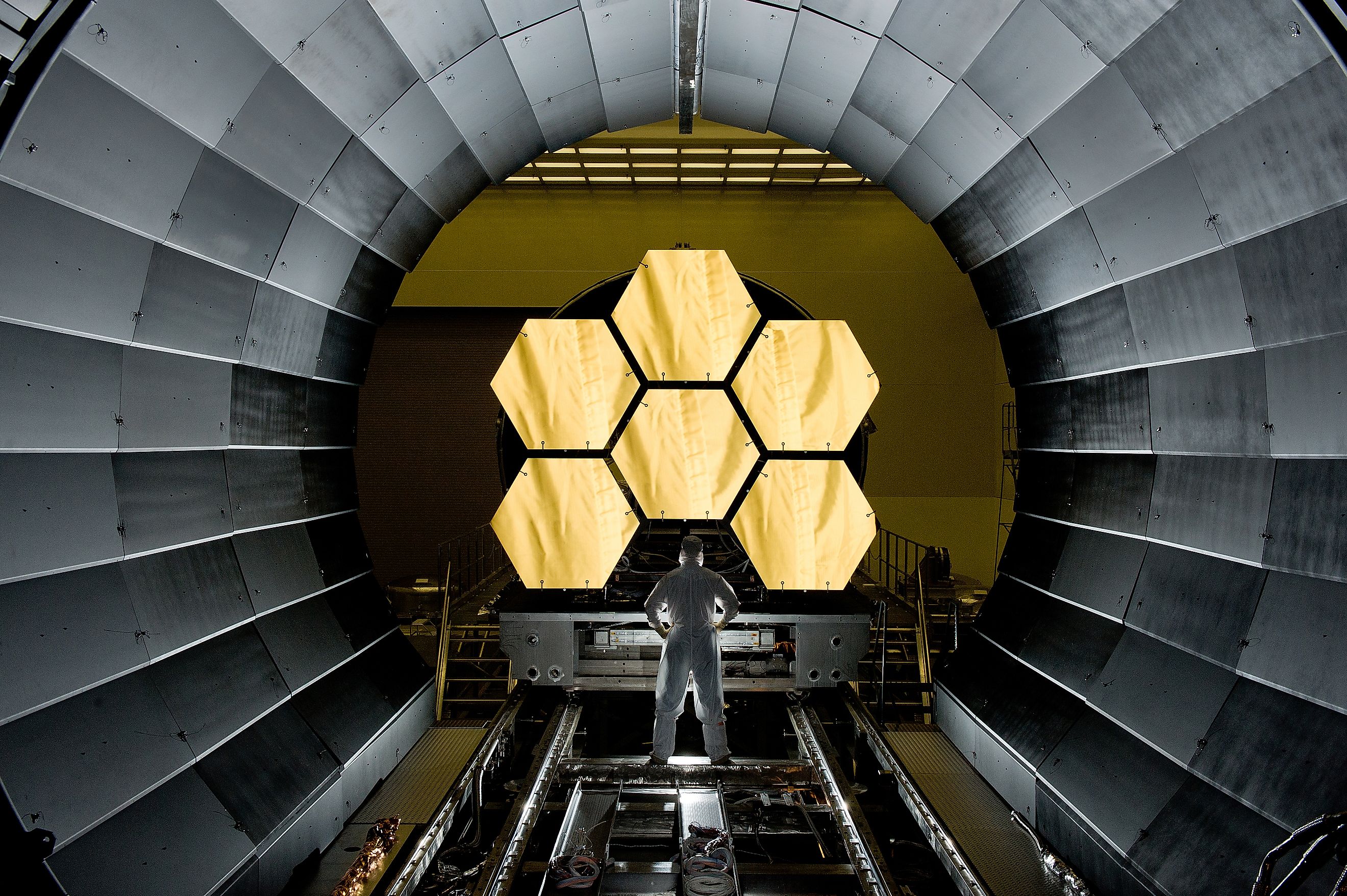
JWST was built to see infrared light, including the faint glow from the earliest galaxies. As the universe expands, ancient light is stretched into these longer wavelengths. This allows JWST to look farther into the past than earlier telescopes could. Before JWST, models showed the first galaxies growing in stages. Dark matter pulled gas together, the gas cooled, and the first stars began to shine. Small galaxies slowly joined or collected more material, becoming larger over hundreds of millions of years.
However, many galaxies found by JWST don't follow that timeline. Some shine far brighter than expected only 300 million years after the Big Bang. Others seem to contain more stars than models predicted could form so quickly. In the most extreme early interpretations, the galaxies would have needed to convert nearly all the ordinary matter available in their dark-matter halos into stars. That's what "shouldn't exist" means. The galaxies are physically possible, but the older models couldn't anticipate so many large, bright objects so early in cosmic history.
The First Shock Was Their Brightness

One of the first signs that something was wrong was simple: these galaxies were too easy to see. In 2024, researchers confirmed two galaxies that existed only a few hundred million years after the Big Bang. Both gave off far more light than models expected from such an early time. The brighter galaxy, JADES-GS-z14-0, has a half-light radius of about 850 light-years, meaning that half its ultraviolet light emerges from a region roughly 1,700 light-years across. If the 100,000-light-year-wide Milky Way stretched across a football field, the bright part of JADES-GS-z14-0 would cover a circle only about five feet wide. Yet JWST could still detect its light after it had traveled for more than 13 billion years.
Brightness doesn't always mean a galaxy is massive. A smaller galaxy can shine fiercely if it's forming many hot, young stars at once. A feeding black hole can also add light. However, observations suggest that stars produced most of the light in these two galaxies. The discovery showed that bright galaxies were already common 300 million years after the Big Bang. Researchers estimated that they appeared more than ten times as often as earlier observations had suggested.
Some Impossible Galaxies Were Hiding Black Holes

Some of the galaxies that first seemed impossible may have been wearing a disguise. JWST found many tiny red objects in the early universe that looked packed with stars. Researchers called them "little red dots." Their light suggested enormous stellar masses, even though the universe had barely had time to build them. Closer study showed that many may contain feeding black holes, although the nature of the population remains debated. Gas spinning around those black holes becomes extremely hot and can shine brighter than the galaxy itself.
Astronomers estimate a distant galaxy's mass partly from its light. If they assume the glow comes from stars, they may count far more stars than are really there. JWST can split that light into a spectrum, revealing signs of fast-moving gas near a black hole. For some objects, accounting for the black hole's contribution reduces the estimated stellar mass and eases the apparent conflict with cosmological models. It does not, however, eliminate the broader excess of bright early galaxies that JWST continues to find.
Early Galaxies May Have Held Onto Their Gas

New stars can make it harder for a galaxy to keep growing. They release intense heat, radiation, and powerful explosions that push nearby gas away. Without that gas, the galaxy cannot continue making stars. Many older models assumed this process would place a strong limit on how quickly the first galaxies could grow.
Some early galaxies may have been better at holding onto their fuel. Their gas was packed into small spaces, creating a strong pull that made it harder for stellar explosions to blow material out. Fresh gas from outside the galaxy may also have replaced what was lost. Instead of shutting down, star formation could continue at a rapid pace. This would help explain why JWST sees galaxies that are so bright at such an early age. The models may have overestimated how easily young galaxies lost their gas and underestimated how quickly they could replace it.
The Blueprint May Be Right, But The Building Went Faster

Think of the cosmological framework of the universe as a blueprint. It sets the size of the construction site, the materials available, and the amount of time the builders have. Early galaxy models then try to explain how those materials became stars. JWST hasn't proved that the blueprint is wrong. Instead, it has found buildings that seem to have gone up much faster than the construction schedule allowed.
The missing piece may be the speed of the work. Models assumed that heat and exploding stars would regularly blow gas out of small galaxies, slowing their growth. Some early galaxies may have held onto more gas and turned it into stars with greater speed. This would let them become bright and massive without breaking any physical limit. The universe may still contain the amount of matter scientists expected. JWST is showing that its first galaxies may have used that matter far more efficiently.
The Answer Is Hidden In The Light

A bright spot in a JWST image cannot reveal exactly what's creating the glow. Astronomers need to split that light into a spectrum, much like a glass prism turns sunlight into a rainbow. The pattern can show whether the light comes mainly from young stars, hot gas around a black hole, or clouds of gas between them. It can also confirm how far away the galaxy truly is.
Better spectra will help researchers measure the ages of the stars and the elements inside each galaxy. Those details can reveal whether a galaxy grew during one violent burst or formed stars over a longer period. MoM-z14, for example, shows tentative signs of unusually strong nitrogen enrichment relative to carbon, although better spectra are needed to confirm the result. Each new spectrum gives scientists another piece of the galaxy's history, allowing them to test which growth models can produce what JWST actually sees.
The Galaxies Exist, But The Explanation Doesn't Yet
Galaxies like MoM-z14 aren't breaking the laws of physics. They're showing how much scientists still have to learn about the universe's first few hundred million years. Galaxies may have pulled in gas faster, formed stars more efficiently, and grown in sudden bursts that older models didn't fully capture.
Each new discovery moves the limits again. The first galaxies weren't dim, slow-building collections of stars waiting for the universe to mature. Some were already blazing while the cosmos was still in its infancy. JWST has changed our understanding of the universe by showing that they exist. The harder task now is explaining how the young universe built them so quickly.