Why Is Space Black?
Look up on a clear night, and vast stretches of the sky read as pure black. The universe may hold up to a septillion stars. That is a one trailed by 24 zeros. Every one of them floods space with light in all directions. A sky that is crowded should glow everywhere you look. Astronomers have a name for that puzzle: Olbers’ paradox. And the answer reaches all the way back to the age and expansion of the universe itself.
The Night Sky and the Sky of Deep Space are Two Different Questions

It helps to separate two things that look similar but have different explanations. The first is why the sky above your backyard turns dark after sunset. The second is why space itself, photographed by spacecraft far from any planet, still reads as black behind the stars. The everyday answer is the simpler of the two. During the day, sunlight scatters off nitrogen and oxygen molecules in the atmosphere, and that scattered blue light floods the sky. It is the same reason the daytime sky is blue rather than clear. As Earth rotates your location away from the Sun, less direct sunlight illuminates the atmosphere overhead, leaving far less light to scatter across the sky.

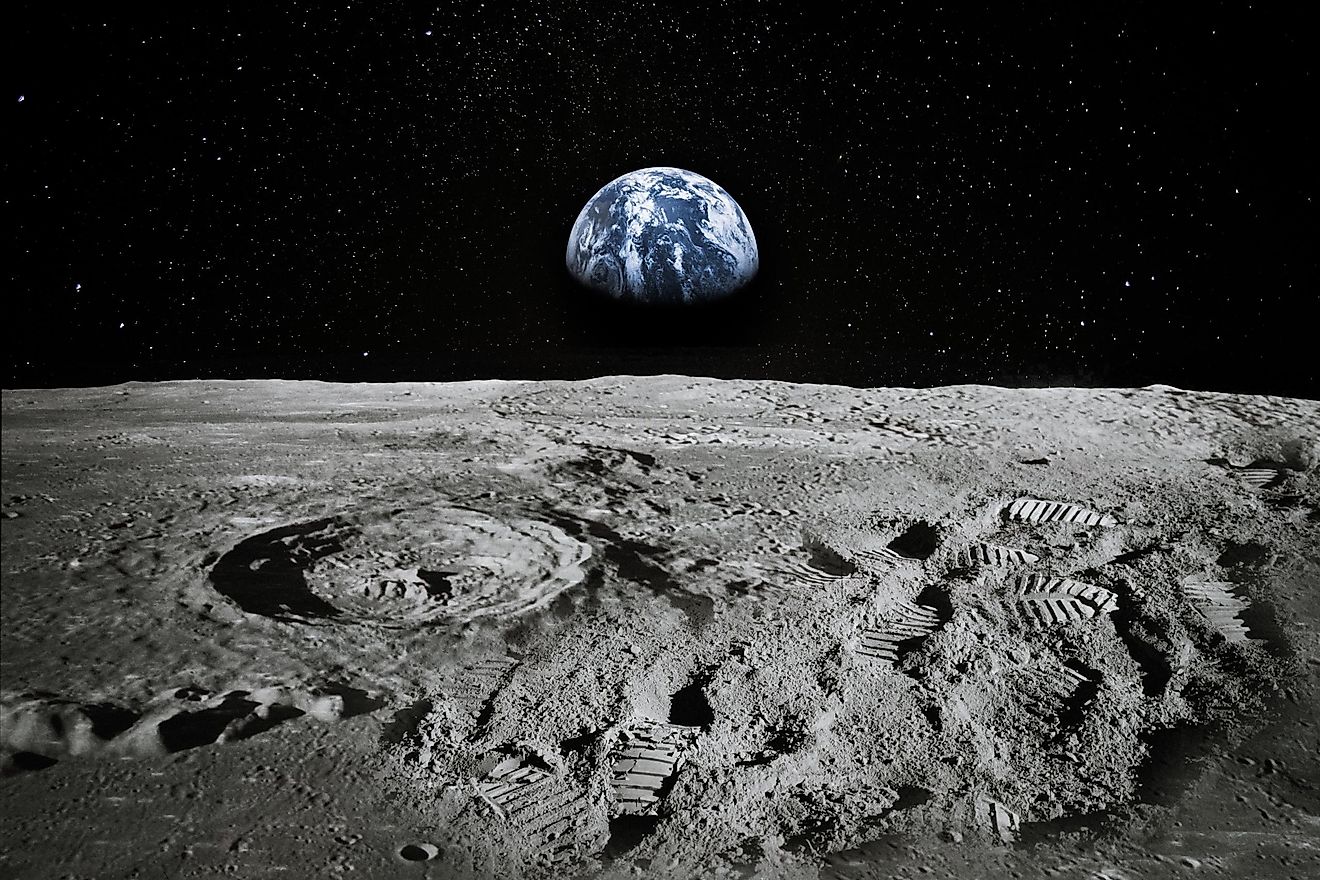
Deep space is a harder case. A camera aboard a spacecraft sits in a near-perfect vacuum, with no air to scatter light into a glow, so the background between bright objects records as black. Exposure settings tuned for a bright, nearby subject also drown out faint stars behind it. But neither of those explains the deeper mystery, because the universe genuinely is full of stars in every direction. If light travels forever and stars are everywhere, why is the space between them not ablaze?
Olbers' Paradox: Why an Infinite Sky is Not a Bright One

The problem is old enough to carry a name. It is often called Olbers' Paradox, after the German astronomer Heinrich Wilhelm Olbers, who wrote about it in 1823, though earlier thinkers had circled the same idea. The reasoning runs like this. Imagine the universe is infinitely large, unchanging, and evenly filled with stars. In that case, every possible line of sight, extended far enough, should eventually land on the surface of a star. The whole sky would blaze as bright as the Sun. The paradox is that it plainly does not. That contradiction tells us at least one of the starting assumptions is wrong, and untangling which one reshaped how astronomers understood the cosmos.
The resolution rests on two facts: the universe has a finite age and is expanding. Its finite age means some distant light has not had time to reach us, while expansion stretches other light into longer wavelengths. As a result, distant sources do not combine to make the entire sky bright.
A Finite Age Puts a Wall Around What We Can See

Light is fast but not instant. In a vacuum, it travels at about 186,282 miles per second, and the distance it covers in a year defines one light-year, roughly 5.88 trillion miles. Because that speed is fixed, every glimpse into space is also a glimpse into the past. Light from a galaxy a billion light-years away left it a billion years ago.
The universe is about 13.8 billion years old, and that finite age sets a hard limit on how far we can see. Light from regions beyond a certain distance simply has not had time to reach us yet. Expansion stretches that boundary outward, so the edge of the observable universe now lies about 46 billion light-years away, but it is still an edge. Everything past it is invisible, not because it is dark, but because its light is still in transit. An infinite, eternal sky would have starlight arriving from every direction. A 13.8-billion-year-old one does not, and the gaps between the stars are the parts of the sky whose light has not arrived.
Expansion Stretches the Missing Light Out of Sight

The second effect is the expansion of space itself. As the universe grows, distant galaxies recede from us, and the light already traveling toward Earth gets stretched along the way. Stretching light lengthens its wavelength and shifts it toward the red end of the spectrum, an effect astronomers call redshift. Push it far enough, and visible light slides into the infrared, past the range the human eye can register. So even some light that does reach us no longer arrives as anything we can see. The farther away a source sits, the stronger the redshift, until the most distant radiation has been stretched clean out of the visible band.
This is why the answer to the question has two parts working together. Space looks black because a near-vacuum has nothing to scatter light into a glow, and because the universe is young enough and expanding fast enough that distant starlight either has not arrived or has been redshifted beyond sight. The darkness is not empty. It is a record of cosmic age and motion.
Space is Only Black to Human Eyes

There is a final twist. Space is not truly dark at every wavelength, only at the ones our eyes evolved to catch. Point the right instrument at any patch of empty sky, and it fills with a faint, even hiss of microwave radiation reaching us from every direction. This is the cosmic microwave background, the cooled afterglow of the hot early universe, released when the cosmos first turned transparent about 380,000 years after the Big Bang. Once, it glowed at visible wavelengths. Billions of years of expansion have stretched it down to microwaves, invisible to us but detectable across the entire sky.
Stars are also far from the only things out there. Clouds of gas and dust, asteroids, rogue planets, and whole galaxies fill space, most of them too faint or too distant for the unaided eye. Whether any object registers depends on how much light it emits or reflects, how far away it is, what wavelength the light arrives at, what lies in the path, and how sensitive the instrument is. The night sky the eye sees is only the thinnest slice of what is actually there.
The Dark Sky as Evidence
The darkness between the stars turns out to be one of the most informative sights in nature. A truly infinite, ageless, unchanging universe would leave humans under a blazing sky in every direction. Instead, there is black, and that black is a direct consequence of a universe with a beginning and a universe that is growing. The same two facts that dim the sky, finite age and expansion, are cornerstones of the Big Bang model. In that sense, the answer to why space is black is also evidence for how the universe began.