Why Doesn't the Moon Fall?
The Moon is falling toward us on Earth this very moment. In fact, it has been doing so for billions of years without ever hitting the ground. The explanation lies in the physics of an orbit. Earth's gravity continually pulls the Moon inward while its motion carries it forward through space. Instead of crashing into Earth or fully escaping into space, the Moon keeps falling around our planet.
Why does the Moon fall toward Earth?

Earth's gravitational force continually causes the Moon to fall toward it. Since the Earth is unbelievably massive, its large mass exerts an ongoing gravitational pull on the Moon. While most objects would fall straight down and hit the surface, the Moon experiences that downward pull differently because it is also moving forward through space. Sir Isaac Newton explained this concept in his First Law of Motion, stating that an object in motion will continue in a straight line unless acted upon by an outside force. Earth's gravity continually pulls the Moon toward Earth and bends its path into an orbit. Without it, the Moon would move through space in a never-ending straight path. Instead, Earth's gravitational force continuously changes the direction of its motion, causing it to follow an orbital path around Earth.
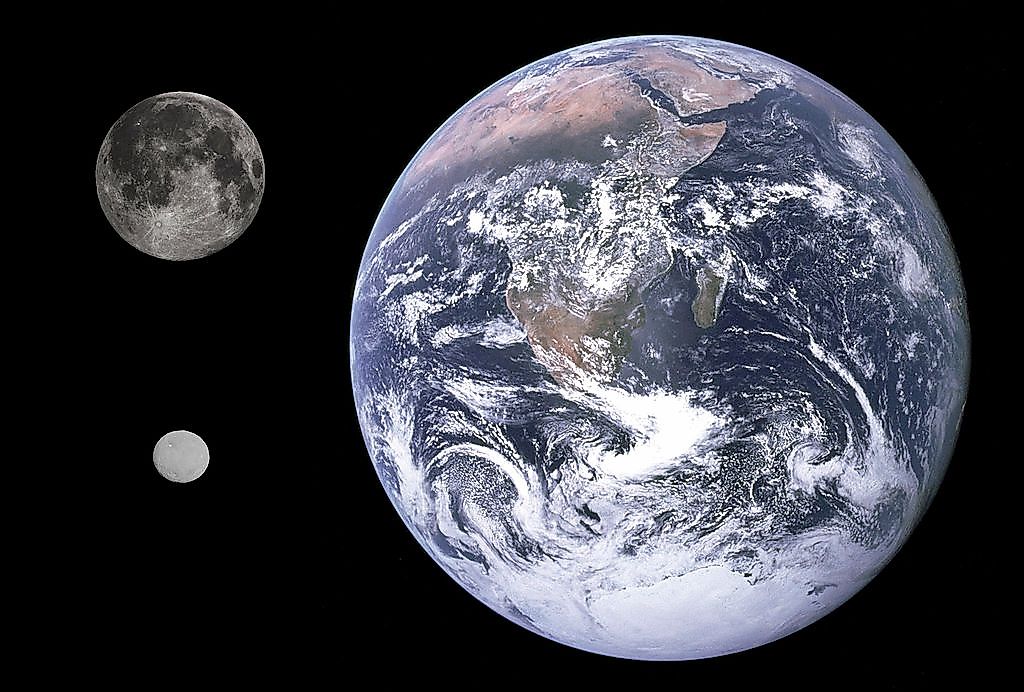
The Moon's tangential motion carries it forward while gravity continually accelerates it toward Earth, producing its curved orbital path. In other words, gravity continually changes the Moon's velocity, curving its trajectory around Earth. This is why the Moon does not need to be held in place by anything. Its motion and Earth's gravitational pull work together to create its unique cycle.
Why doesn't the Moon fall straight into Earth?

One of the main reasons the Moon does not fall onto Earth is because of its tangential velocity. Although gravity constantly pulls the Moon toward the Earth's center, its tangential velocity carries it forward, preventing it from falling directly into the Earth. The Moon moves sideways at an unbelievably fast speed of approximately 2,300 miles per hour. This fast-forward motion allows the Moon to orbit Earth while gravity continually pulls it inward. Newton explained this further with his Cannonball Analogy. He notes that if you fire a cannonball with too low a tangential velocity, it will be pulled down by gravity and crash into Earth. If you fire it at a medium velocity, it goes further, but still falls. But, if you fire it at a sufficiently high speed, it will continue falling toward Earth while its forward motion carries it around Earth. Because Earth's surface curves away beneath it, the cannonball can continue falling without crashing into Earth.
How can the Moon fall without hitting the Earth's surface?

The Moon falls without hitting the Earth's surface because it has enough tangential velocity to keep orbiting the planet. As the Moon falls toward Earth, it also moves forward. Because the Moon is moving sideways so incredibly fast, the Earth's surface continually curves away beneath its path. As a result, the Moon can keep falling toward Earth without reaching its surface. This phenomenon highlights a profound reality in the orbit of space. Despite its appearance, an orbit is not a state of stillness. It is actually a state of perpetual falling. If the Moon were ever to lose its forward orbital velocity, gravity would pull it straight down into Earth. Its continual movement results from the unique circumstances that allow it to remain in orbit around Earth.
Why doesn't the Moon lose its forward motion?

The Moon does not lose its forward motion because space is a near-perfect vacuum with very little friction to slow its motion. This lack of interference allows the Moon to maintain its forward motion, which connects to Newton's First Law of Motion, explained earlier. While gravity does pull the Moon, it does not stop it. As the Moon orbits Earth, gravity continually changes the direction of its motion, bending its path around Earth without rapidly slowing its forward motion. Newton's First Law demonstrates why the Moon does not need a constant source of energy to move forward. Inertia allows an object, like the Moon, that is already in motion to keep moving unless it is interrupted by an outside force. Gravity acts on the Moon, but its main effect is to change its direction rather than bring it to a sudden stop.
Falling Without Landing
The Moon has been orbiting the Earth for billions of years, yet its motion remains mysterious to many. Gravity, tangential velocity, Earth's curvature, and the lack of significant friction create the Moon's continuous orbit around the Earth. What appears to be an unmovable object in the night sky actually moves continuously through space while falling toward Earth. This remarkable orbit showcases how gravity, motion, and Earth's curvature work together to keep the Moon from falling onto Earth's surface.