Which Planet Has The Fewest Visitors From Earth?
Uranus and Neptune have each received exactly one spacecraft visitor from Earth, and remarkably, it was the same machine. Voyager 2 flew past Uranus in 1986 and Neptune in 1989 after traveling billions of miles through space. At Uranus, sunlight was about 400 times dimmer than on Earth; at Neptune, winds can scream past 1,200 miles per hour. A human descending into either world would find no solid ground to stand on, only an atmosphere that becomes increasingly dense, hot, and crushing with depth. Nearly four decades after Voyager 2 left Neptune behind, scientists still have enormous gaps in their understanding of both planets.
One Satellite, Two Worlds

Voyager 2 left Earth on August 20, 1977, carrying cameras, spectrometers, detectors, and other instruments intended to examine the outer Solar System. It first flew past Jupiter and Saturn before continuing into territory no spacecraft had ever explored at close range. The journey required patience on a human scale. Voyager 2 took more than eight years to reach Uranus and roughly 12 years to reach Neptune. A child born on the day of its launch would have been approaching adolescence by the time the spacecraft completed its final planetary encounter.
The mission was possible partly because Jupiter, Saturn, Uranus, and Neptune were positioned favorably for a series of gravity assists. Each planet's gravity changed Voyager 2's trajectory and helped send it toward the next destination. Such an arrangement is uncommon, which made the mission particularly difficult to repeat. Voyager 2 remains the only spacecraft ever to visit both ice giants.
A Brief Encounter

Voyager 2's first close look at Uranus came on January 24, 1986. The spacecraft passed about 50,600 miles above the planet's cloud tops after traveling to a world roughly 1.8 billion miles from the Sun. The conditions made photography difficult. Sunlight around Uranus was about 400 times weaker than the daylight Voyager would have experienced near Earth, and radio signals took approximately 2.5 hours to travel between the spacecraft and Earth. Despite years spent getting there, Voyager had only about 5.5 hours of particularly close observation during the flyby.
Voyager discovered 10 moons during the encounter, including Puck, Portia, Juliet, and Cordelia, along with two previously unknown rings. It also obtained detailed views of Uranus' larger moons. Miranda proved especially bizarre, with immense cliffs, grooves, and regions that look almost as if separate landscapes had been broken apart and reassembled.
The spacecraft also revealed one of Uranus' strangest features: its magnetic field is dramatically misaligned with the planet's rotation. Measurements showed the magnetic field tilted by roughly 59 degrees and significantly offset from the planet's center. Earth's magnetic field is comparatively well aligned, making the Uranian configuration look almost lopsided.
An Abnormal Orbit

Even without its strange magnetic field, Uranus would be one of the Solar System's oddest planets. Its rotational axis is tilted by 97.77 degrees. Earth is tilted by about 23.5 degrees. Instead of spinning roughly upright as it travels around the Sun, Uranus effectively rotates on its side. That produces seasons almost impossible to imagine on Earth. One Uranian year lasts about 84 Earth years. Near the seasonal extremes, one pole faces toward the Sun while the opposite portion of the planet experiences a winter lasting roughly 21 Earth years.
If humans could somehow float safely above Uranus' clouds, the sky's seasonal behavior would bear little resemblance to anything on Earth. The Sun could remain associated with one polar region for years rather than following the familiar daily path from sunrise to sunset. There would be a more immediate problem: survival. Uranus has no solid surface where a spacecraft or person could simply land. Its upper atmosphere is brutally cold, with temperatures reaching roughly -371 degrees Fahrenheit (-224 degrees Celsius) in some regions. Descending farther would eventually bring increasing pressure and temperature. Scientists still debate exactly how Uranus acquired its extreme tilt. A massive collision with an Earth-sized object early in the Solar System's history is one leading possibility, but a single Voyager flyby could not settle the question.
Neptune Was An Even Harder Target

Voyager 2 reached Neptune on August 25, 1989, flying roughly 3,000 miles above the planet's cloud tops. No spacecraft had ever seen Neptune up close, and none has done so since. Neptune is about 2.8 billion miles from the Sun, making sunlight there extraordinarily faint. Longer camera exposures were necessary, but Voyager was racing past the planet at tremendous speed. Engineers programmed the spacecraft to rotate carefully during exposures so its cameras could track features rather than producing blurred streaks.
Even receiving the photographs required enormous infrastructure on Earth. NASA enlarged the major dishes of its Deep Space Network from 210 feet to 230 feet across to improve reception from Voyager's weakening signal. A 230-foot dish occupies an area comparable to a large portion of a football field, yet the signal it was listening for originated billions of miles away. The effort paid off. Voyager 2 revealed previously unknown moons and rings, examined Neptune's atmosphere, and then made a close pass of Triton, Neptune's enormous icy moon.
A Planet With Supersonic Weather

Scientists might reasonably have expected Neptune to be relatively quiet. It receives only a tiny fraction of the sunlight reaching Earth, yet Voyager instead encountered one of the most violent atmospheres in the Solar System. Neptune's winds can exceed 1,200 miles per hour. That is several times faster than the winds inside Earth's most powerful hurricanes and comparable to the speed of a fighter aircraft. Voyager also discovered the Great Dark Spot, an enormous vortex in Neptune's southern hemisphere large enough at the time to rival Earth in scale.
When the Hubble Space Telescope observed Neptune several years later, the Great Dark Spot was gone. Other enormous dark vortices have subsequently formed, wandered through the atmosphere, and disappeared. In 2018, Hubble identified a storm roughly 4,600 miles across, wider than the Atlantic Ocean. Instead of continuing toward Neptune's equator and breaking apart as expected, it unexpectedly reversed direction. Scientists are still working to understand the birth, motion, and destruction of these immense storms.
Ice Giants Are Stranger Than Their Name Suggests
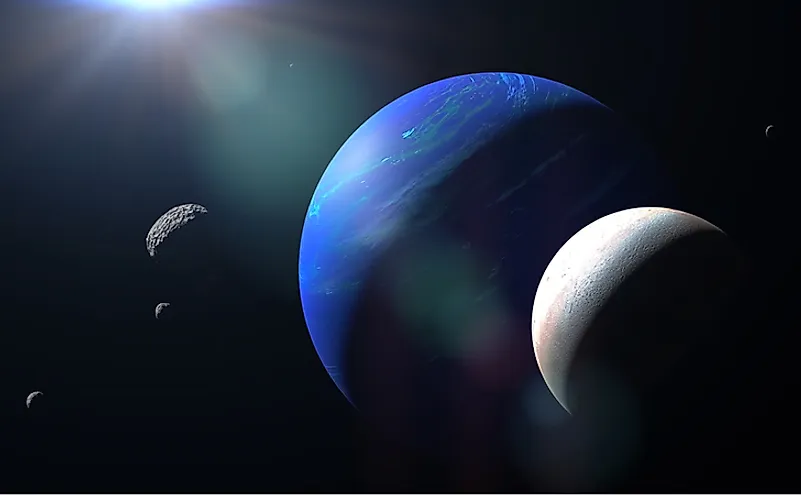
Uranus and Neptune are called ice giants, but anyone imagining two gigantic frozen snowballs would be badly mistaken. Their outer atmospheres consist primarily of hydrogen and helium, along with methane and other substances. Methane absorbs red wavelengths of light and contributes to the planets' blue-green appearance. Deeper inside, scientists think both planets contain much larger proportions of water, methane, ammonia, and heavier material than Jupiter and Saturn. Under the tremendous pressures and temperatures inside the planets, those substances can exist as extremely hot, dense fluids.
Even the familiar pictures of the two planets have been somewhat misleading. Classic Voyager imagery made Neptune appear a much deeper blue than Uranus. Modern reprocessing has shown that their true visible colors are more similar, with some of Neptune's famous deep-blue appearance resulting from image processing used to emphasize atmospheric details.
One Flyby Can Leave Decades Of Questions

For decades, Voyager measurements appeared to suggest that Uranus released almost no internal heat, unlike Jupiter, Saturn, and Neptune. Scientists struggled to explain why one giant planet seemed to have lost so much of the heat left from its formation. More recent analysis has changed that picture. Research published in 2025 indicates that Uranus probably releases about 15% more energy than it receives from the Sun. The planet apparently does have internal heat, just considerably less than Neptune. Scientists reached that conclusion by combining modern models with decades of telescope observations rather than relying primarily on Voyager's brief encounter.
When Will We Go Back?
Uranus currently has the better chance of receiving Earth's next ice-giant visitor. The US planetary science Decadal Survey identified a Uranus Orbiter and Probe as the highest-priority new flagship mission for the 2023-2032 period. Unlike Voyager's rapid flyby, the proposed concept would place a spacecraft in orbit around Uranus for years and drop a probe into its atmosphere. A NASA-led study published in June 2026 examined updated trajectories, spacecraft designs, propulsion systems, and later launch opportunities. As of September 2026, however, there is no confirmed launch date for a Uranus mission.
Neptune is even less certain. The latest Decadal Survey includes a possible Triton Ocean World Surveyor among concepts for a future New Frontiers competition, and NASA has funded early technology studies involving Neptune and Triton, but no return mission to Neptune is currently approved for flight. For now, Uranus and Neptune remain tied at one visitor apiece. Voyager 2 crossed Neptune's path in 1989 and kept going, carrying humanity's only close-range measurements of two entire planets with it.