Which Planet Has The Deepest Canyon?
The Grand Canyon is one of Earth's most iconic landmarks. At 277 miles long, up to 18 miles wide, and about a mile deep, it has become the benchmark for colossal canyons. Yet compared with what's found elsewhere in the solar system, it looks surprisingly small.
One canyon stretches 2,400 miles long and up to 370 miles wide. It plunges more than 4 miles deep, with its deepest sections deep enough to swallow Mount Everest.
Canyons form when powerful forces reshape a planet’s surface over millions or even billions of years. But nowhere else has this process carved a scar of such staggering scale. The question is: which planet is home to this colossal scar, and how did something like it ever form?
What Is the Deepest Canyon in the Solar System?

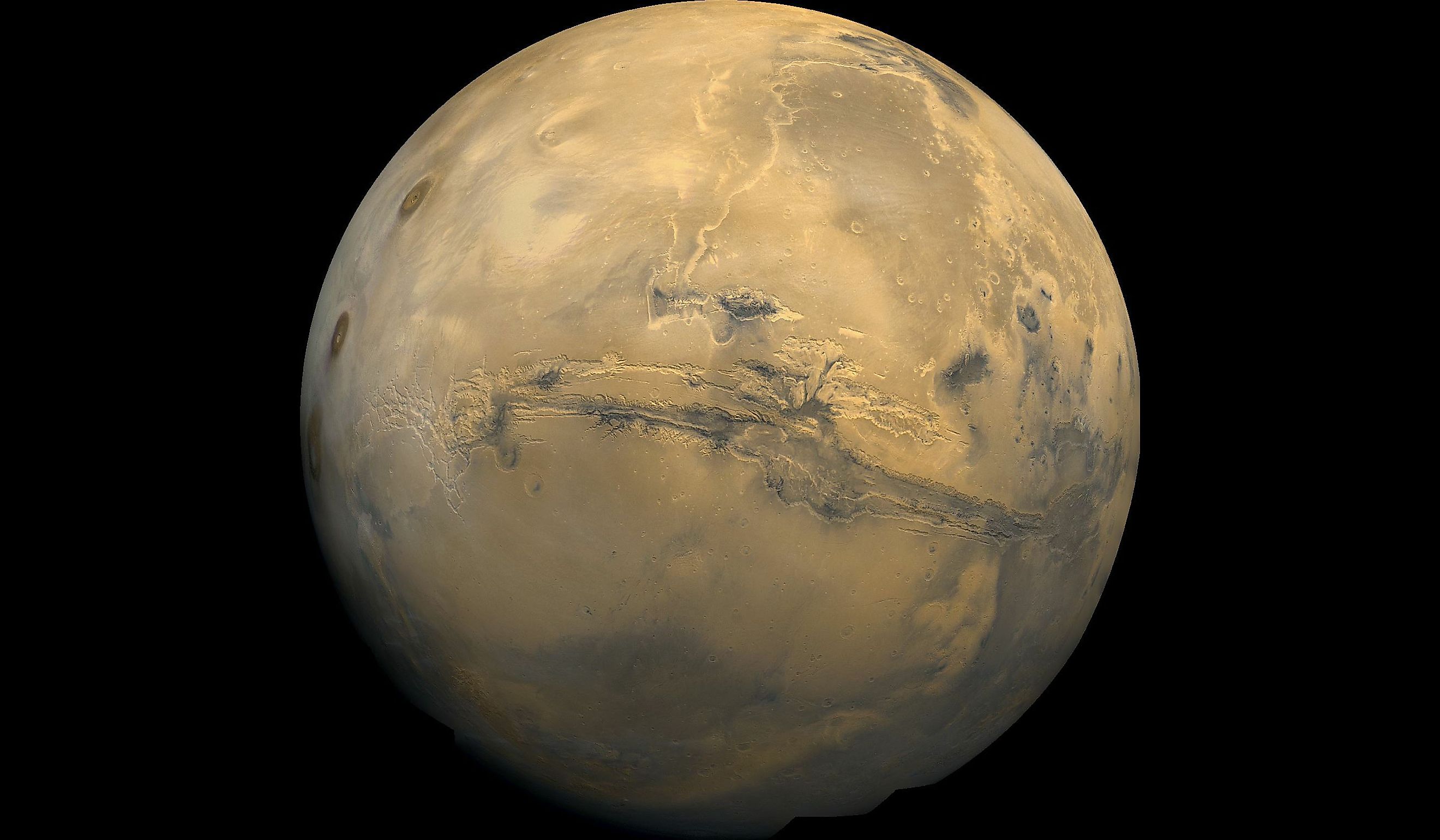
The deepest and largest canyon system in the solar system is Valles Marineris, carved into the surface of Mars.
At over 2,400 miles long, it stretches across nearly one-fifth of Mars's circumference. Its deepest sections plunge nearly 7 miles, while its widest point reaches about 370 miles across. Together, those dimensions make it unlike any other canyon in the solar system.
If you stood on one rim, the opposite side could be so far away that it would disappear beyond the horizon. You wouldn't simply be looking at a canyon. You'd be staring into a gap hundreds of miles wide, so immense it's easy to forget you're looking into a hole in the ground.
There are no airplanes on Mars, of course, but a commercial jet cruising at about 500 mph would need around 45 minutes to cross the canyon at its widest point. Walking nonstop would still take more than five days. At a realistic hiking pace, the journey could stretch to nearly three weeks.
Unlike Earth's Grand Canyon, Valles Marineris wasn't carved by a river. Instead, it began when Mars's crust started to pull apart.
Billions of years ago, volcanic activity built the Tharsis Bulge, home to Olympus Mons, a giant volcano about three times taller than Mount Everest. As this enormous region swelled, it stretched the surrounding crust like taffy until it finally fractured.
Huge blocks of Martian crust collapsed along those fractures, opening an enormous rift that dwarfs Earth's Grand Canyon. Wind, landslides, and perhaps ancient water later widened and reshaped the walls, but the canyon itself began when Mars's crust literally cracked open.
Seen from orbit, the canyon's western end resembles a giant spiderweb etched across the Martian surface. This maze of intersecting fractures is known as Noctis Labyrinthus, or "Labyrinth of the Night." Scientists believe it formed as the crust continued stretching and collapsing into a network of connected valleys, though they are still piecing together exactly how the entire system evolved.
How Does Valles Marineris Compare?
Even those numbers don't fully capture its scale.
You could fit about nine Grand Canyons end to end inside Valles Marineris. At its maximum width, the Martian chasm stretches about as far as the straight-line distance between Los Angeles and San Francisco. Nothing on Earth comes close.
So, does anything else in the solar system come close?
Mercury has towering cliff-like features called scarps, created as the planet cooled and shrank, wrinkling its surface like a drying fruit. They're spectacular, but they're cliffs rather than true canyons.

Saturn's moon Tethys is home to Ithaca Chasma, a canyon about 1,240 miles (2,000 km) long that stretches nearly three-fourths of the way around the moon. Even so, it is still much smaller than Valles Marineris.
Another contender is Verona Rupes on Uranus's moon Miranda, thought to be the tallest cliff in the solar system. Rising over 6 miles high, it's taller than Valles Marineris is deep. Yet it's a single cliff face rather than an enormous canyon system. Because Miranda's gravity is so weak, a fall from the top would take a little under ten minutes.
None combines the length, width, and depth of Valles Marineris.
Could Humans Survive Inside It?

Not without serious help, but the canyon floor is one of the more hospitable places on Mars.
The planet's surface is already hostile. Its atmosphere is extremely thin, dust storms can engulf entire regions for weeks, and nighttime temperatures regularly fall below -100 degrees Fahrenheit. Without a pressurized suit, the near-vacuum conditions would cause exposed body fluids to boil, a phenomenon known as ebullism, making survival impossible within minutes.
Oddly enough, the canyon floor has one advantage. Its immense depth traps a denser layer of the already thin Martian atmosphere, much like cold air settles in valleys on Earth. Although the air is still far too thin to breathe, atmospheric pressure at the bottom is measurably higher than on the surrounding plains. The towering walls also provide some protection from radiation, making conditions slightly less harsh than on the exposed surface above.
Life-support systems would still be essential. Even so, scientists consider the canyon floor one of the more promising locations for future human habitats because conditions are slightly less extreme and the region may contain buried water ice that future explorers could use.
Scientists Still Don't Know Every Detail
Even after decades of orbital observations, Valles Marineris continues to raise new questions.
Some areas contain minerals that appear to have formed in ancient lakes, suggesting water lingered long after the original rift opened. Other regions bear the marks of sudden floods that carved channels before the water disappeared beneath the surface or escaped into the atmosphere.
Researchers are still investigating how much ice remains buried below the canyon floor, why different sections collapsed in different ways, and whether protected pockets inside the canyon could once have supported microbial life. Those unanswered questions continue to make Valles Marineris one of the most compelling destinations for future Mars exploration.
Valles Marineris is more than the largest canyon in the solar system. It may also be one of the best places in the solar system to search for evidence that Mars was once wetter, warmer, and possibly alive.
Future astronauts could one day descend into a canyon unlike anything found on Earth. Deep enough to influence its own local weather, old enough to preserve billions of years of Martian history, and rich with clues about the planet's past, Valles Marineris is one of the most extraordinary landscapes in the solar system.