Which Planet Has Days Longer Than Its Years?
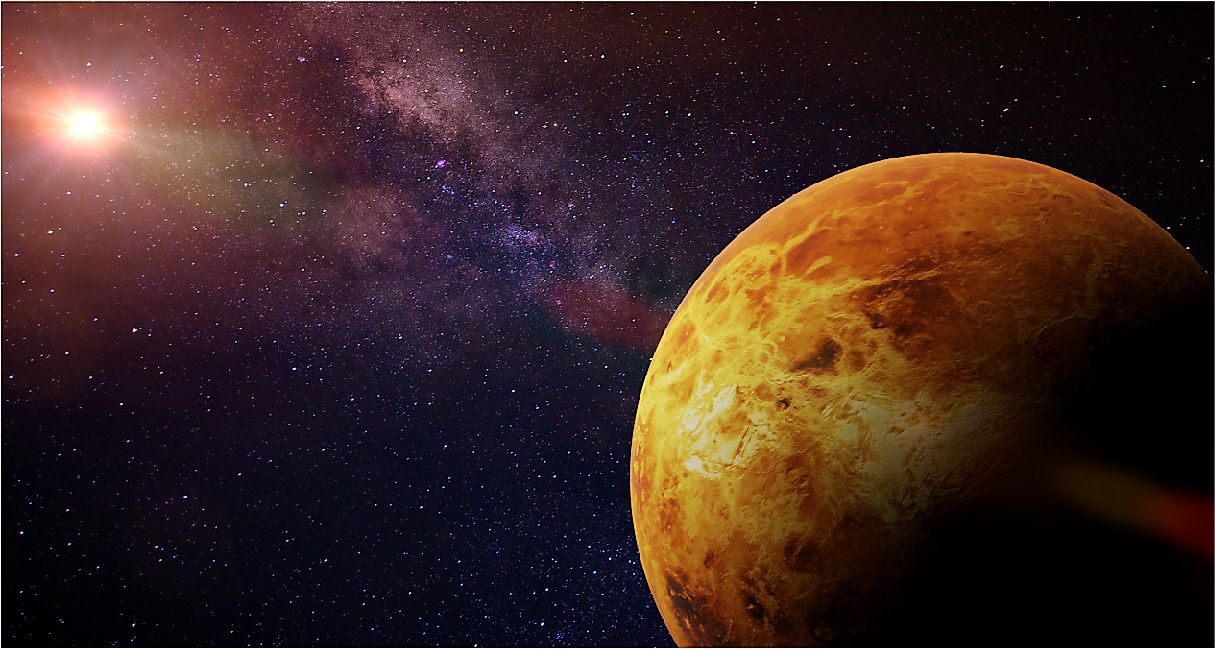
Imagine celebrating your birthday before the ground beneath you completed a single turn. A person could experience this on Venus, where a year lasts about 225 Earth days, while one rotation takes roughly 243. The planet has already traveled all the way around the Sun and started its next orbit by the time it finally finishes spinning once. Even more strangely, Venus appears to move backward relative to Earth, yet the Sun still crosses its sky nearly twice each year. Understanding how both can be true requires looking at two very different ways to measure a day.
Venus Has Two Different Kinds of Days

It's important to define exactly what a day means. The 243-day figure describes a sidereal day, or the time Venus needs to complete one rotation relative to the distant stars. On Earth, a sidereal day lasts 23 hours and 56 minutes, only four minutes less than the solar day measured between successive noons. The difference is so small that most people never need to think about it.
On Venus, those two measurements are separated by more than four months. Its solar day, the time required for the Sun to return to the same position in the sky, lasts about 117 Earth days. This is why the Sun can cross the Venusian sky nearly twice during the planet's 225-day year, even though Venus hasn't completed one full rotation. When people say a day on Venus is longer than its year, they're referring to its 243-day sidereal rotation rather than the cycle someone would experience between consecutive noons.
Venus Spins Backward

Venus's two kinds of day differ so dramatically because the planet rotates in the opposite direction from Earth. Imagine walking backward around the edge of a moving carousel. As the platform carries you one way and your steps take you the other, you can end up facing the same direction again before the carousel itself completes a turn. Venus's orbit and backward rotation work together in a similar way. Although the planet needs 243 Earth days to turn once relative to the distant stars, the two motions bring the Sun back to the same part of the sky after only 117 days.
The Long Night Brings No Relief

On Earth, sunset begins a rapid escape of heat from the ground. Venus is the hottest planet in the solar system, remaining close to 867°F (464°C) whether its surface is facing the Sun or spending weeks in darkness. Its massive carbon dioxide atmosphere traps heat and distributes it around the planet, preventing the long night from producing the dramatic cooling someone might expect. High above the slowly turning surface, winds carry Venus's clouds around the planet in only four Earth days, even though the solid world takes 243 days to rotate once.
The change in light would be equally unfamiliar. Venus's permanent cloud cover scatters incoming sunlight, creating a murky, reddish-orange glow rather than a clear view of the Sun. Daylight would brighten and fade so gradually that the shift could be difficult to notice from one Earth day to the next. Instead of watching a recognizable morning race toward evening, an observer would see the same hazy landscape remain almost unchanged for weeks.
Venus's Slow Rotation Remains a Mystery

Scientists can measure Venus's rotation, but they can't look back far enough to see how it became so slow or why it reversed. One possibility is that a massive object struck the young planet and disrupted its original spin. Early collisions were common as the planets formed, although no surviving evidence proves that one flipped Venus.
Another explanation involves forces that acted gradually over billions of years. The Sun's gravity pulls on the solid planet, creating tides that can slow its rotation. At the same time, sunlight heats different parts of Venus's thick atmosphere, shifting enormous masses of air and creating atmospheric tides.
These forces can push the planet's rotation in different directions. Scientific models suggest that the current slow, backward spin may represent a balance between tides in the solid planet and those in its atmosphere. Venus may owe its strange rotation to a long tug-of-war rather than one violent event, but scientists still can't reconstruct exactly how that process unfolded.
A Fast Orbit Creates a Short Year

Venus may turn slowly, but it doesn't move slowly through space. The planet races around the Sun at roughly 22 miles (35 kilometers) per second. Traveling at that speed, a person could cross the continental United States in a little over two minutes. Its year is short partly because Venus lies only about 67 million miles (108 million kilometers) from the Sun. This gives it a smaller path to complete than Earth, while the Sun's gravity also pulls it along its orbit more quickly. Venus travels hundreds of millions of miles before returning to its starting point, but the entire journey still takes only about seven and a half Earth months. Its unusual calendar comes from two extremes working together, an exceptionally slow rotation and a relatively fast, compact orbit.
No Spacecraft Has Survived a Venusian Day

The longest-lasting spacecraft on the surface of Venus operated for just 127 minutes. The Soviet Venera 13 lander returned color photographs and scientific measurements in 1982 before the extreme environment destroyed it. If Venus's 117-Earth-day solar cycle were compressed into 24 hours, the lander's entire mission would have lasted only about one minute.
A human would face the same conditions without the benefit of Venera 13's protective shell. The atmosphere presses down with roughly 92 times the pressure felt at sea level on Earth, comparable to being about 3,000 feet (900 meters) beneath the ocean. Above the surface are clouds containing sulfuric acid, while the temperature is hot enough to melt lead. Surviving long enough to watch the light change would require technology far beyond anything that has operated there.
Mercury Complicates the Answer

Venus is the only planet whose rotation takes longer than its year, but Mercury experiences a different version of the same oddity. A year on Mercury lasts 88 Earth days, the shortest year of all the planets, while the period from one sunrise to the next lasts 176 Earth days. The planet completes two orbits during one solar day.
This doesn't mean Mercury takes 176 days to rotate. It turns once every 59 Earth days, completing three rotations for every two trips around the Sun. Because Mercury rotates in the same direction that it orbits, each trip around the Sun shifts how far the planet must turn before the Sun returns to the same place in its sky. Venus experiences nearly two solar days during each year, while Mercury needs two full years to complete one.
A Planetary Clock Unlike Any Other
Venus's strange calendar is created by a rare combination of motions. Its rapid orbit carries it into a new year before its slow, backward rotation is complete, while that same reversed spin allows the Sun to cross its sky nearly twice along the way. Mercury produces a different mismatch, but no other planet takes longer to rotate than it does to orbit the Sun. Behind Venus's 243-day turn may be billions of years of collisions, gravitational tides, and atmospheric forces that have created a planetary history that scientists can model but have yet to fully reconstruct.