Which Moon Could Be Shooting Geysers Into Space?
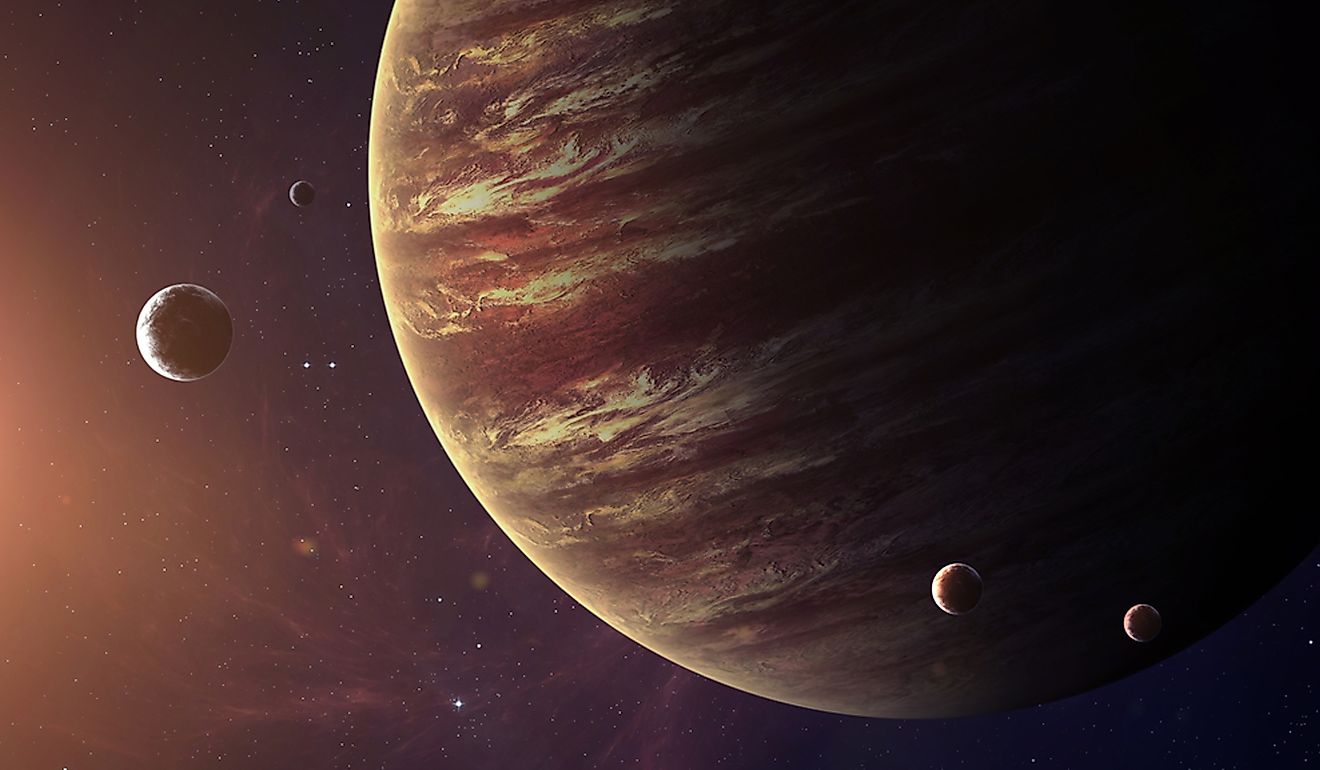
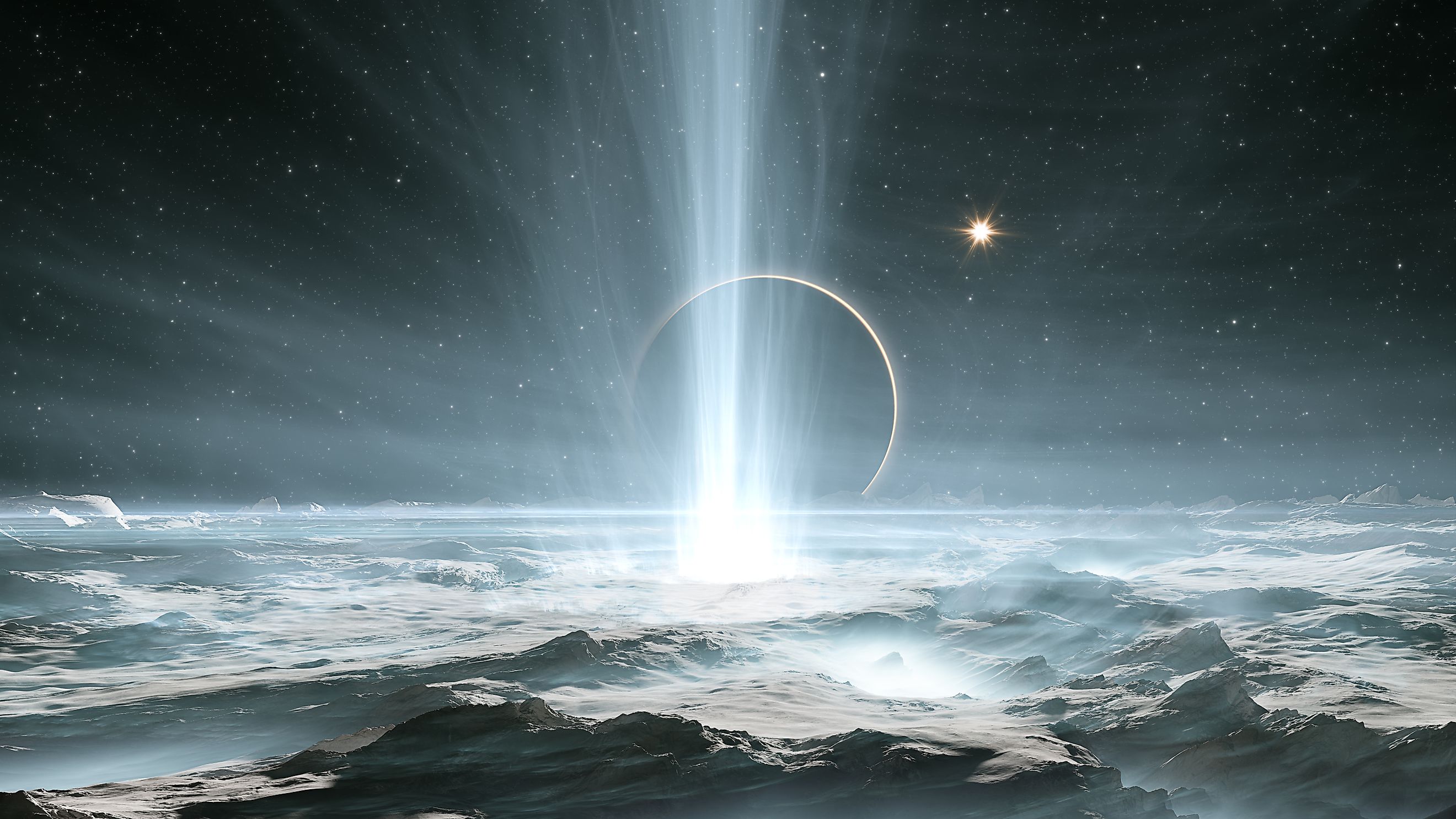
Jupiter's moon Europa could have geysers that shoot out from the surface of the moon 125 miles up. There is a growing body of evidence based on computer models that this moon produces powerful geysers. If proven, it would join the ranks of another moon that has been confirmed to have geysers in the neighboring world of Saturn. Within four years, a recently launched spacecraft will reach Europa to gather more data.
Europa's features

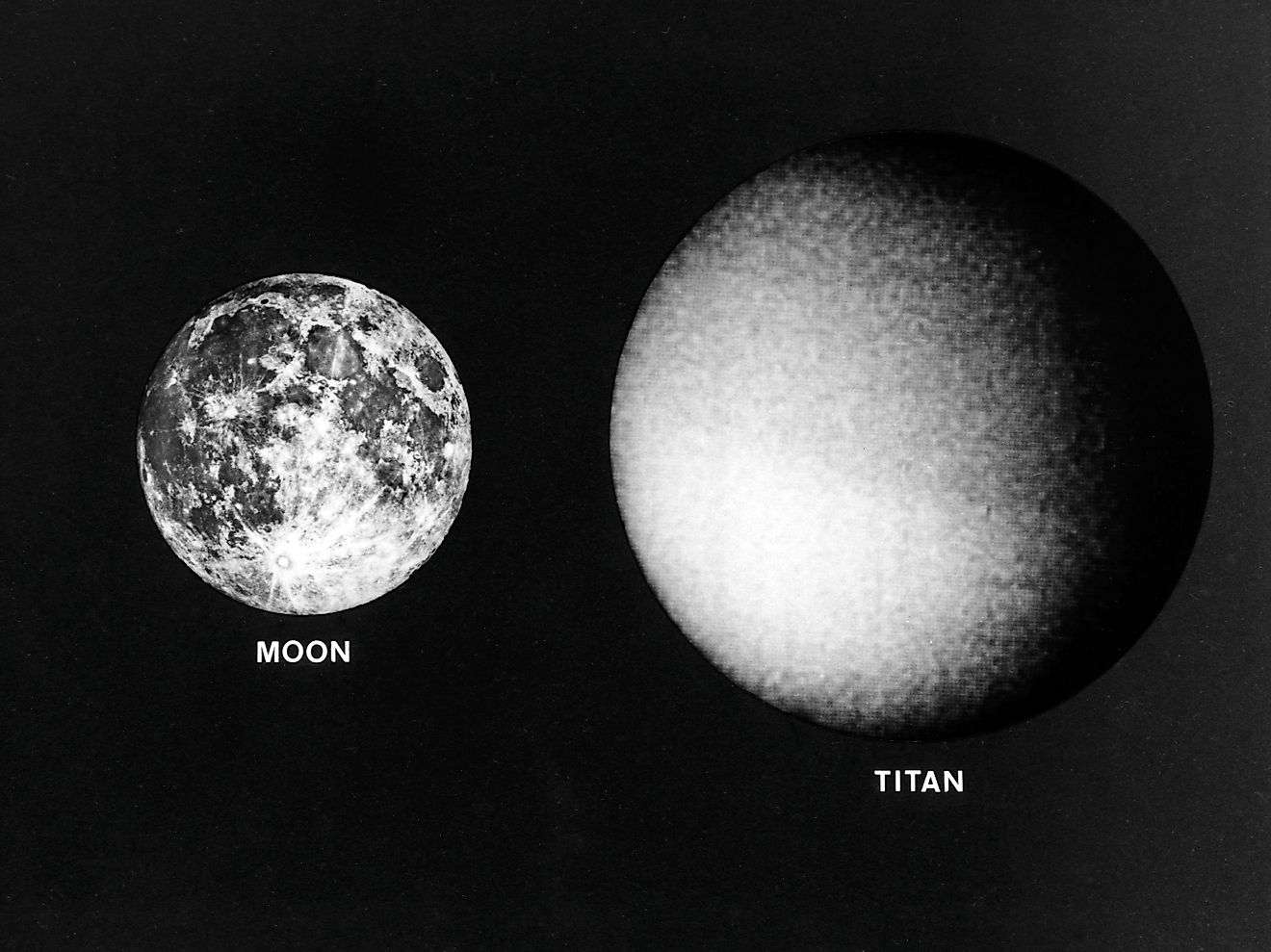
Europa is one of four of Jupiter's larger moons, with a diameter of 1,940 miles, making it comparable in size to the Earth's Moon. Unlike the Earth's Moon, Europa is covered by a surface of liquid ice, which makes it reflect back 5.5 times the amount of sunlight as Earth's Moon.
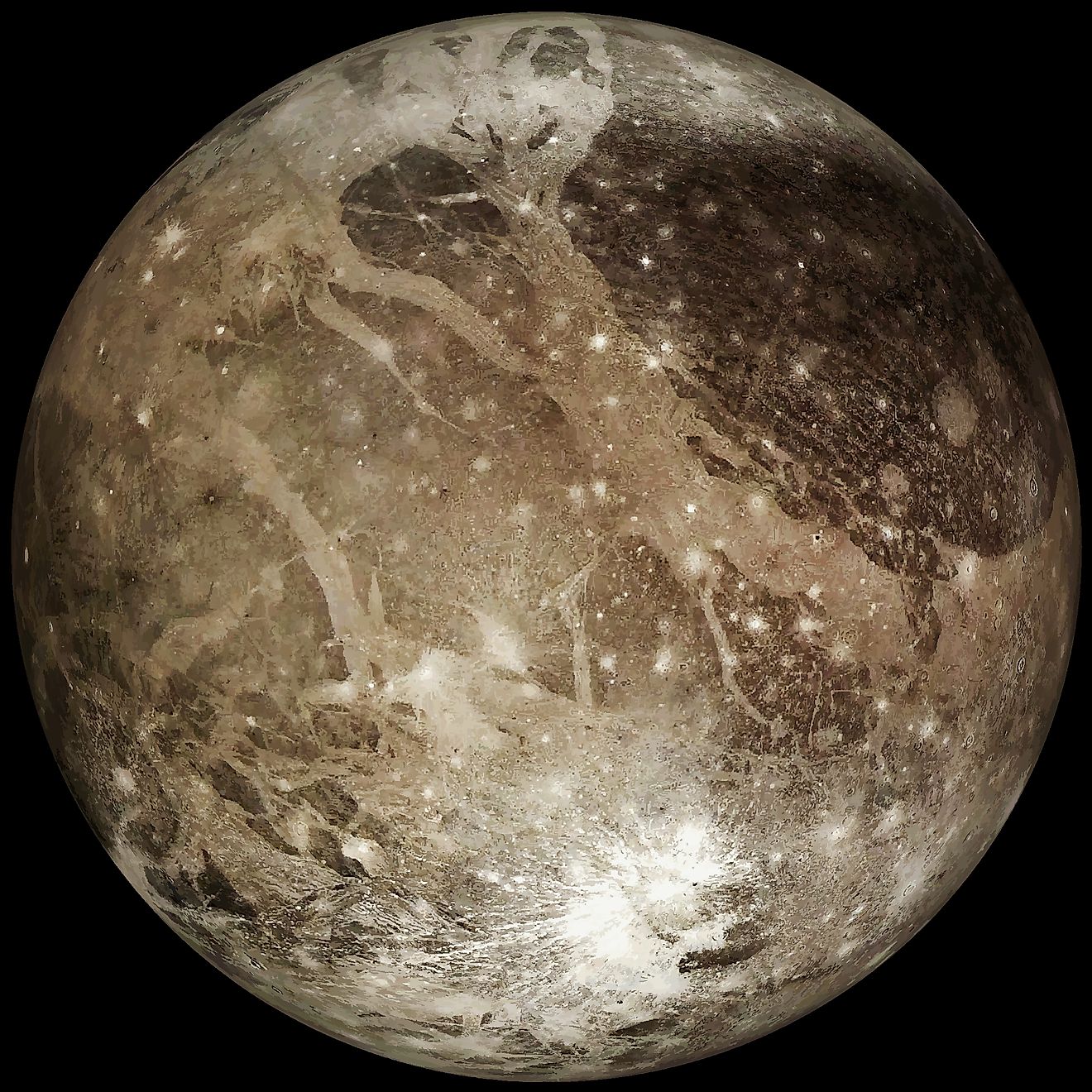
It takes 3.5 days for Europa to orbit around Jupiter. It has no seasons due to Jupiter only being tilted by 3 degrees, unlike Earth, which is tilted by 23.5 degrees. Europa's orbit is not circular as its gravity is influenced by the moons Io and Ganymede, which orbit in a resonance. This means that every time Ganymede completes 1 orbit of Jupiter, Europa completes two, and Io completes four orbits. This resonance produces gravitational tugs that give Europa an elliptical orbit.
Beneath Europa's 10- to 15-mile-thick crust of ice, scientists theorize there is an ocean of salty water that extends to depths of 40 to 100 miles. This salty ocean could contain life, although there is no direct evidence as of yet of life on Europa.
One possible exit point for this water is a wide variety of reddish-brown cracks found all across the ice surface of the moon. These cracks most likely get their color from salt or sulfur mixed in with the ice.
Another feature on the moon's surface is a series of domes and ridges that rise for several hundred feet. These features could have been created by internal heat causing the warmer ice to rise above the cooler, denser ice.
In 2013, the Hubble Space Telescope discovered the first signs of water above Europa. This was formed by NASA in 2019. This would give great credence to the theory of geysers.
When was Europa discovered?

Europa was discovered in 1610 by famed astronomer Galileo Galilei from Pisa, Italy. He found it along with three other moons with his telescope.
Since then, three spacecraft have flown by Europa. The first was Voyager 1 in 1979, which mainly took photos of Jupiter, but also captured Europa. Voyager 2 gave a closer look that same year, capturing photos of Europa's red, cracked surface.
The Galileo mission in 1996 captured some of the most interesting data from Europa, revealing that the moon possesses a magnetic field. This was a crucial piece of evidence that Europa may have a saltwater ocean under its crust that could produce such a field.
Evidence of geysers

Some of the evidence for geysers comes from computer models analyzing findings from the NASA probe Galileo, which came as close as 125 miles from Europa's surface in 1997 and circled back in 2000.
ESA scientist Dr. Hans Huybrighs analyzed data from this flyby in 2000, which showed much fewer protons from the moon than would be expected, especially considering Jupiter's strong magnetic field.
He, along with other scientists, ran computer simulations that revealed that a plume of water erupting out of the surface could have caused this anomaly. The protons would collide with the plume, absorbing electrons and becoming uncharged particles.
"This means they are no longer trapped in Jupiter's magnetic field and can leave the system at high speed," Huybrighs noted.
Scientists uncovered additional evidence by analyzing images taken by the Hubble Space Telescope in 1999 and 2012, with a particular focus on hydrogen and oxygen. From this data, they uncovered large spikes in hydrogen and oxygen levels in the southern hemisphere of Europa. It is from these findings that the estimated geyser size of 125 miles high came. These figures only occurred for seven hours.
In addition, this data was collected when Europa was at its farthest point from Jupiter, and also when Jupiter's gravitational pull is at its weakest. This would mean that cracks in the surface of Europa open up as the pull relaxes, allowing geysers to burst out.
In January 2014, the Hubble Space Telescope viewed what could be plumes rising out of the moon. In particular, the Space Telescope Science Institute discovered projections emerging out of the moon as it passed in front of Jupiter. The team would later see the same projections on three occasions over 15 months. All of these observations were taken when Europa passed in front of Jupiter on 10 separate instances.
Enceladus

Enceladus is the other moon in the solar system that has geysers. These geysers were confirmed by NASA's Cassini spacecraft in 2005.
The moon shoots out water particles and gas at 800 miles per hour, providing a continuous stream of materials, which in turn provides the materials for Saturn's E Ring. Most of the material falls back onto Enceladus, giving it a white, shiny surface. The water shoots out from warm spots in the crust out to 6,000 miles into space.
The E ring of Saturn contains small trace elements of silica, which are produced when liquid water and rock mix together at 200 degrees Fahrenheit. This means that the geysers on Enceladus must be due to hydrothermal activity.
This water comes from an ocean beneath the icy crust of the moon, which launches out of cracks in the ice's surface.
Europa Clipper's mission

To gain more information about Europa, NASA launched the spacecraft Europa Clipper on October 14, 2024. This spacecraft's primary mission is to look for signs of life on Europa, with 49 flybys of the moon, aiming to reach as low as 16 miles above the surface.
This spacecraft is as large as a basketball court, making it the largest planetary mission spacecraft ever built by NASA. It will use solar arrays and radar antennas for power.
With its current trajectory, it will reach Jupiter in April 2030 and will orbit the gas giant while making its flybys of Europa.
Will Clipper confirm the presence of geysers?

While Clipper will not be able to land on the surface of the moon itself, it will analyze the moon's surface and interior, and will also certainly capture any geysers on its instruments if they do, in fact, occur on the moon. Clipper will, in particular, spend four years in orbit, searching for any sign or possibility of life hidden beneath the icy surface.
The program scientist for the mission, Curt Niebur, expressed great enthusiasm for the mission, pointing out that such an in-depth look at an ice-covered moon had never been attempted before, and is sure to lead to discoveries.