Where America Watches For Asteroids From
An asteroid roughly six miles wide struck Earth 66 million years ago and helped erase about three out of every four species alive at the time. The impact excavated a crater about 110 miles across beneath what is now Mexico's Yucatán Peninsula. If another large asteroid were headed our way, however, the first warning would probably not come from some futuristic command center. America's asteroid defense system begins with telescopes on mountains in places such as Hawaii and Arizona, then passes through computers and scientists scattered across Massachusetts, California, Maryland, and Washington, DC.
Hawaii And Arizona Search The Sky

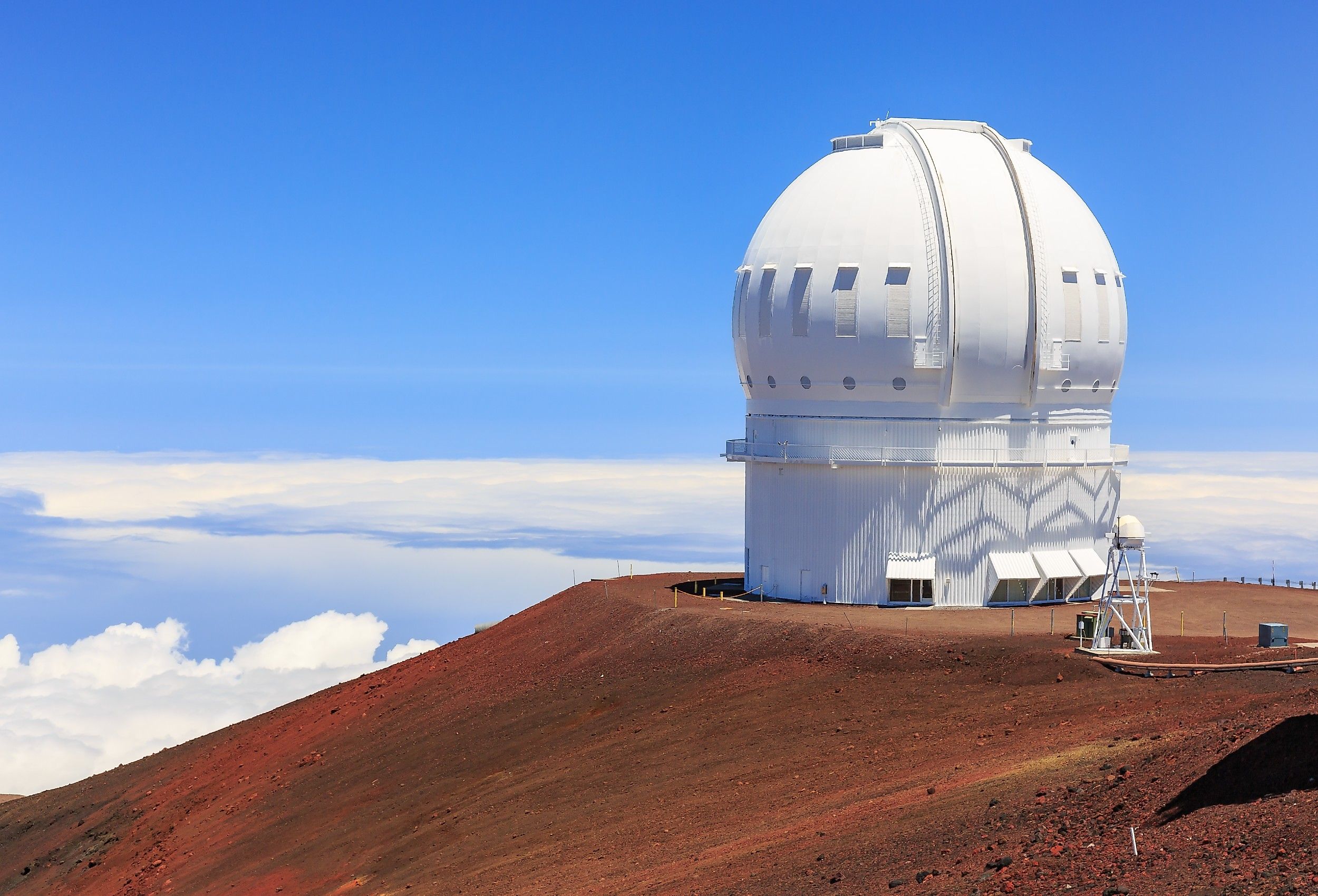
Some of America's most important asteroid hunters sit high above the clouds in Hawaii and Arizona. NASA's Near-Earth Object Observations Program currently funds several major searches, including the University of Arizona's Catalina Sky Survey and two University of Hawaii programs: Pan-STARRS and the Asteroid Terrestrial-impact Last Alert System, better known as ATLAS.
ATLAS is particularly easy to picture as an early-warning system. Four of its telescopes sit in Hawaii, Chile, and South Africa, and a fifth joined the network from Teide Observatory in Spain in 2025, so the system can scan the entire dark sky once every 24 hours. A telescope in Hawaii may be sitting in daylight while another on the other side of the planet is already looking upward.
The warning time depends heavily on size. According to the University of Hawaii, ATLAS could provide roughly one day's warning for an incoming asteroid about 20 meters wide, an object large enough to cause serious local destruction. A 100-meter asteroid might be spotted as much as three weeks before impact. That is why asteroid defense is partly a race against distance: larger objects can generally be seen while they are still farther away.
Arizona provides another major piece of the search. The Catalina Sky Survey uses telescopes around Tucson to discover near-Earth objects, while other American observatories can perform follow-up observations after something unusual appears. The result is less like one giant eye watching space and more like a collection of lookout posts repeatedly photographing the sky and searching for dots that have moved.
Cambridge Is The World's Asteroid Clearinghouse

Once an observatory reports a possible asteroid, one of the most important places on Earth is an office in Cambridge, Massachusetts. The Minor Planet Center operates at the Smithsonian Astrophysical Observatory under the International Astronomical Union. It receives positional measurements of asteroids, comets, and other small bodies from observatories around the world, checks them, calculates orbits, assigns designations, and distributes the information. It is the single worldwide destination for that data, a role no other institution fills.
An asteroid discovered on a mountain in Chile can quickly become the concern of astronomers in Massachusetts, California, and elsewhere. Professional observatories provide much of the data, but observations from smaller facilities and qualified amateur astronomers can also become part of the enormous stream of measurements used to refine asteroid orbits.
Pasadena Calculates Whether Earth Is In The Way

The next critical location is NASA's Jet Propulsion Laboratory in Pasadena, California, home of the Center for Near-Earth Object Studies, or CNEOS. Here, observations gathered elsewhere are turned into extremely precise asteroid and comet orbits. Its Sentry system continuously searches those orbits for possible Earth impacts during the next century. Another system, Scout, begins examining newly reported objects even before their discoveries have been fully confirmed. If the calculated orbit comes sufficiently close to Earth, scientists can estimate the probability of impact and determine when that collision might occur. With enough observations, the uncertainty usually shrinks. In most cases, Earth eventually falls outside the asteroid's possible paths.
Washington Coordinates The Response

If scientists ever found an asteroid with a serious chance of striking Earth, the problem would eventually reach NASA Headquarters in Washington, DC. NASA's Planetary Defense Coordination Office oversees the agency's efforts to find potentially hazardous objects, track them, issue warnings, and coordinate planning for an actual threat. CNEOS performs the orbit and impact calculations, while the Planetary Defense Coordination Office serves as a central point for the broader government response.
The United States is also part of the International Asteroid Warning Network, which links observatories and scientists around the world. An asteroid does not care about national borders, so neither can an effective warning system. Other pieces of the American network deal with the vast quantity of scientific information produced along the way. NASA's Planetary Data System Small Bodies Node archives and distributes datasets concerning asteroids, comets, and interplanetary dust. Its Comet Subnode is based at the University of Maryland in College Park, while its Asteroid/Dust Subnode operates at the Planetary Science Institute in Tucson.
The Asteroid That Put The System To The Test

A real-world example took place on December 27, 2024, when an ATLAS telescope in Chile discovered asteroid 2024 YR4. The object was eventually measured at roughly 53 to 67 meters wide, approximately the height of a 10-story building. Early calculations indicated a small possibility that it could strike Earth on December 22, 2032. As astronomers gathered more observations, NASA's calculated probability climbed to 3.1% in February 2025, the highest probability the agency had recorded for an object of that size or larger.
More telescopes watched YR4. More measurements went to the Minor Planet Center. CNEOS recalculated the orbit. Within days, the estimated Earth-impact probability collapsed to 0.004%, and NASA concluded that the asteroid posed no significant threat to Earth for at least the next century.
There was still one strange possibility left. Scientists calculated that YR4 might strike the Moon instead. That probability eventually reached 4.3%. NASA turned the James Webb Space Telescope toward the fading asteroid for unusually difficult follow-up observations. New Webb measurements in February 2026 finally eliminated the lunar-impact possibility as well. YR4 is now expected to pass about 13,200 miles from the Moon's surface in 2032.
What Happens If We Find One That Really Is Coming?

Finding an asteroid is useful only if humanity can do something about it. NASA tested one possibility in 2022 with the Double Asteroid Redirection Test. DART deliberately smashed into Dimorphos, a roughly 560-foot-wide moonlet orbiting the larger asteroid Didymos. Neither object threatened Earth. Scientists chose the system because it offered a safe place to test whether hitting an asteroid could change its motion.
It worked. The collision shortened the time Dimorphos needed to orbit Didymos by about 33 minutes. Research published in 2026 showed that the collision even produced a measurable change in the pair's orbit around the Sun. Humanity had deliberately altered the path of a celestial body.
Next Steps For Better Protection
The next major improvement will be finding dangerous objects earlier. NASA's NEO Surveyor is scheduled to launch no earlier than September 2027. Unlike Webb, it is being built specifically to hunt potentially hazardous asteroids and comets. Its infrared telescope will detect the heat given off by objects, including dark asteroids that can be difficult for visible-light telescopes to see. Over its five-year baseline survey, NASA expects it to find at least two-thirds of the still-undiscovered near-Earth objects larger than about 140 meters.
There is, therefore, no single place where America watches for asteroids. The warning chain stretches from mountaintops in Hawaii and Arizona to the Minor Planet Center in Cambridge, orbit specialists in Pasadena, and planetary-defense officials in Washington. In the future, part of that watch will take place about a million miles from Earth aboard NEO Surveyor. The goal is simple: if another dangerous asteroid ever appears in the darkness, scientists want to see it while there is still enough time to make sure it misses us.