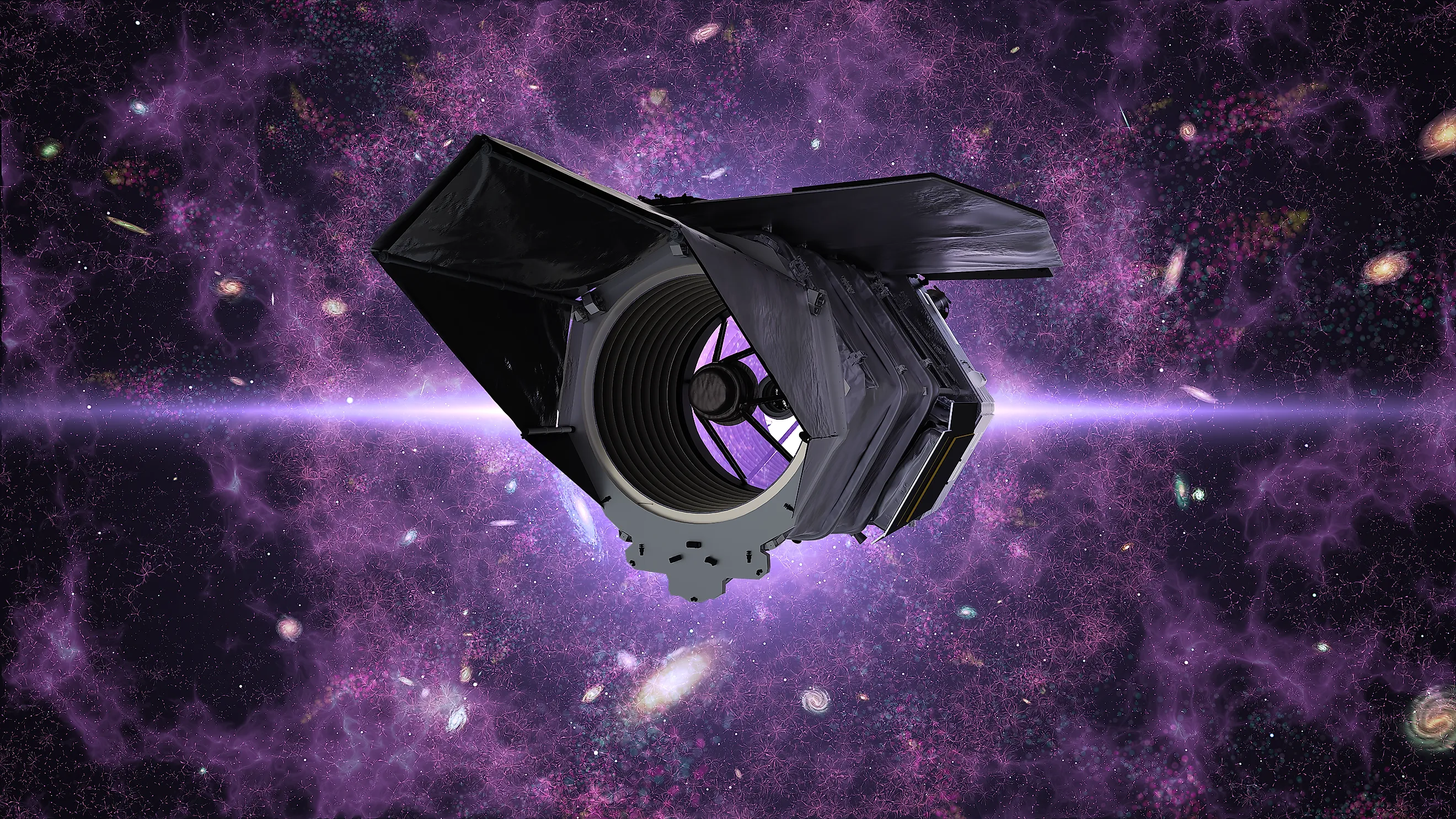
What The Nancy Grace Roman Telescope Will Do That Webb Cannot
When NASA launched the Nancy Grace Roman Space Telescope in August 2026, a new chapter of understanding the complexity of exoplanets and the wider universe began. Although it will share the same observation region as the James Webb Space Telescope, improved technology will give Roman an edge in observing a larger portion of space. The newly launched survey telescope is also key to answering researchers' questions about the effects of dark matter in the universe.
Roman's massive field of view, coupled with its agility and precision, will give scientists groundbreaking views of planets beyond our solar system. Using the upgraded, sensitive instruments on Roman alongside the observatory's Webb and Hubble Space Telescope predecessors could refine our models of the wider universe as scientists make more discoveries and potentially confirm the existence of thousands of suspected exoplanets. Roman's expanded view of space is a crucial tool in expanding scientists' view of space that Webb alone cannot reach.
Roman's Wider View of the Universe

The defining difference between Roman and Webb is the new telescope's wider field of view. The broad view will be captured by Roman's Wide Field Instrument, which detects subtle infrared light across the galaxy. Most impressively, the 18 detectors within the instrument, each the size of a mere cracker and about 4,000 by 4,000 pixels, will combine to produce a 300-megapixel image. According to NASA scientists, the new imaging technology will enable Roman to "capture images 50 times larger than Webb can."
Once the telescope begins taking surveys of space, astronomers will be able to use the panoramic view to explore space without targeting a specific object to study, as is done with Webb. Scientists are hoping that a survey of the central part of the galaxy, where Roman will observe the light from millions of stars, will produce a new record for the farthest known exoplanet.
Since Roman's images capture about 100 times more sky than Hubble, astronomers will even be able to expand on previous discoveries made using Webb's deep infrared capabilities. Roman's broader view can provide further context on patterns in the universe's ecosystems and neighboring galaxies.
Studying Dark Matter with Precision

Although Roman and Webb both use infrared to observe objects in space, Roman's sensitive cameras will provide a more precise view of the effects of dark matter masses. As they capture images of space, the two telescopes can detect how an object's gravity and mass warp the paths of light, changing the appearance of galaxies. However, Webb's narrow field of view makes the effect harder for scientists to detect.
Roman's wider scope and 300-megapixel camera will allow it to use an effect called weak gravitational lensing to measure clumps of dark matter that warp the appearance of galaxies. Larger, crisper images can capture and document the gravitational lensing effect more often than smaller images from Webb. Measuring the effects of invisible dark matter will eventually bring scientists one step closer to uncovering which particles make up the material.
It could also alter the way scientists map the universe. As researchers piece together a more complete picture of how dark matter is distributed across the universe and how it affects the appearance of galaxies, Roman's images could prompt scientists to fine-tune their existing models of the universe's structure.
A Faster Search Across the Universe

Another advantage of Roman's wider field of view is that it will allow scientists to make discoveries at a faster rate. As its advanced camera captures and processes images, the telescope will transmit 1.4 terabytes of data (about 1,400 gigabytes) to scientists every day. The telescope can observe the universe faster than its predecessors, giving it the highest rate of data return to Earth of any NASA astrophysics mission so far.
The survey telescope's design also gives it the agility to complete its operations more quickly. NASA notes that Roman's "rigid design" enables the telescope to carry out sweeping surveys of the sky without needing to spend long periods calibrating between observations. The massive camera will be able to conduct wide-ranging infrared surveys that would take years with Webb's narrower view and complete them around 1,000 times faster than Hubble.
Why Scientists Want to Use Roman to Study Dark Matter

With Roman, scientists hope to solve some of the many unanswered questions surrounding dark energy and masses of dark matter throughout the universe. So far, very little is known about dark energy except that it comprises around 68% of the total energy in the universe and appears to be driving its accelerating expansion. Similarly, the mystery of dark matter has yet to be completely solved, thanks in part to our inability to see it. Researchers believe that dark matter is the material that helps organize galaxies and makes up 27% of the universe, but they have yet to determine what the material is made of.
Making up a large part of the universe, scientists plan to get to the bottom of how each component affects its structure. As Roman observes the systems of planets beyond our own, the Wide Field Instrument will measure the distances and shapes of galaxy clusters and survey an exploding star to build that knowledge. These surveys will help explain how dark energy and dark matter have evolved over time, where they are most abundant, and how each has influenced the growth of distant galaxies.
Webb and Roman's Technology Will Work Together

Once the Roman Space Telescope begins conducting its surveys, researchers will be able to leverage the combined strengths of Webb and Roman to learn more about the universe. Roman will bring them one step closer to documenting more of the space beyond our solar system, and Webb will be able to add greater detail to each new exoplanet discovery. Together, they could add context to potentially 100,000 planets that lie beyond our reach in the continuously expanding universe and give us a better understanding of the invisible forces at play in our solar system.
.jpg)

.jpg)