What's the Loudest Sound in Space?
No sound has been confirmed as the loudest in space, but a supermassive black hole about 250 million light-years away produced some of the most powerful pressure waves ever inferred. The inferred wave period was just under 10 million years. NASA's 2022 sonification later resynthesized the signals 57 and 58 octaves higher to make them audible, which is 144 quadrillion and 288 quadrillion times their original frequencies.
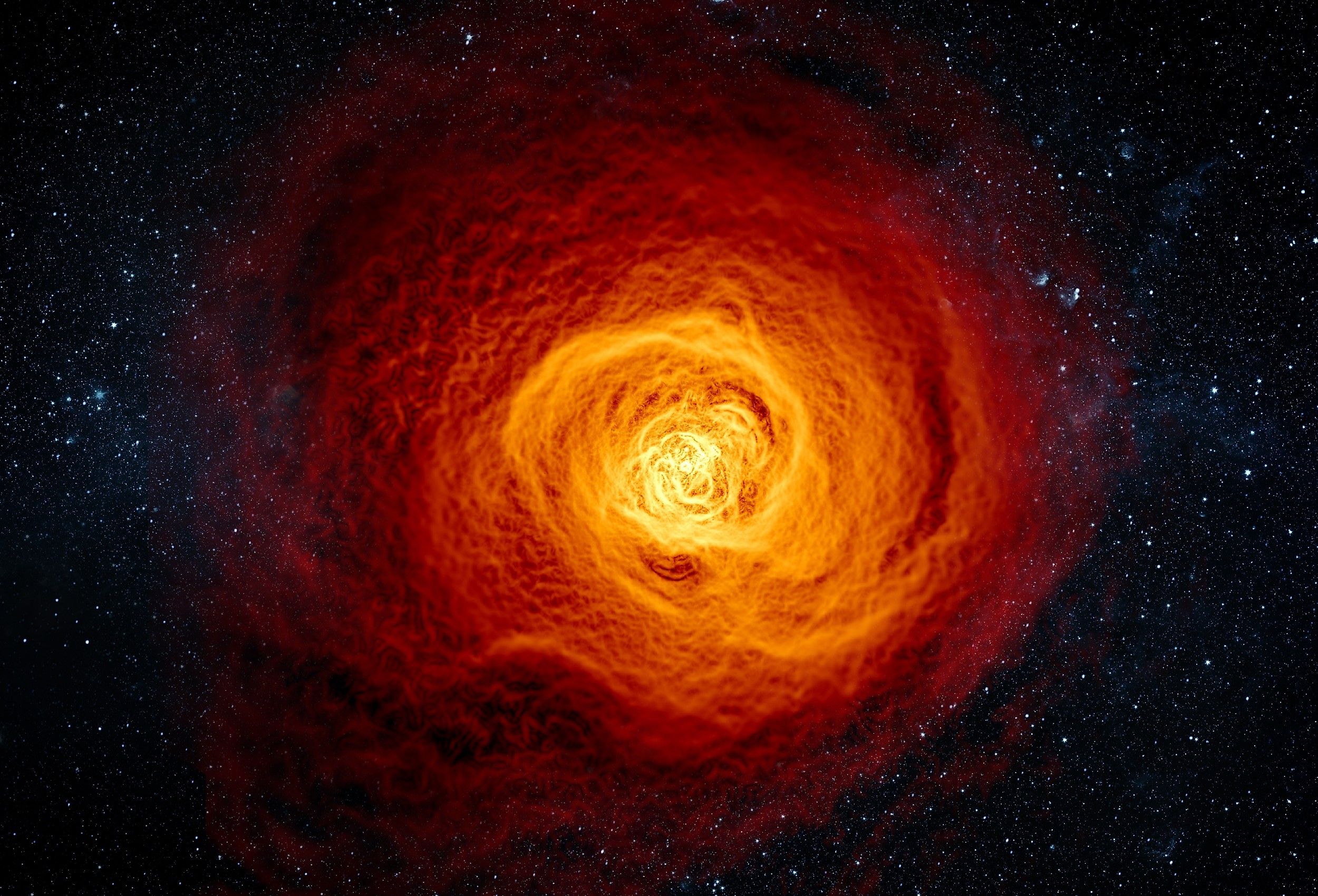
Pitch corresponds to frequency, while physical sound intensity is the wave's average power per unit area and depends on its pressure amplitude and the properties of the surrounding medium. The Perseus note was far too low for humans to detect, yet it still influenced the surrounding gas on a massive scale. Chandra detected X-ray surface-brightness ripples that researchers interpret as pressure waves, allowing astronomers to infer an acoustic signal rather than record it with a microphone. The science behind this "loudest" claim reveals how sound crosses cluster gas, how NASA made it audible, and why “loudest” remains an informal label.
How Sound Travels Through Space

Sound needs matter to carry it. On Earth, a ringing phone pushes against nearby air molecules, which bump into their neighbors until the vibration reaches the ear. In the near-vacuum between planets and stars, particles are too widely scattered to pass those vibrations along in the same way.
An explosion outside a spacecraft could produce a brilliant flash without creating a boom inside the cabin. An astronaut might hear vibrations if debris or a pressure wave struck the spacecraft itself, but the sound couldn't cross empty space and enter through the walls.
Space isn't equally empty everywhere. Planets have atmospheres, stars contain hot plasma, and galaxy clusters can hold vast clouds of gas between their galaxies. The gas in the Perseus Cluster is thin by Earth's standards, but it fills such an enormous area that pressure waves can travel through it for hundreds of thousands of light-years.
The Black Hole That Shook a Galaxy Cluster

The Perseus Cluster holds more than a thousand galaxies, but much of its ordinary matter lies outside them. A vast cloud of gas surrounds the galaxies, reaching roughly 50 million kelvins (about 90 million degrees Fahrenheit). That heat makes Perseus the brightest galaxy cluster in the X-ray sky. Near the center is NGC 1275, a giant elliptical galaxy also cataloged as Perseus A, and it hosts an active supermassive black hole.
The black hole doesn't send sound directly from inside its event horizon. Instead, gas and dust falling toward it form a rapidly spinning disk, where some material is redirected into powerful jets before crossing the point of no return. These jets blast into the surrounding gas and inflate enormous cavities like bubbles rising through water.
As each cavity expands, it pushes against the cluster gas like a piston. Repeated outbursts create a series of pressure waves that spread away from the center, leaving curved bands visible in X-ray images. Rather than producing one sudden cosmic bang, the black hole has generated pulses again and again over millions of years.
Turning the Black Hole's Note Into Sound

Astronomers calculated the note by measuring the distance between the ripples and estimating how quickly sound moves through the cluster's gas. The spacing revealed a B-flat about 57 octaves below middle C. A piano would need an impossible row of keys extending far beyond its left side to reach anything close to it.
In 2022, NASA scientists turned Chandra X-ray Observatory data into audio through a process called sonification. They extracted the waves extending outward from the cluster's center, then raised their frequencies by 57 and 58 octaves. This moved the signals into the range of human hearing while preserving differences found in the original data.
The finished recording resembles a deep, eerie groan that rises and falls as the scan circles the cluster. It isn't a microphone recording of the black hole, and it doesn't reproduce what an astronaut would hear nearby. It maps the spatial X-ray ripples in successive radial directions into audible frequencies; it is not a time-compressed recording of the waves propagating through the cluster.
Is It Really the Loudest Sound in Space?

The Perseus black hole is often described as producing the loudest sound ever detected, but the original discovery was more firmly a record for pitch. Researchers called it the deepest note found in the universe. Their observations also showed that the waves carried enough power to replace much of the energy the cluster's hot gas was losing through X-rays.
Deeper notes have since been inferred elsewhere. In M87, a giant elliptical galaxy at the center of the Virgo Cluster, unevenly spaced loops in the hot gas point to small outbursts roughly every 6 million years and to sound waves near 56 octaves below middle C. A large cavity and an accompanying shock front there imply notes as deep as 58 or 59 octaves below middle C, powered by much larger eruptions.
There is no cosmic decibel chart that allows scientists to rank every sound on the same scale. Sound behaves differently depending on the density, temperature, and pressure of the material carrying it. Astronomers must calculate the power of the Perseus waves from changes in the cluster's X-ray glow rather than measure them with a microphone.
Total event energy cannot establish which phenomenon is "loudest," because only the portion carried by pressure waves through a specified medium is relevant to an acoustic comparison. Carving the Perseus cavities took energy comparable to the combined output of 100 million supernovae. Much of that energy escapes as light, heat, particles, or gravitational waves rather than sound. Perseus remains one of the clearest examples of immensely powerful pressure waves crossing space, but its title as the loudest is an informal description rather than a confirmed universal record.
Could a Human Survive Near the Sound?

Practically, survival would be impossible near the sound without a spacecraft. The cluster gas reaches tens of millions of degrees, while the near-vacuum would leave a person without oxygen or usable atmospheric pressure. Radiation from the hot gas and the active center of NGC 1275 would add another serious threat.
However, if a person theoretically could survive in the Perseus Cluster without a spacesuit or craft, they still wouldn't experience a deafening blast. The pressure changes arrive too slowly for the ear to recognize them as sound, and the gas is far thinner than any atmosphere a human could breathe. There would be no perceptible sensation of the wave passing by.
Inside a spacecraft, the waves wouldn't rumble inside its cabin either. Because one cycle unfolds over millions of years, the change would be far too gradual to make the hull vibrate like a speaker. Instruments could measure changes in the surrounding gas, but no crew would hear the black hole's note.
A Sound That May Keep the Cluster Hot

The pressure waves may help solve a long-standing mystery inside the Perseus Cluster. Its glowing gas continually loses energy by releasing X-rays. Astronomers expected the gas near the center to cool, sink toward NGC 1275, and supply the material needed to produce enormous numbers of new stars, yet far less cooling and star formation were observed than early models predicted.
Energy from the black hole offers a possible explanation. As the pressure waves spread and gradually weaken, some of their energy can become heat within the surrounding gas. This could replace energy lost through X-rays and prevent much of the gas from cooling enough to form stars.
If the waves really have been doing that work, the black hole's note would have held roughly constant in pitch and intensity for about 2.5 billion years already. Researchers are still investigating exactly how the waves release their energy, but the ripples show that a black hole can influence conditions far beyond its own galaxy. Its extremely low note may help control how an entire galaxy cluster develops.
A Note That Can Reshape a Galaxy Cluster
No human will ever hear the Perseus black hole at its natural pitch, but its effects are written across the cluster's glowing gas. Each outburst pushes energy outward, leaving ripples that reach hundreds of thousands of light-years and may help prevent vast amounts of gas from cooling into new stars.
Perseus is one of the clearest known examples of powerful pressure waves in a galaxy cluster, but observations do not establish it as the loudest sound ever detected. Few known sounds operate on such an extraordinary scale. The current ripple spacing implies outbursts about every 10 million years, and a rate near that one, sustained for roughly 2.5 billion years, is what the model needs to offset radiative cooling.