What's the Heaviest Star Ever Found?
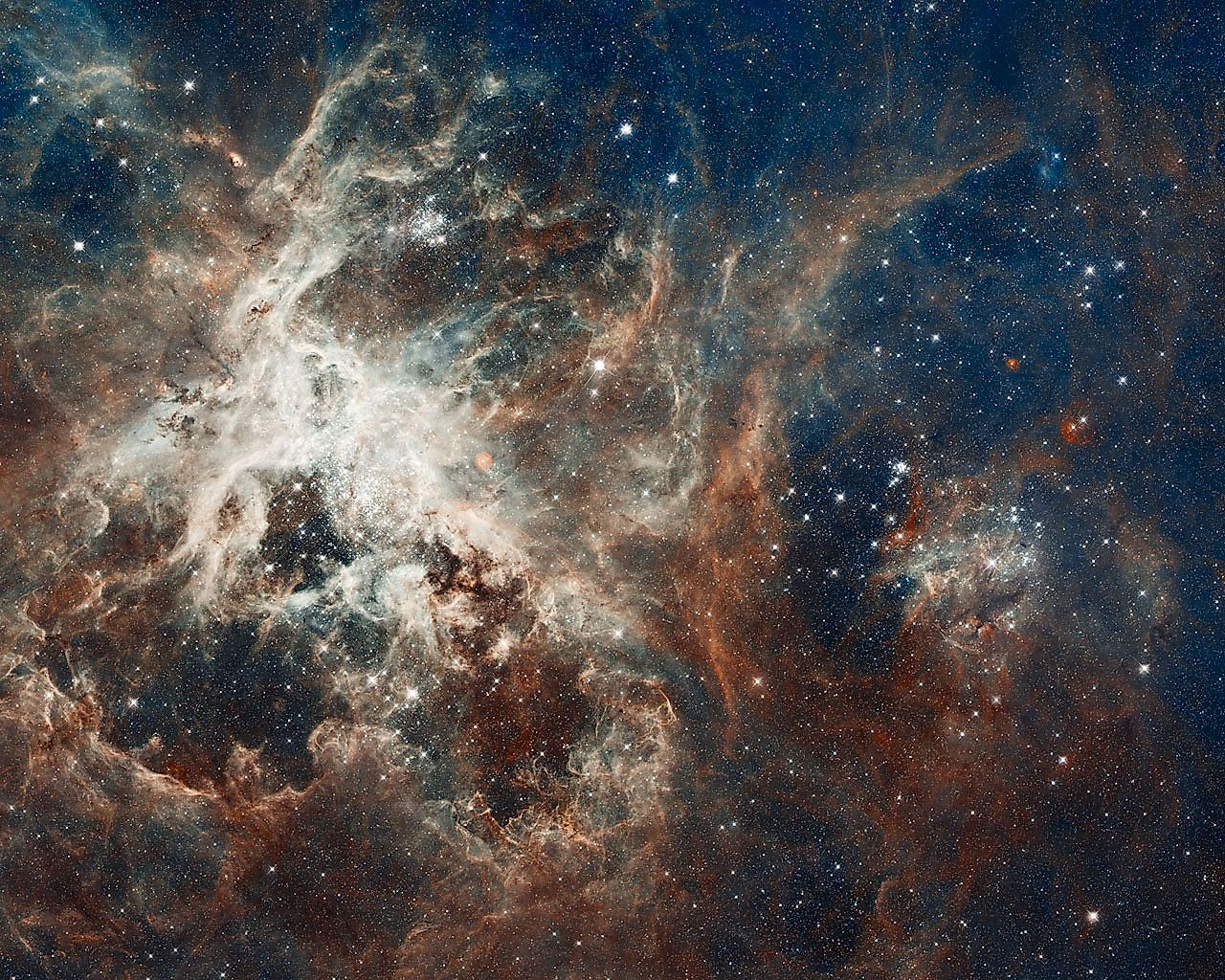
If you stepped onto a spaceship and flew toward the Tarantula Nebula, you would encounter a blistering cosmic nightmare: a colossal star packed with the mass of around 200 suns crammed into a space only about 35 times the Sun's diameter. This is R136a1, a blinding powerhouse that boasts a brightness nearly five million times greater than our Sun, blasting out more raw energy in a few minutes than our Sun generates in a human lifetime. It sits in a chaotic starburst nursery 163,000 light-years away, surviving in a constant state of self-destruction. Yet, its mere existence presents a staggering mystery that challenges current models of how stars are born. Scientists still cannot fully explain how it managed to grow this massive without blowing itself apart.
Size vs. Weight: The Cosmic Balloon vs. The Anchor

Most famous cosmic monsters, like the bloated red supergiant UY Scuti, are just giant 'balloons' in a manner of speaking. If you dropped UY Scuti into our solar system, its outer edge would swallow Earth, Mars, and by some estimates, stretch all the way past Jupiter. Yet, that giant star is incredibly thin and lightweight, holding only about 10 times the weight of our Sun.
R136a1 is not unusually dense, but it manages to pack close to 200 solar masses into a star only a few dozen times wider than the Sun. As a member of the hydrogen-rich WN5h class, it is still a young, hydrogen-burning star even though its powerful wind gives it the spectral appearance of a Wolf-Rayet star.
Discovery: Peering Into the Monster's Nest

For decades, this titan hid in plain sight inside a dense, glowing knot of stars known as the R136 cluster. When astronomers looked at it through older telescopes around 1980, the area looked like one single, impossibly bright blob. It looked as though a single object weighing thousands of suns was sitting in the middle of space. By 1985, speckle interferometry revealed that R136a contained at least eight separate stars. In 2010, a team led by Paul Crowther combined Very Large Telescope observations with Hubble data and concluded that R136a1 was more massive than any star previously measured.
Gravity: A Violent Tug-of-War

Inside R136a1, a terrifying war is raging every single second. For a star to exist, it must balance two forces: the inward crush of its own gravity and the outward push of its nuclear fire. For normal stars, this is a peaceful balance. But for R136a1, the balance is a violent, explosive struggle.
Astronomers once suspected that stars could not form with much more than 150 times the Sun's mass. That proposed upper mass limit was related partly to radiation pressure: as a growing star brightens, its light pushes against incoming gas and makes further growth increasingly difficult. R136a1 showed that this proposed ceiling was too low. It did not violate the Eddington limit or any physical law; instead, it revealed that gravity, radiation, and other factors like stellar winds can reach a workable balance at much higher masses than researchers once expected.
Origin: The Impossible Birth Scenario

How did a star this massive manage to form? Because scientists have difficulty explaining how a single star could become so massive, they have considered another possibility: R136a1 may be a cosmic freak born of circumstance.
Instead of growing from a single gas cloud, R136a1 may have been born through a catastrophic stellar demolition derby. In the crowded center of its home cluster, massive sibling stars orbit each other in dangerously tight circles. Some astronomers believe that two giant stars spiraled into each other and collided in a blinding flash. Instead of breaking the current understanding of star birth, it may have formed through a violent merger.
Atmosphere: Winds Faster Than a Spacecraft

If a human spacecraft attempted to approach R136a1, it would be obliterated long before getting close. The star's surface temperature reaches around 50,000 degrees Celsius, nearly ten times hotter than the surface of our Sun. This extreme heat creates an environment of pure, unadulterated violence.
The outward pressure of light is so intense that it literally rips the star's outer atmosphere away, screaming into the vacuum of space. This creates hyper-velocity stellar winds moving at an estimated 2,600 kilometers per second. That is fast enough to circle the entire Earth in less than 16 seconds. These winds act like a continuous, massive cosmic sandstorm, stripping away roughly fifty suns' worth of material every million years. R136a1 is burning the candle at both ends, shedding its own skin just to stay alive.
Lifespan: Living Fast and Dying Young

In the universe, the smaller you are, the longer you live. Tiny red dwarf stars burn their fuel so slowly that they can live for trillions of years. Our own Sun is a stable, middle-aged star that has been shining for 4.6 billion years and will keep going for another 5 billion.
R136a1 has no patience for longevity. Its crushing internal gravity forces its core to cook fuel at a frantic pace. Even though it is 'barely' one million years old, a mere infant in cosmic time, it is already hurtling toward its mid-life crisis. It is the ultimate cosmic rock star: burning brighter than millions of worlds combined, running on pure adrenaline, and racing toward a sudden, catastrophic end.
Death of a Star

R136a1's death is harder to predict than the average rock star's behavior. Predictions for its final act vary. Its winds may remove so much mass that it avoids a pair-instability explosion altogether. Recent models instead suggest that it could end in core collapse, possibly as a hydrogen-poor Type Ib or Ic supernova, before potentially forming a black hole. Whether the collapse goes out with a bang or a quieter finish depends on how much mass the star loses during its remaining life.
Scientific Significance: A Window to the Big Bang

Studying this impossible titan is the closest thing astronomers have to a time machine. Hundreds of millions of years after the Big Bang, the universe was simple, made only of pure hydrogen, helium and trace amounts of lithium. Without heavier elements like carbon or iron to help cool down collapsing space clouds, some of the primordial Population III stars are thought to have been absolute monsters.
Because those ancient monsters died out billions of years ago, R136a1 acts as an analogue to study certain aspects of earlier massive stars. By watching how this modern heavyweight behaves, fights gravity, and sheds its mass, scientists can map out aspects of how the first generation of stars behaved. It is a blinking neon sign illuminating the dark, violent era of the Cosmic Dawn.
Redrawing the Maps of Space
R136a1 stands as a stark reminder that our understanding of nature is constantly evolving. Every time we build a stronger telescope, the cosmos serves up an anomaly that shatters our textbooks. If powerful instruments like the James Webb Space Telescope find even larger monsters hiding in the deep universe, R136a1 will still be remembered as the titan that forced us to rethink what is possible. If we ever hope to truly map the limits of reality, we must first learn to understand this rule-breaking giant, burning itself alive in the deep dark of space.