What Happens If Kessler Syndrome Starts
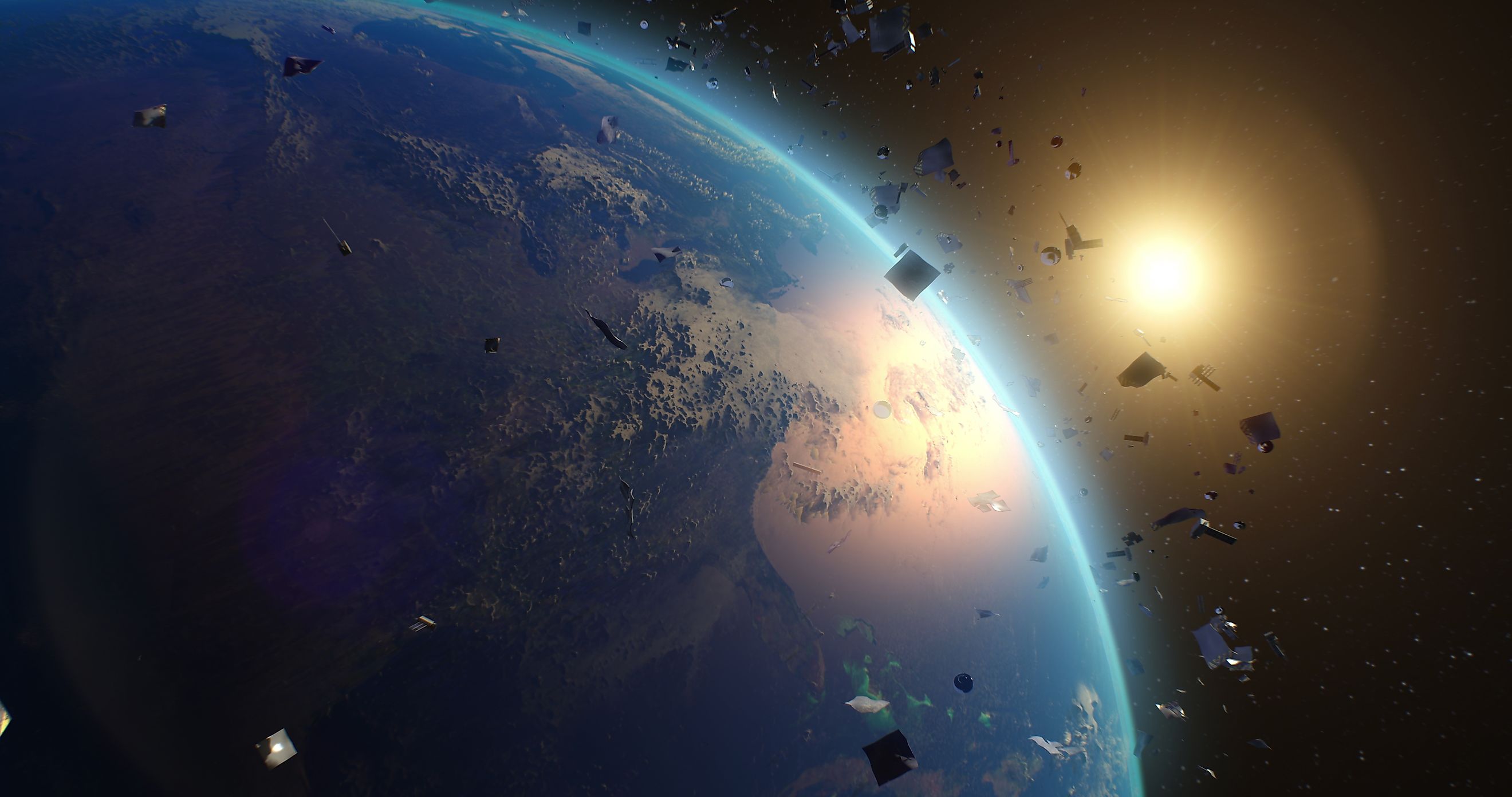
About 100 million pieces of debris are circling Earth, most of them are no bigger than a grain of sand, and ground radar can find roughly 50,000 of them. Two NASA researchers predicted this in 1978. Donald Kessler and Burton Cour-Palais argued that collisions would throw off fragments, and those fragments would cause more collisions until the process ran itself. The belt would begin forming before 2000, they wrote, and turn serious in the century that followed. Three catastrophic breakups and roughly 33,000 catalogued objects later, the question is no longer whether the cascade begins. The question is how fast it runs, and what it takes down.
The Warning Arrived in 1978

Two researchers at NASA's Johnson Space Center published that argument in the Journal of Geophysical Research in June 1978, years before any two satellites had ever struck one another. Kessler and Cour-Palais worked through the arithmetic of collisions in orbit. Every impact makes fragments, and every new fragment raises the odds of the next impact. Past a certain density, the debris population feeds itself.
Their comparison came from planetary science, since the same runaway process is thought to have built the asteroid belt. The model also carried a schedule. Under certain conditions, the authors wrote, such a belt could begin to form within that century and become a significant problem during the next one. Written in 1978, the forecast meant before 2000, then worsening after it. The paper also noted that unseen fragments from earlier spacecraft explosions would shorten the timeline. NASA opened its Orbital Debris Program Office the following year.
Three Breakups Account for Most of It

Three events dominate the entire history of the catalog, and NASA identifies all three by name. The first came on January 11, 2007, when a Chinese anti-satellite test destroyed the weather satellite Fengyun-1C. Trackers logged more than 2,500 large fragments within the year, and NASA still describes the result as the most severe debris cloud in history. The altitude made it worse, since the region was already thick with working satellites and older wreckage.
The second event arrived on February 10, 2009, roughly 490 miles above Siberia. The working communications satellite Iridium 33 and the derelict Russian craft Cosmos 2251 collided at about 26,000 mph. The crash was the first unintentional collision of two intact satellites, and it produced more than 1,800 pieces measuring about 4 inches or larger. A Russian anti-satellite test broke up Cosmos 1408 on November 15, 2021, adding more than 1,500 trackable fragments. By 2013 the first two events alone had put 5,579 catalogued pieces into orbit, close to half of everything then tracked below 620 miles.
Speed Does the Damage, Not Size

Orbital debris travels at an average of about 22,000 mph, and that figure explains why a fragment nobody can see is able to end a mission. Kinetic energy climbs with the square of velocity, so mass matters far less than pace. NASA puts the result in terms a reader can picture. A 4-inch piece of wreckage arrives carrying roughly the force of 15 pounds of TNT.
Spacecraft cannot be armored the way a vehicle on the ground can, because every pound of shielding is a pound taken from the mission. The usual answer is the Whipple shield, a thin outer bumper held away from the hull. Wreckage that strikes the bumper shatters, melts, or vaporizes, and the resulting spray of particles disperses across a wider area before reaching the wall behind. Armor of that kind buys margin rather than immunity. The International Space Station carries roughly 500 separate shields, and the modules are not all protected equally.
Almost Nothing Dangerous Can Be Tracked
The Haystack Ultrawideband Satellite Imaging Radar in Massachusetts reads orbiting objects down to about a fifth of an inch in the lowest orbits. The Goldstone radar in California reaches smaller than that. Neither one sees most of what is up there. NASA counts approximately 50,000 trackable objects against something on the order of 100 million millimeter-sized fragments, because debris follows a power law. The smaller the piece, the more of them exist.
The distribution inverts the popular version of the problem. NASA is blunt about the consequence. For satellites working close to Earth, the fragments most likely to punch through and finish a mission are the millimeter-sized ones. A fragment that size will not shred a spacecraft. It only has to reach a fuel tank or a battery, and a dead satellite then becomes a target of its own. The agency also reports a measurement gap between roughly 370 and 620 miles, where ground sensors cannot resolve the small population and several hundred spacecraft operate.
Some Orbits Clean Themselves and Some Never Will

Cosmos 1408 broke apart about 300 miles up, low enough that thin traces of atmosphere still drag on whatever passes. NASA expected more than 90% of that cloud to reenter within five years. The 2009 collision happened near 490 miles, and NASA has projected that some of its wreckage will still be circling at the end of this century. Fengyun-1C came apart near 530 miles, where about half the fragments were expected to still be circling in the 2030s.
Identical physics, three altitudes, three different answers. The gradient is why the disposal rules changed. On September 29, 2022, the Federal Communications Commission cut the deadline for retiring a satellite from 25 years to five, covering anything operating at or below roughly 1,200 miles. Leaving dead hardware to come down over decades was no longer sustainable, the commission wrote. Satellites already flying were exempt, which means the rule shapes the next generation and not the current one.
The Crowded Shell Is the Useful One

NOAA-20 circles the poles 512 miles above the surface, and what it sees becomes the American weather forecast. The satellite belongs to the National Oceanic and Atmospheric Administration (NOAA). Its polar fleet supplies roughly 85% of the data feeding numerical weather prediction, the models behind any forecast three to seven days ahead. The altitude falls between the two debris concentrations NASA traces to the Fengyun-1C and Iridium collisions, which lie near 480 and 530 miles.
Navigation supplies the contrast. GPS satellites fly in medium orbit at 12,550 miles, well above the shells where the wreckage concentrates. The International Space Station has no such margin. It performed 41 collision avoidance maneuvers between 1999 and 2025, against 27 recorded as of 2020 and 30 as of 2022. Its shielding thresholds are measured in inches: four tenths on the sturdiest modules, an eighth on the rest. One of its 2021 maneuvers dodged a piece of Fengyun-1C, 14 years after the satellite came apart.
One Cloud Has No Known Cause

Radar data from the middle of 2024 carries a group of objects matching no event on record. The cluster turned up below about 310 miles, near 88 degrees of inclination, in observations from Haystack, and it persisted through 2025. Radars find these families by staring at a fixed patch of sky and counting whatever crosses the beam. NASA checked its own fragmentation history and found nothing at that height and that date to explain the grouping.
NASA's leading explanation is that something shed material gradually instead of breaking apart in one burst, a process the agency terms low-velocity shedding. Another cluster near 82 degrees has surfaced in the data year after year without ever being traced to a source. Both turned up the same way, in radar data rather than in any launch or breakup record. As of July 2026, the published NASA position is that potential sources remain under investigation.
What Starting Actually Means
The catalog held 25,182 objects in February 2022 and 33,098 in May 2026. Kessler never described a switch that flips. He described a process measured in decades, and NASA analysts still say the long timescale makes any single starting moment hard to name. The 1978 paper forecast a debris belt forming before 2000 and turning serious afterward. The second half of that forecast now has figures behind it.