What Happens If GPS Goes Down
Ask most people what a GPS blackout would ruin, and they picture a phone that can no longer show them where they are. That is the least of it. The same satellites that put a location on the map also broadcast extraordinarily precise time signals, and wireless networks, financial trading, farm machinery, and parts of the electric grid across the United States all quietly run on them. So what actually breaks, how fast, and what holds?
Your Phone Might Still Know Where You Are

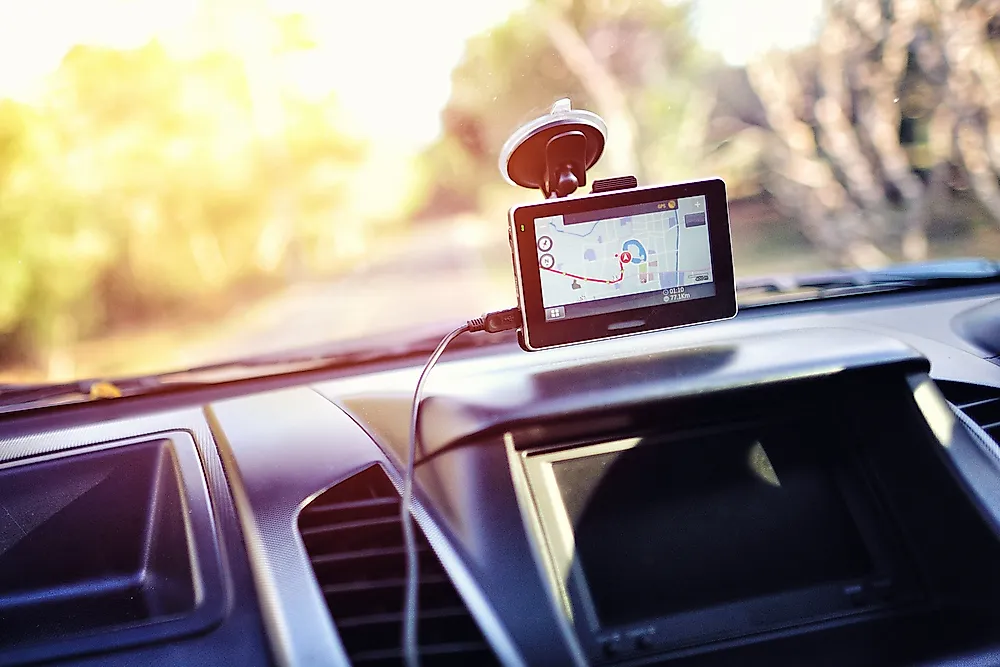
A GPS outage would not necessarily make every smartphone go blind. Many modern devices can receive signals from several satellite constellations, while phones can also estimate their location using Wi-Fi networks and cell towers.
Google Maps would not disappear either. The maps themselves are digital information delivered over the internet. What the phone pulls from GPS and other navigation satellites is the position fix, and that fix is what puts the moving blue dot on the right street. If a phone could switch to Galileo or another compatible system, navigation might continue with little obvious difference. If all satellite positioning became unavailable, the map would remain visible while the phone became much less certain about its owner's location.
The problem would be more noticeable for industries built around real-time positioning. Ride-hailing companies, trucking fleets, delivery services, and emergency dispatchers use satellite navigation to locate vehicles, calculate routes, and estimate arrival times. Drivers could still use road signs and maps, but much of the automation behind modern transportation would become less effective.
Cell Networks Could Start Losing Their Shared Clock
One of GPS's least visible jobs may almost be more important than navigation. Each GPS satellite carries atomic clocks, allowing receivers on Earth to obtain extremely accurate time. Cellular networks depend on that shared timing to keep equipment synchronized and radio signals ordered. If GPS disappeared, backup clocks could keep many networks operating for some time. The situation is similar to unplugging an accurate clock and forcing it to depend on its internal mechanism. At first, almost nothing changes. Gradually, tiny errors accumulate.
A NIST-sponsored study modeled a 30-day GPS outage and found that wireless networks could remain relatively stable during the early stages before timing problems became more significant. Data speeds could decline, while handoffs between parts of a cellular network could become less reliable. The internet itself would not simply switch off. Networks have their own timing equipment and alternative sources. A prolonged outage could nevertheless make telecommunications less reliable as equipment exhausted its ability to maintain precise synchronization without its normal reference.
Planes Would Not Fall Out Of The Sky

Modern aviation relies heavily on GPS, but aircraft would not suddenly become helpless without it. Pilots and air traffic controllers still have access to ground-based navigation equipment and other procedures developed before satellite navigation became dominant. The Federal Aviation Administration maintains a backup network of VOR radio beacons specifically so aircraft can continue navigating during a GPS disruption. The system is designed so that suitably equipped aircraft in the contiguous United States can reach an airport with a non-GPS instrument approach within about 100 nautical miles.
The result would be delays and reduced efficiency rather than immediate paralysis. Some GPS-dependent routes and approaches could become unavailable, forcing pilots and controllers to use older procedures. Controllers could safely work fewer aircraft through the same airspace, increasing the chances of delays, rerouting, and cancellations. Emergency services would face similar difficulties on the ground. Dispatchers rely on GPS to locate ambulances, police cars, and fire engines and to identify which vehicle is closest to an emergency. Other positioning methods would remain available, but losing satellite location information could reduce the speed and precision of some responses.
Farms And Freight Would Lose Precision

A farmer operating a modern tractor may depend on satellite signals almost as much as someone driving through an unfamiliar city. GPS-guided equipment can steer extremely straight paths across fields, allowing farmers to plant rows, distribute fertilizer, and avoid covering the same ground twice.
Without GPS, the tractor would not stop working. The farmer could still drive it. What disappears is the precision that allows a machine to repeat nearly identical paths across hundreds of acres. That helps explain why the economic consequences of a GPS outage would depend on when it occurred. The NIST-sponsored economic study estimated average losses of roughly $1 billion per day, but found that damage could be considerably greater during the spring planting season.
Freight networks would experience a different kind of slowdown. Trucks and delivery vans would still move, but companies could lose some ability to track vehicles in real time, automatically select routes, and predict arrival times. Instead of highways filling with motionless trucks, the effect would resemble a giant logistics system suddenly becoming harder to see.
Finance And The Power Grid Need Precise Time

Perhaps the strangest consequence of losing GPS would be millions of machines becoming less certain about exactly what time it is. In financial markets, precise timestamps record the order of transactions. Modern electronic trades can occur so close together that ordinary clocks are not accurate enough to distinguish them reliably. GPS is one inexpensive way to synchronize systems separated by hundreds or thousands of miles.
That does not mean ATMs would stop working or stock exchanges would immediately close. Major exchanges and financial firms generally maintain backup clocks and other timing systems. NIST's outage study found financial markets relatively resilient during its modeled 30-day loss of GPS.
Parts of the electric grid present a more complicated problem. Modern monitoring devices can compare electrical conditions at widely separated locations using clocks synchronized to millionths of a second. From those measurements, operators detect disturbances spreading across the grid. Without GPS, electricity wouldn't go out, but operators could lose some of the tools behind the fastest and clearest picture of what is happening across the system. During an emergency, that reduced visibility could make a developing problem harder to identify and address.
Losing Every Satellite Navigation System Would Be Worse
GPS is the American system, but it is no longer the world's only satellite-navigation network. Galileo, GLONASS, and BeiDou are independent alternatives, and many modern receivers can use signals from several constellations simultaneously. If GPS alone disappeared, some consumer devices could continue determining their positions using other satellites. Critical infrastructure designed specifically around GPS would face greater difficulty, and not every receiver could automatically switch to another constellation.
A simultaneous failure or disruption of multiple GNSS networks would be far more serious. Precision agriculture could lose satellite guidance, aircraft would depend more heavily on ground navigation, delivery networks would lose accurate tracking, and telecommunications companies would have to rely on backup timing for much longer.
That is also why deliberate interference is particularly troublesome. Jamming drowns out the weak satellite signals a receiver needs, while spoofing feeds it false position or timing information. A receiver with no signal at all can be set to fall back on a backup. A receiver fed convincing but incorrect data faces a harder problem, because nothing about the fake signal announces itself as wrong.
A World Without Its Invisible Clock
GPS disappearing would not produce an instant technological apocalypse. Cars could still drive, aircraft could still land, financial systems have backup clocks, and many phones could use other satellite constellations. The danger would increase as an outage became longer and affected more navigation systems. Modern infrastructure has gradually become dependent not simply on knowing where things are, but on knowing their location and the exact time almost continuously.
The same invisible radio signals behind the restaurant search on a phone also steer tractors across fields, place ambulances on a map, hold cell towers in sync, and time the sensors on the electric grid. Turn those signals off for long enough, and the greatest problem may not be that people no longer know where they are. It may be that millions of machines no longer agree on precisely where, or when, anything is happening.