Which World Has The Tallest Mountain In The Solar System?
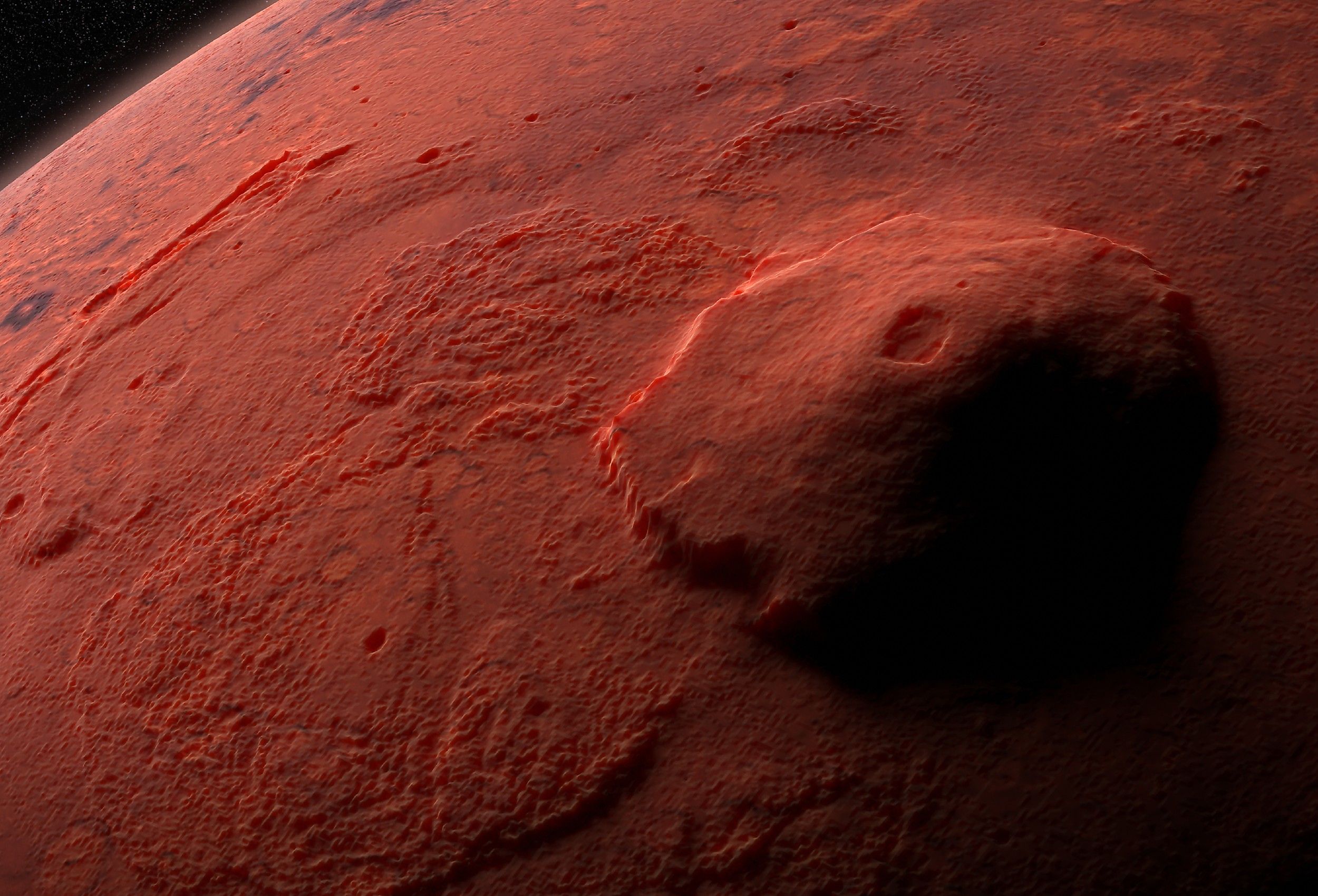
Mars has the tallest known mountain in the Solar System: Olympus Mons. At approximately 84,400 feet, it is almost three times as tall as Mount Everest. Its base stretches 374 miles across, making it as wide as the US state of Arizona. Even standing at the base, it would be impossible to see the summit because the slopes rise so gently. It is an enormous shield volcano formed by a slow accumulation of fluid lava over millions of years. It is Olympus Mons on Mars: the tallest mountain in the Solar System.
How Was It Formed?

Major construction of Olympus Mons began roughly 3.7 billion years ago and continued for hundreds of millions of years. Much younger lava surfaces indicate that low levels of volcanism persisted far later. Its footprint of roughly 320,000 square kilometers (about 124,000 square miles) is comparable to Italy, though considerably smaller than metropolitan France. It lies northwest of the three Tharsis Montes volcanoes. Each of those is several times wider than Mauna Loa, and depending on which one, roughly five to fourteen times greater in exposed volume.
Olympus Mons is as remarkable for its width as for its height. Published estimates place its exposed edifice at roughly 2.4 to 4 million cubic kilometers. That is about 30 to 50 times the volume of Mauna Loa, estimated at 80,000 cubic kilometers. Larger figures that appear in some accounts refer to total erupted material rather than the present exposed edifice.
Despite its staggering height, Olympus Mons is about 20 times wider than it is high. This is because it is a shield volcano. Shield volcanoes are generally broad with gentle slopes. Olympus Mons is the result of a magma plume under the surface, which is similar to how the Hawaiian Islands were formed.

A long-lived mantle upwelling or magma source fed the repeated lava eruptions that built Olympus Mons to its immense size. Two additional factors helped it grow exceptionally large. First, Mars' gravity is only about 38 percent of what is experienced on Earth, so a volcanic pile can stand far higher before it begins to collapse under its own weight.
Second, Mars lacks the moving plates that break up volcanic construction on Earth. The Hawaiian Islands formed as the Pacific plate pushed over a hotspot, which spread the eruptions out into a chain of separate islands. The magma that plumed underneath Mars' crust instead erupted lava to the same spot over millions of years. Mars has lacked Earth-like mobile plate tectonics for most of its history, so its relatively stationary crust allowed repeated eruptions above a long-lived volcanic source to accumulate in one region. The planet's thermal evolution likely contributed to this stagnant-lid regime.
When Was It Discovered?

What is now known as Olympus Mons was first observed in 1879 by Italian astronomer Giovanni Schiaparelli. Schiaparelli began mapping Mars through a telescope, making detailed observations and naming the geographical features of the planet. He named the bright albedo feature Nix Olympica, Latin for "Olympic Snow." Telescopes of the period could not reveal its topography, although its persistent visibility encouraged speculation that it was elevated.
Mariner 9 launched on May 30, 1971, and entered orbit around Mars on November 14. Its images resolved Nix Olympica into an immense shield volcano, far larger than any known volcano on Earth. Astronomers renamed it Olympus Mons, Latin for "Mount Olympus." The name points to the home of Zeus and the rest of the Greek pantheon, and it reflects the mountain's new status.
Could Humans Ever Climb Olympus Mons?

Olympus Mons is the largest known volcano in the Solar System. Many humans have challenged themselves by conquering mountaineering objectives like the Seven Summits, the Seven Volcanic Summits, and climbing all 14 mountains higher than 8,000 meters. Since the mountain's slopes are not as steep as many peaks on Earth, humans could potentially climb Olympus Mons in the future, provided that the necessary advanced space technology exists and after extensive preparation. In fact, since the slopes of Olympus Mons are only a few degrees, humans would not have to climb it with the use of crampons, ice axes, and ropes. Much of the shield has gentle slopes, but a route would have to avoid or negotiate rough lava terrain and a basal escarpment reaching roughly 6 to 8 kilometers (4 to 5 miles) high, so an ascent could not be characterized simply as an uphill walk.
At the summit, climbers would encounter a complex of overlapping calderas about 65 by 80 kilometers (40 by 50 miles) across. It formed during successive collapse episodes as magma drained from beneath the summit, often in connection with flank eruptions. The closest thing to Olympus Mons on Earth would be visiting Hawaii Volcanoes National Park on the Island of Hawaii.
The challenge of climbing Olympus Mons would by far be the environmental conditions. The thin atmosphere, freezing temperatures, and lack of oxygen would force every climber to depend on advanced space suits, life-support systems, and carefully planned logistics.
Other Big Mountains in the Solar System

Olympus Mons is not the only mountain in the Solar System that surpasses Mount Everest. The Rheasilvia basin covers much of the southern hemisphere of the asteroid Vesta, one of the largest objects in the asteroid belt between Mars and Jupiter. The unnamed central mountain inside that basin has roughly 20 kilometers (12 miles) of relief, with some estimates reaching 25 kilometers. The impact occurred about 1 billion years ago and excavated deep crustal material, but whether it reached the mantle is disputed. Dawn observations and subsequent modeling place Vesta's crust-mantle boundary more than 80 kilometers deep. Published height estimates use different baselines and carry significant uncertainties, so Rheasilvia's central peak may rival the roughly 22 kilometers of relief that Olympus Mons stands above the Martian datum. Olympus Mons is still generally described as the tallest known mountain in the Solar System.

The Equatorial Ridge follows the equator of Iapetus, Saturn's outermost major moon. Topographic models put much of the ridge at a height of 13 kilometers (8 miles), while limb measurements suggest that some sections reach roughly 20 kilometers. Its formation has been the topic of debate. One leading hypothesis is that an ancient giant impact produced a subsatellite around Iapetus. Tidal interactions then brought it closer while tearing it apart, and the resulting debris ring rained down along the equator to build the ridge.
A Giant Mountain Unlike Any Other
Olympus Mons demonstrates that other worlds can produce volcanic landforms far larger than those found on present-day Earth. Lower gravity. The absence of tectonic plates. Billions of years of volcanic activity. These factors combined created a mountain nearly three times as tall as Mount Everest. While mountaineers have climbed the highest peak on Earth, distant peaks across the Solar System remain unconquered. While the technology does not yet exist, there could come a day in the future when man stands atop Olympus Mons.