Could Earth Ever Have Two Moons?
Earth has already hosted a second moon roughly the size of a small car. The asteroid 2020 CD3, only about 6 to 12 feet across, spent at least 2.5 years trapped by Earth's gravity before escaping again. Even stranger, computer models suggest one or two meter-scale objects could be temporarily captured around Earth at any given time, most of them too small and dark for anyone to notice. Earth may not have a second permanent Moon, but tiny temporary moons can arrive, circle the planet, and disappear without most people ever knowing they were here.
On February 15, 2020, astronomers with the Catalina Sky Survey spotted 2020 CD3 near Earth. Subsequent tracking and observations showed that it was a natural object and that Earth's gravity had temporarily captured it. Its looping orbit sometimes carried it far inside the Moon's orbit before it eventually escaped and returned to an orbit around the Sun. It wasn't even the first. A similar object called 2006 RH120 orbited Earth for about a year between 2006 and 2007 before slipping away.
Why Nobody Notices These Moons

These captured objects are called minimoons, and they're incredibly difficult to detect. Most are only around a few feet across or smaller, making them no bigger than a household appliance. They are also extremely faint, so even when they're relatively close to Earth, they may appear as little more than dim points of light.
Their speed makes finding them even harder. Main-belt asteroids detected by surveys typically move about 0.25 degrees across the sky per day, while minimoons can move around 3 degrees per day, about 12 times faster. Instead of appearing as sharp points of light, they can leave elongated streaks in telescope images, making them much harder for automated surveys to detect.
Computer simulations suggest Earth is likely to have one or two natural minimoons around 3 feet across or larger at any given time. In addition, roughly ten times as many temporarily captured flybys may pass through Earth's gravitational neighborhood without completing a full orbit. The average minimoon remains captured for about nine months, completing nearly three trips around Earth before escaping back into orbit around the Sun. Because most of these objects are so small, faint, and fast-moving, astronomers think they've probably detected only a tiny fraction of them. Many may come and go without anyone ever realizing they were briefly part of Earth's collection of natural satellites.
Earth's Phantom Moons

Not all of Earth's companions are true captured moons. Some only appear to behave like them. For example, asteroid 469219 Kamoʻoalewa is one of the strangest objects near Earth. It doesn't orbit our planet directly. Instead, it orbits the Sun in near lockstep with Earth, making it appear to loop around Earth like a moon. This kind of orbit is called quasi-satellite motion. Calculations indicate Kamoʻoalewa has been in its current quasi-satellite configuration for roughly a century and will remain an Earth companion for centuries to come.
Even stranger, scientists still do not know where Kamoʻoalewa came from. Its unusual spectrum resembles some lunar material, leading researchers to suggest that it could be a piece of the Moon blasted into space by an ancient impact. A 2024 study identified the 13-mile-wide Giordano Bruno crater as a possible source. But the mystery has deepened. Other recent research has proposed a different lunar crater, Tycho, as a possible source, while studies published in 2026 found that Kamoʻoalewa could instead have come from the main asteroid belt, possibly the Flora family. Scientists may eventually get a much clearer answer from China's Tianwen-2 mission, which launched in 2025 to collect samples from Kamoʻoalewa.
Another object, called 2024 PT5, was discovered in 2024 and initially attracted attention as a supposed temporary second moon. It never actually became gravitationally captured by Earth and continued orbiting the Sun throughout its close passage. However, observations have provided strong evidence that 2024 PT5 may be a piece of rock ejected from the Moon by an impact only a few thousand years ago. Quasi-moons aren't unique to Earth. Venus has one officially named Zoozve. Quasi-satellites have also been identified around Jupiter, Saturn, Neptune, and even the dwarf planet Ceres.
Could Earth Ever Have a Real, Permanent Second Moon?

Here's where things get complicated. Temporarily capturing a small object isn't impossible, as 2020 CD3 proved. Permanently capturing a large second moon is far more difficult. A passing object would first need to approach Earth unusually slowly. It would also have to enter the region where stable satellite motion around Earth is possible despite the gravitational influence of the Sun. Earth's Hill sphere, the rough boundary of this region, extends about 930,000 miles, or 1.5 million kilometers, from the planet.
Simply entering this region isn't enough. A passing object also needs to lose orbital energy. Without some way to shed that energy, gravity can bend its path around Earth for a while, but the object will usually escape again. A collision or an interaction involving a third body could provide that energy exchange. In the early solar system, gas surrounding young planets could also slow objects enough for capture, but no such dense disk exists around Earth today. That's why confirmed natural minimoons have been temporary. Most stick around for a few months, while unusual cases can remain for years before escaping or, more rarely, entering Earth's atmosphere.
Also, Earth already has a large Moon. Its gravity does not dominate all the space around Earth, but it can significantly perturb the orbit of another captured object. The Sun is another powerful gravitational influence. A second large moon would therefore need an orbit that remained stable despite repeated gravitational tugs from both bodies.
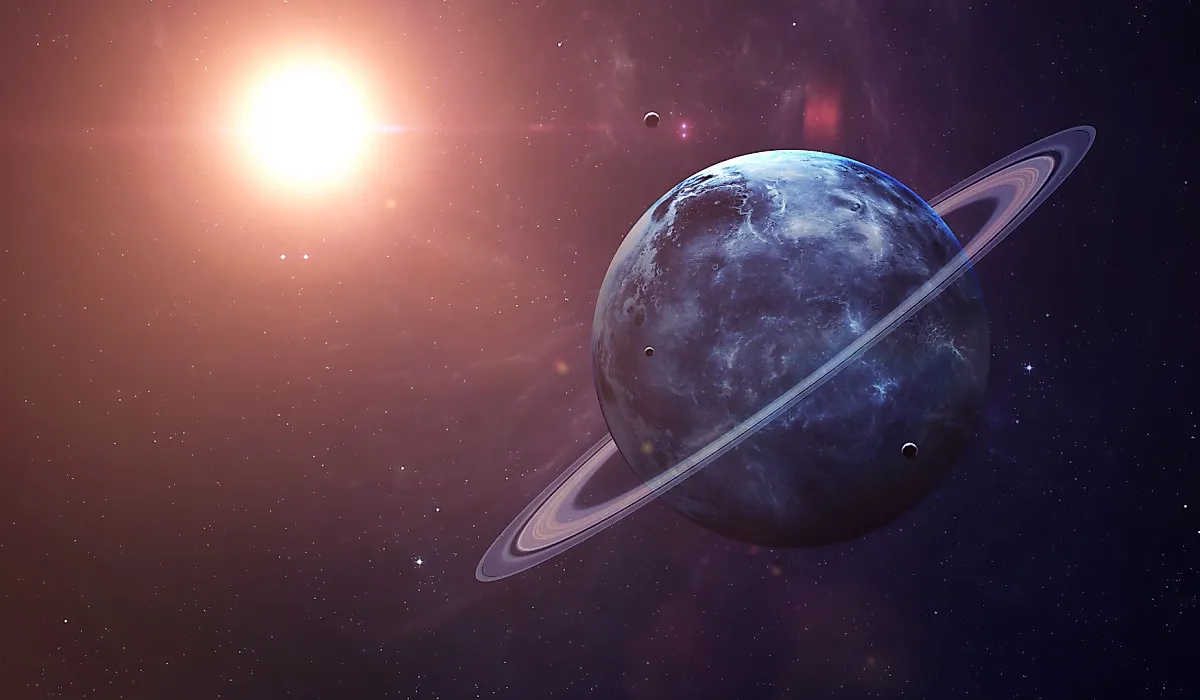
Permanent capture has happened elsewhere in the solar system under very different conditions. Neptune's largest moon, Triton, is thought to be a Kuiper Belt object captured billions of years ago. It is the only large moon in the solar system that circles its planet backward relative to the planet's rotation, a strong clue that it did not form alongside Neptune.
Neptune is nearly four times wider than Earth and about 17 times more massive, but its greater mass alone does not explain Triton's capture. One leading model suggests Triton originally belonged to a pair of objects. When the pair passed close to Neptune, the encounter tore them apart. One object escaped while Triton lost enough energy to remain behind. It was effectively a cosmic exchange, with one world thrown away so another could become a moon.
What a Real Second Moon Would Look Like in the Sky

Suppose, for a moment, that Earth captured something bigger. Perhaps not a car-sized rock, but a mountain-sized body or even a small moon like one of Mars's two companions, Phobos and Deimos. Mars is a preview of how strange that sky could look. Phobos, the larger of Mars's two moons, orbits only about 3,700 miles above the Martian surface and circles Mars roughly three times every day. It rises in the west and sets in the east because it completes an orbit faster than Mars completes a rotation.
If Earth had a Phobos-sized second moon in a similarly tight orbit, the night sky would look dramatically different. Instead of one steady, familiar Moon, there could be a second object racing across the sky over the course of only a few hours. Its position against the background stars would visibly change during a single evening, and depending on the orbit and viewing location, it could pass overhead more than once in a night.
The Danger of Two Moons

A second moon wouldn't necessarily be a peaceful addition to the sky. Each of the moons' gravity would pull on the other's, subtly changing their paths over time. Depending on their masses and orbits, those interactions could remain stable for extremely long periods or gradually destabilize the system. In an unstable arrangement, the moons could experience increasingly close encounters or develop crossing orbits.
If a moon's orbit were pushed steadily inward, another danger would appear. Get close enough to Earth and it could cross the planet's Roche limit, the region where the difference in Earth's gravitational pull across the moon can become powerful enough to tear it apart. The exact distance depends on the moon's density, composition, and internal strength. Instead of a second moon, Earth could then gain a temporary ring made from the wreckage.
If the destroyed moon were rocky, the ring would also be dominated by rocky debris orbiting far inside the current Moon's path. Collisions among the fragments, tidal forces, atmospheric drag on the lowest material, and other effects would gradually change the ring. Some debris could eventually enter Earth's atmosphere, while material beyond the Roche limit might collect into small moonlets. This isn't entirely theoretical, as it's already happening to Phobos. Mars's larger moon is spiraling toward the planet by about 6 feet every century. Scientists expect that within roughly 30 to 50 million years, it will either crash into Mars or be pulled apart and form a ring.
Ghost Moons Around the Earth

There's one more candidate for "second moon" status, and it might be the eeriest of all. Near two special gravitational regions in the Earth-Moon system are enormous, extremely faint concentrations of dust known as the Kordylewski clouds. Rather than circling Earth like ordinary moons, the clouds gather near the L4 and L5 Lagrange regions, located roughly as far from Earth as the Moon. At these locations, the combined motion and gravity of Earth and the Moon can allow dust to linger for extended periods.
Each cloud can stretch far wider than the Moon, yet the dust is spread so thinly that the clouds are extraordinarily difficult to see. They are also not fixed structures. Gravity from the Sun and other disturbances can continually reshape them and sweep particles away. Polish astronomer Kazimierz Kordylewski reported observing faint patches of light near one of these regions in 1961, but the clouds remained controversial for decades because other astronomers struggled to detect them.
Modern observations have strengthened the case considerably. Researchers detected polarized light from the L5 dust cloud in 2017 and reported the results in 2018. Later observations provided polarimetric evidence for the L4 cloud as well, and additional detections have continued into the 2020s. A study published in 2026 even measured short-term changes in the polarization of the L4 cloud, reinforcing the picture of a constantly shifting concentration of dust rather than a solid object.
Calling these clouds moons is a stretch. They are not solid bodies, and individual dust grains do not behave like rocks orbiting Earth in the conventional sense. Still, they may be the closest thing Earth has to two ghost moons: enormous structures that can occupy our neighborhood while remaining almost completely invisible.
A One-Moon World, Mostly
Earth gaining a second large, permanent moon through natural capture under present-day conditions is extremely unlikely. A passing world would need the right speed, the right trajectory, and some way to lose enough orbital energy to stay, all while surviving the gravitational influence of the Sun and our existing Moon.
Yet Earth is not quite the simple one-moon world it appears to be. Tiny captured asteroids can spend months or years orbiting the planet. Quasi-satellites can shadow Earth for centuries without actually circling it. Vast clouds of dust can linger near the Moon's orbit, almost invisible against the night sky. The strangest possibility is also the easiest to overlook. Somewhere in the darkness, another meter-wide asteroid may already be looping around Earth, completing an entire career as our temporary second moon before anyone on the surface ever notices it.