Space
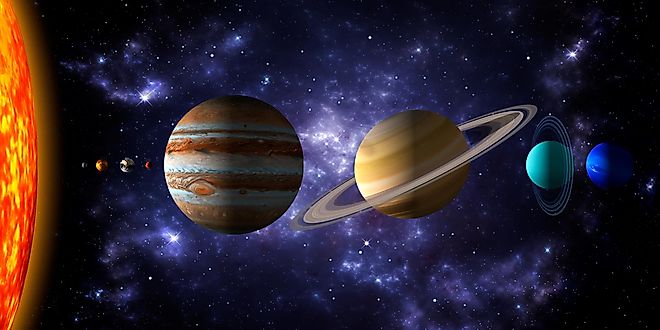
What Is The Heliopause?
The heliopause is the region where solar radiation is overcome by radiation from interstellar space, which marks the edge of the solar system.
What Is The Hottest Thing In The Universe?
The hottest known objects in the universe are stellar explosions called supernovae, which can reach temperatures exceeding 100-billion degrees.
Scientists Uncover Two New Minerals In A Meteorite
Scientists working from the University of Alberta have uncovered two new minerals never before seen in nature, contained within a meteorite.
How Big Is The Asteroid Belt?
The Asteroid Belt is a region of the solar system located between the orbits of Mars and Jupiter. It spans a distance of 140-million miles.
The Smallest Exoplanet Ever Found
The smallest exoplanet ever found is Kepler-37b, located 209-light years away. Kepler-37b is only 35% the size of Earth.
How Big Is Jupiter?
Jupiter is the largest and most massive planet in the solar system with a diameter of 86,880-miles (139,820-kilometres).
The Farthest Object In The Solar System
The farthest known object in the solar system is a small object called Farfarout. Farfarout orbits the sun at a distance of 12.3-billion miles.
Lunar Eclipse vs Solar Eclipse: What’s The Difference?
A lunar eclipse occurs when the Earth’s shadow is cast upon the moon, while a solar eclipse is when the moon’s shadow is cast upon the Earth.
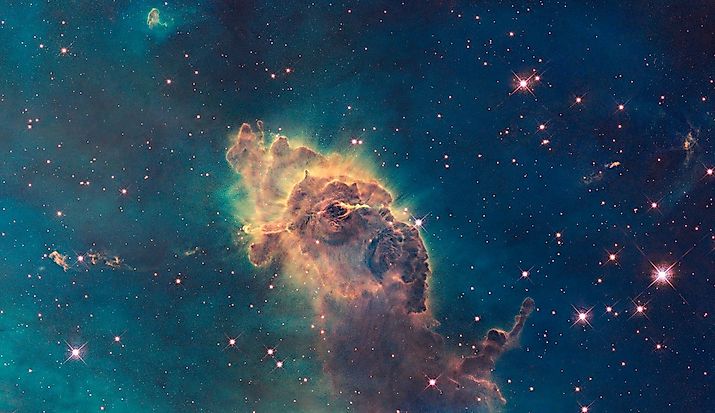
How Do Stars Form?
Stars form in vast clouds of hydrogen called nebulae. When hydrogen gas clumps together and collapses under its own gravity, it becomes a star.
10 Cool Facts About Jupiter’s Moon, Europa
Europa is one of the four Galilean moons of Jupiter and was discovered by Galileo Galilei in 1610. It is covered in ice and contains an ocean of liquid water.
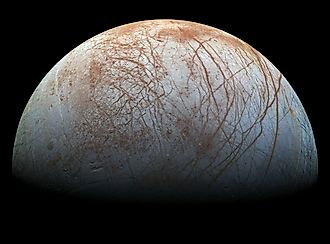
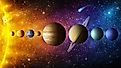
What Color Is The Sky On Each Planet?
Every planet has its own unique color of sky, from the bright blue skies of Earth, the red skies of Mars, and yellow skies of Saturn.
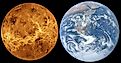
Was Venus More Earth-Like In The Past?
Venus and Earth are significant different today, yet Venus was likely a habitable world billions of years ago, with its own oceans and stable atmosphere.

What’s The Longest Time Someone Has Been In Space?
The current record for most time in space during a single mission is 438-days, completed by cosmonaut Valery Polyakov from 1994 to 1995.
What Was The Big Bang?
The Big Bang model is a scientific theory that describes the very earliest moments of the universe, and how space and time evolved 13.8-billion years ago.
When Was The First Exoplanet Discovered?
The first planets found beyond our solar system were discovered around a pulsar in 1992, while the first planet found orbiting a star was in 1995.
What Is The Great Red Spot?
The Great Red Spot is a massive hurricane-like storm system located in the Southern Hemisphere of Jupiter’s atmosphere.
Astronomers Find Debris Of An Ancient Solar System
While observing the composition pf two white dwarfs, astronomers found evidence of a solar system that formed 10-billion years ago.
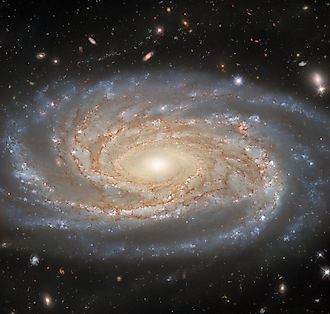
Where Do The Planets Get Their Names?
Almost all the planets in our solar system are named after the Roman gods, the only two exceptions being Earth and Uranus.
What Is Hubble’s Law?
Hubble’s Law is a law of physics that describes how the speed of a galaxy relative to us is directly proportional to its distance.
Super Saturn Exoplanet Has Largest Known Ring System
The largest known ring system ever discovered belongs to an exoplanet nicknamed “Super Saturn”, whose rings are 600 times larger than Saturn’s main rings.
Scientists Discover Closest Black Hole
Scientists have recently discovered the closest known black hole, located at a distance of about 1,560 light years away from our solar system.
Scientists Discover New Class Of Exoplanet
Scientists have discovered a new class of exoplanet that is half rock and half water, making them the most water-rich planets ever discovered.
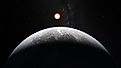
Scientists Find Evidence Of Ancient Ocean On Mars
Scientists have just recently uncovered evidence of a vast, ancient ocean that existed on Mars around 3.5-billion years ago.
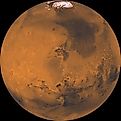
What Are Supernovae?
A supernova is a stellar explosion representing the final stage of a star’s life. Supernova generally occur in stars 8 to 15 times the mass of the sun.
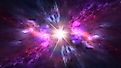
How Fast Did The Moon Form?
A new model predicts that it took the moon only a few hours to form after the Earth was impacted by another planet 4.5-billion years ago.
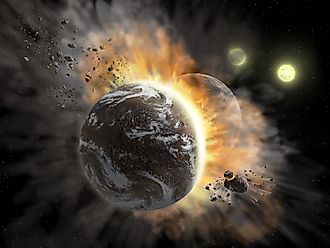
Tree Rings Reveal Evidence Of Radiation Storms
Over the last 10,000 years, the Earth has experienced multiple bombardments of radiation called Miyake Events. The exact cause of these events is a mystery.
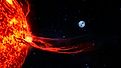
Why Do The Gas Giants Spin So Fast?
The gas giants spin significantly faster than the rocky planets, likely due to the amount of angular momentum involved in their formation.
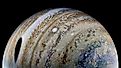
Five Space Pictures To Celebrate Halloween
Objects in space can appear beautiful and terrifying. Some images of celestial objects even make it seem like the universe celebrates Halloween.
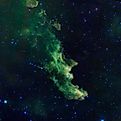
What Are Red Giants?
Red giants are a type of supergiant star that represents the final stages of a star’s life. Every star will become a red giant near the end of their life.
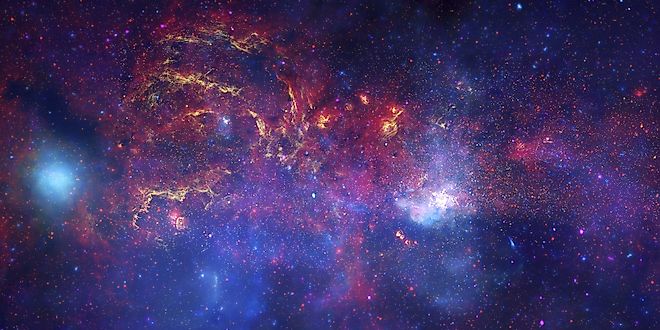
What Is At The Center Of The Milky Way?
The center of the Milky Way is a strange, chaotic place, home to star clusters, filaments of gas, forming stars, and a supermassive black hole.
What Is The Great Attractor?
The Great Attractor is a gravitational anomaly that all nearby galaxies are moving towards. It is hidden from view by the plane of the Milky Way.
What Is The Doppler Effect?
The Doppler Effect describes how wavelengths of sound and light change depending on the velocity of an object relative to our position.
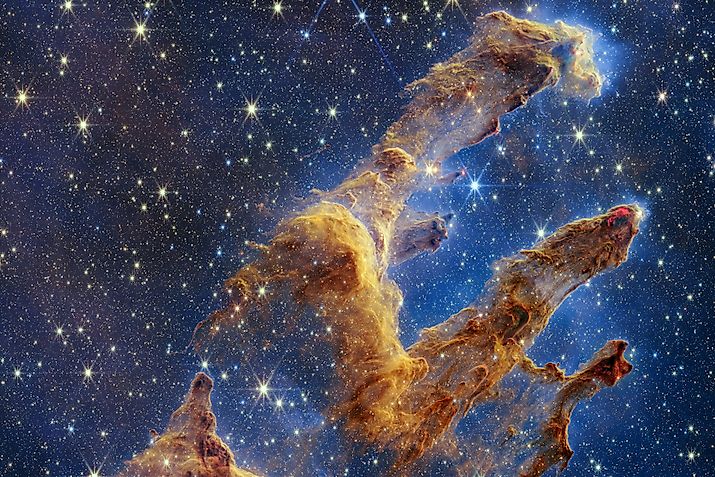
NASA Releases New Image Of The Pillars Of Creation
The James Webb Space Telescope has captured the most detailed, highest resolution image of the Pillars of Creation to date.
What Is Parallax?
Parallax is a method for determining distance, generally used in astronomy to find the distance to objects within the Milky Way Galaxy.
What Is The Drake Equation?
The Drake equation was devised by Frank Drake in 1961 as a way to estimate the total number of alien civilizations in our galaxy.
Would Saturn Float On Water?
Saturn has the lowest density of all the planets, a density that is lower than liquid water. Theoretically, Saturn would float in a large enough pool.
How Smooth Is Planet Earth?
The Earth does not seem like a smooth planet, yet relative to its size, it is actually smoother than a standard billiard ball.
How Do Black Holes Form?
Black holes are objects whose gravitational pull is so strong that not even light can escape. They form from the gravitational collapse of massive stars.
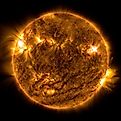
What Is The Solar Cycle?
The solar cycle an 11-year cycle of the sun’s magnetic field. During a typical solar cycle, the sun will have a minimum and maximum period.
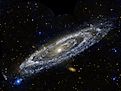
The Andromeda Galaxy
The Andromeda Galaxy is a large spiral galaxy located 2.5. Million light years away, making it the closest large galaxy to the Milky Way.