Space
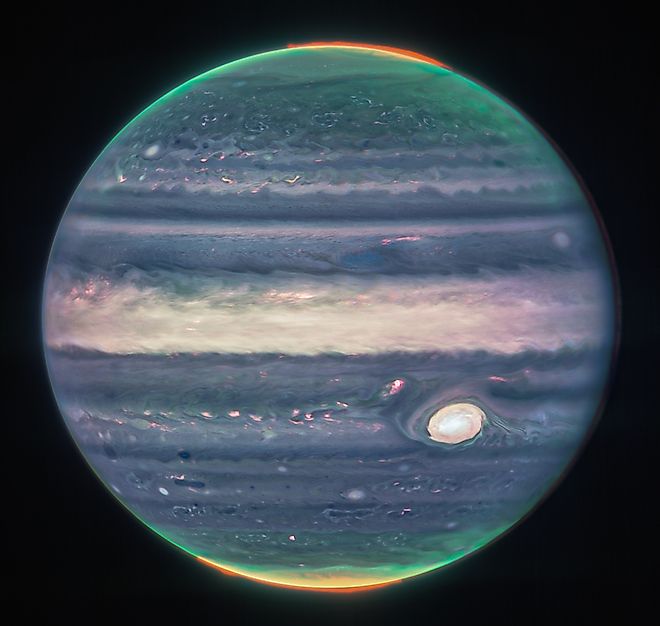
Is Jupiter A Failed Star?
Jupiter has a similar composition to the sun, leading to it being called a failed star. However, Jupiter would need to be 80 times heavier to become a star.
James Webb Finds Carbon Dioxide On An Exoplanet
However, scientists are now beginning to study the atmospheres of distant exoplanets in unprecedented detail, and that’s thanks to James Webb.
How Far Can Humans See In Space?
The farthest object we can see with just our eyes is the Andromeda Galaxy, yet telescopes are capable of seeing many billions of light years further.
What Is Gravity?
Gravity was first described by Isaac Newton in 1687, and it was later refined by Albert Einstein in 1915 with his General Theory of Relativity.
How Far Away Is The Sun?
The Earth orbits the sun at an average distance of 93-million miles (150-million kilometres), yet that distance changes due to Earth’s orbital eccentricity.
Will The Sun Ever Burn Out?
The sun is 4.5-billion years old, and it is likely only half-way through its life. The sun will likely shine for another four to five billion years.
How Are Stars Weighed?
The mass of a star is determined by its gravitational interaction with other objects. The mass of a star can usually only be found if it orbits another star.
What Are Active Galaxies?
Active galaxies are galaxies that are emitting vast amounts of high energy radiation, generally due to an influx of material inside a supermassive black hole.
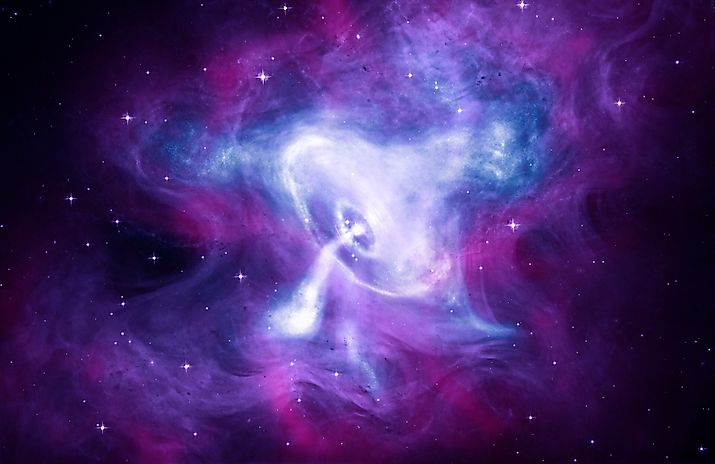
What Are Cosmic Rays?
Cosmic rays are streams of high energy particles that are emitted by events beyond the solar system, such as supernovae or the birth of a star.
How Cold Is The Universe?
Space is mostly empty, and so most of space is cold. By measuring temperatures of the CMBR, the estimated temperature of the universe is 2.725 Kelvin.
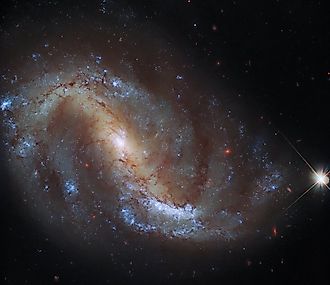
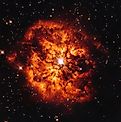
The Five Hottest Stars In The Universe
Most of the hottest stars in the universe are called Wolf-Rayet stars. The five hottest stars all belong to this classification.
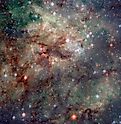
Does The Milky Way Have Satellite Galaxies?
The Milky Way is orbited by two dwarf galaxies called the Small Magellanic Cloud (SMC) and the Large Magellanic Cloud (LMC).
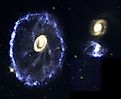
The Cartwheel Galaxy
The Cartwheel Galaxy is a ring galaxy located 500 million light years away. The Cartwheel Galaxy formed as a result of a galactic collision.
What Is Nuclear Fusion?
Nuclear fusion is what powers the stars. It is the process by which atomic nuclei are fused together under high temperatures and pressures to produce energy.
What Is A Supermoon?
A supermoon occurs when a full moon happens to coincide with the moon’s closest approach to Earth. Supermoons are 14% larger than a typical full moon.
Why Is Space Dark?
Space is so dark due to the red-shift of distant objects and the fact that the universe has a finite age and a finite speed of light.
Is Light A Wave Or Particle?
Light behaves as both a wave and a particle, yet it has never been seen as both at the same time. This is known as wave-particle duality.
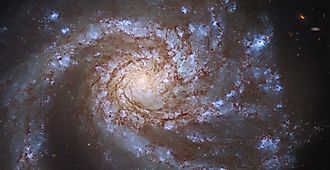
What Is The Most Common Type Of Planet?
There are over 4,000 confirmed exoplanets. Of those worlds, the most common types are planets between the size of Earth and Neptune.
Are There Too Many Satellites?
Without satellites, our modern civilization simply would not exist. However, is it possible to have too many satellites?
How Many Asteroids Have Hit Earth?
Every planet in the solar system experiences the occasional asteroid impact. The Earth has 190 confirmed impact craters, most of which are fairly small.
What Is The Farthest Galaxy?
The James Webb Space Telescope may have broken the record for farthest galaxy. Webb recently observed a galaxy that might be 13.5 billion light years away.
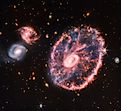
What Is A Pulsar?
Pulsars are neutron stars that spin extremely fast. Pulsars appear to blink as two beams of light are emitted from their poles.
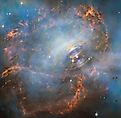
How Fast Does Each Planet Spin?
Every planet in the solar system spins, yet they each differ in how fast they spin. How fast a planet spins will also determine how long a day is.
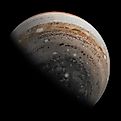
How Many Moons Does Pluto Have?
Pluto is a dwarf planet orbited by a total of five known moons, four of which are too small to become spherical. The largest moon of Pluto is Charon.
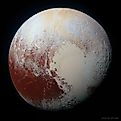
Astronomy vs Astrology: What’s The Difference?
Astronomy is the study of objects and events that occur outside Earth’s atmosphere, while astrology is the belief that stars and planets impact human affairs.
How Many Rovers Have Been On Mars?
There have been a total of six rovers on Mars, five of which were launched by NASA. There are currently three rovers operating on Mars.
Where Did Earth’s Water Come From?
Earth’s water originated in icy debris from the outer solar system, such as asteroids and comets. Upon impact, these objects dispersed their water on Earth.
Is The Moon Shrinking?
The moon is shrinking due to heat loss from its interior. As the moon shrinks, its surface cracks and forms fault lines, as well as moonquakes.
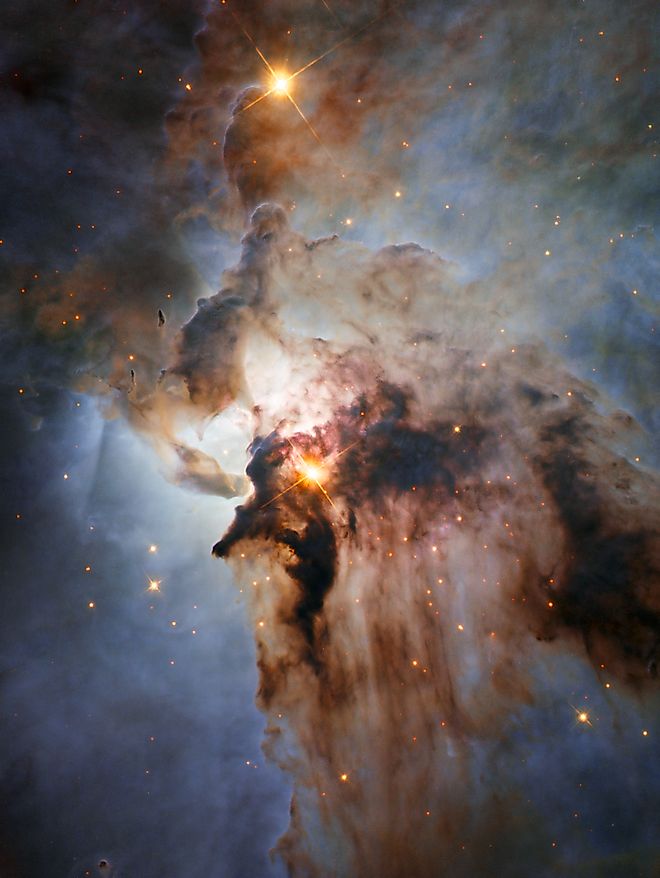
How Are Stellar Life Cycles Determined?
Astronomy deals with events that occur over many billions of years, including the life of a star. How is the life of a star studied given such vast timespans?
What Is The Kardashev Scale?
The Kardashev Scale is a scale used to define a civilizations technological advancement based on the amount of energy it consumes.
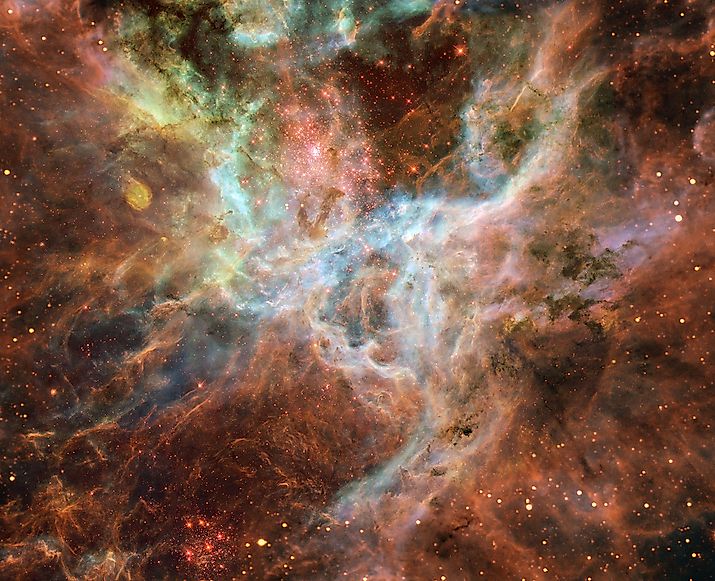
The Second Law Of Thermodynamics
The Second Law of Thermodynamics is one of the most important laws of physics. It measures the amount of entropy, or disorder, in our universe.
James Webb Telescope Finds Its First Supernova
The James Webb Space Telescope is already making big discoveries, one of which might be a supernova in a galaxy over three billion light years away.
Saturn’s Moon Hyperion
Hyperion is one of Saturn’s many moons. It may be small, yet it is one of the most unique moons in the solar system in terms of appearance.
Is There Water On Mars?
There is enormous amounts of evidence that Mars was once covered in water, yet there is some evidence that it may still have some liquid water underground.
What Is The Rare Earth Hypothesis?
The Rare Earth Hypothesis claims that complex life is rare in the cosmos, and that the factors that led to life on Earth are exceedingly rare.
How Long Could You Survive On Each Planet?
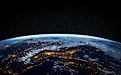
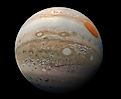
The amount of time you can survive on each planet varies from one to the next. Generally, you can survive no longer than two minutes on any other planet.
What Is Cosmic Inflation?
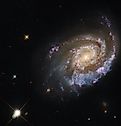
Cosmic inflation was a period of cosmic history shortly after the Big Bang wherein the universe expanded at a rate faster than it has since.